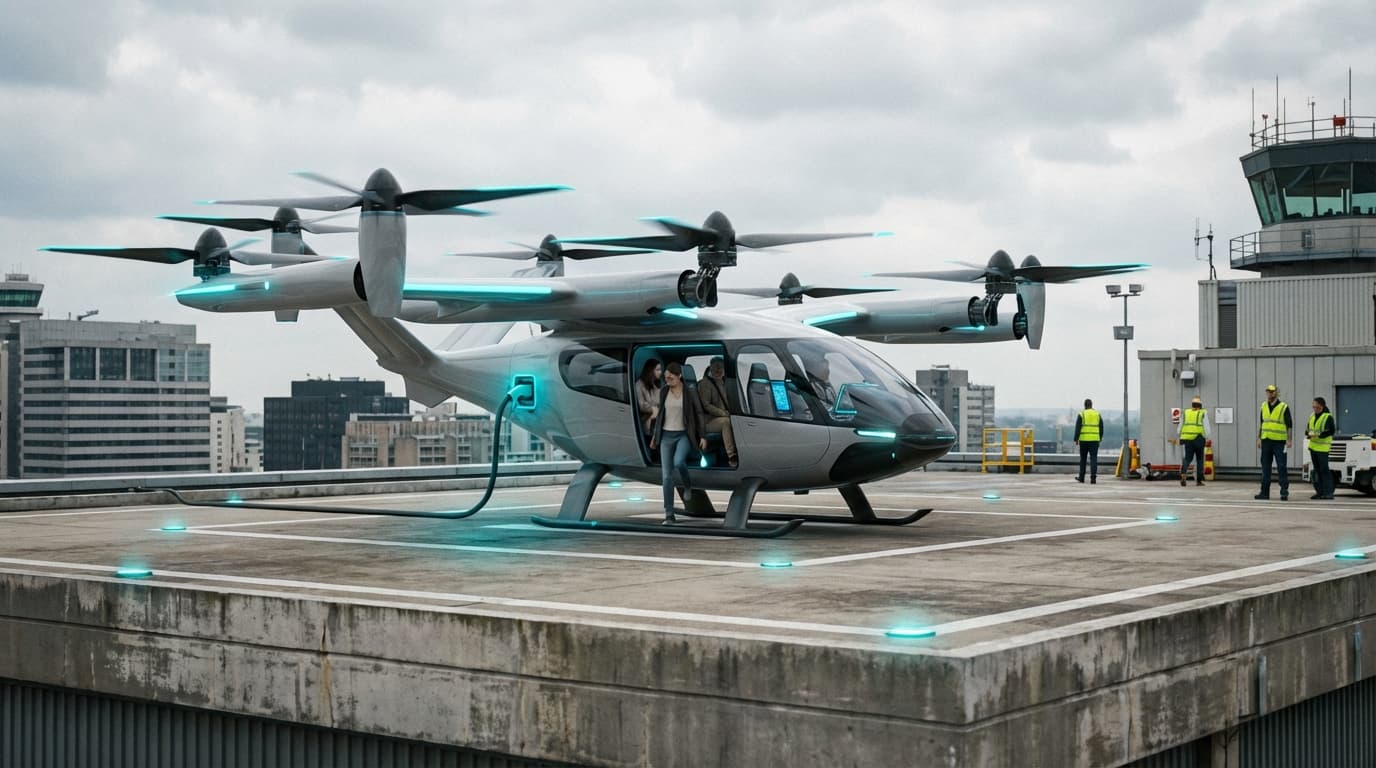
Urban Air Mobility (UAM)
Urban Air Mobility represents a paradigm shift in metropolitan transportation, leveraging electric vertical takeoff and landing (eVTOL) aircraft to create three-dimensional mobility networks above congested urban centers. Unlike conventional helicopters, eVTOL aircraft utilize distributed electric propulsion systems with multiple rotors, enabling vertical ascent and descent without requiring traditional runways. These vehicles typically feature battery-electric or hybrid-electric powertrains that significantly reduce noise pollution and operational costs compared to combustion-powered rotorcraft. The technical architecture relies on advanced flight control systems, often incorporating fly-by-wire technology and varying degrees of automation, from pilot-assisted operations to fully autonomous flight. Supporting infrastructure includes vertiports—compact takeoff and landing facilities that can be integrated into existing urban structures like parking garages, rooftops, and transit hubs—along with sophisticated air traffic management systems designed to coordinate multiple aircraft operating simultaneously in dense airspace.
The aviation industry faces mounting pressure to address urban congestion, with ground-based transportation networks reaching capacity limits in major metropolitan areas. Traditional solutions like expanded highways or subway systems require decades of construction, massive capital investment, and significant disruption to existing infrastructure. Urban Air Mobility offers a fundamentally different approach by utilizing previously untapped vertical airspace, potentially reducing point-to-point travel times by 50-70% for medium-distance urban trips. This technology addresses critical challenges in emergency medical transport, where time-sensitive patient transfers can mean the difference between life and death, as well as airport connectivity, where travelers currently spend substantial time navigating surface traffic. The business model shifts aviation from scheduled, high-capacity operations to on-demand, distributed services more akin to ride-sharing networks, potentially democratizing access to air travel beyond traditional commercial aviation's reach.
Several aerospace manufacturers and startups have progressed beyond concept phases, with certification programs underway in multiple jurisdictions. Early commercial operations have focused on specific use cases such as airport shuttles and scenic tours in select cities, allowing operators to validate technology and refine operational procedures before scaling to broader networks. Regulatory frameworks are evolving in parallel, with aviation authorities developing new certification standards specifically tailored to eVTOL aircraft characteristics and urban operating environments. Industry analysts suggest that initial deployments will likely serve premium markets and specific corridors where time savings justify higher costs, gradually expanding as production volumes increase and operational experience accumulates. The trajectory of Urban Air Mobility intersects with broader trends in electrification, autonomous systems, and smart city infrastructure, positioning it as a potential cornerstone of future multimodal transportation ecosystems that seamlessly integrate ground, rail, and aerial mobility options.
Related Organizations

Manufacturer of the 'Midnight' eVTOL aircraft, focused on urban air mobility networks.

An autonomous aerial vehicle technology platform company, the first to receive a type certificate for an eVTOL in China.

Developing an all-electric vertical takeoff and landing aircraft for commercial passenger service.

German aircraft manufacturer specializing in multicopter designs like the VoloCity for inner-city flights.

Developing the ALIA-250 aircraft and an extensive charging network for electric aviation.

Eve Air Mobility
Brazil · Company
A spinoff from Embraer developing an eVTOL and urban air traffic management software.

Lilium
Germany · Company
Developing the Lilium Jet, an eVTOL using ducted electric vectoring fans for regional mobility.

Leads the SABERS (Solid-state Architecture Batteries for Enhanced Rechargeability and Safety) project.

The Advanced Air Mobility division of Hyundai Motor Group, developing an eVTOL vehicle for 2028 entry.

British aerospace manufacturer developing the VX4 eVTOL aircraft.

A wholly-owned subsidiary of Boeing developing self-flying (autonomous) eVTOL air taxis.

A global high-tech startup developing autonomous eVTOLs, known for the 'Prosperity I' aircraft.

Leading designer, developer, and operator of vertiport infrastructure for the advanced air mobility industry.
Supporting Evidence
Research this in Signals
Signals turns a topic into a sourced research record you can inspect and rerun. Your first scan is free, and this one starts with Urban Air Mobility (UAM) already loaded, so edit it or scan as is.