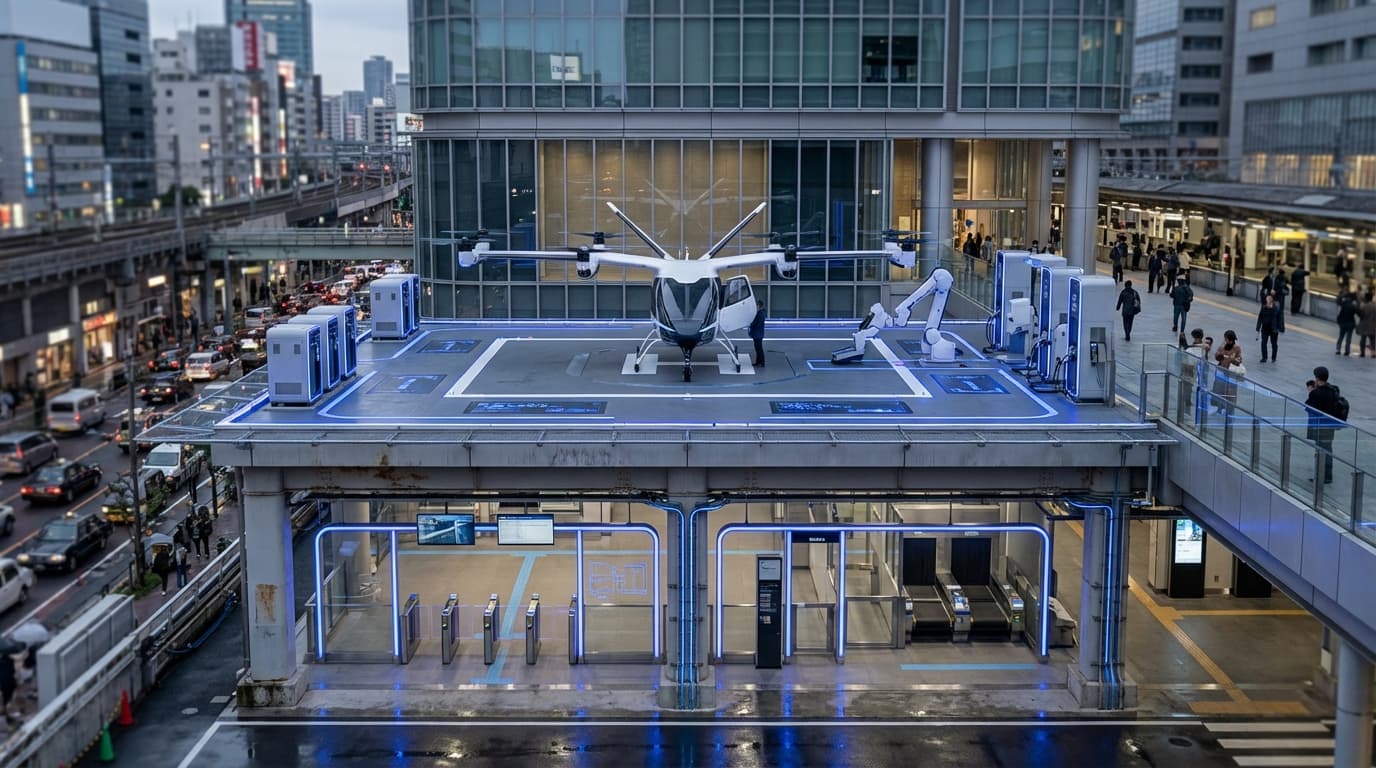
Vertiport Networks
Vertiport networks represent the foundational infrastructure layer necessary to enable urban air mobility, addressing the critical challenge of integrating electric vertical takeoff and landing aircraft into existing cityscapes. Unlike traditional airports that require vast expanses of land on city peripheries, vertiports are compact facilities designed to fit within dense urban environments, typically occupying spaces equivalent to a few parking spots or utilizing underutilized rooftops. The core technical architecture of these facilities centers on several key systems: high-voltage charging infrastructure capable of rapidly replenishing eVTOL batteries between flights, precision landing pads equipped with sensors and guidance systems for autonomous or piloted operations, and passenger processing areas that balance security requirements with the need for quick turnaround times. Advanced vertiports also incorporate weather monitoring systems, noise abatement technologies, and integration with air traffic management networks to ensure safe operations within increasingly congested urban airspace.
The emergence of vertiport networks addresses fundamental limitations in ground-based urban transportation, particularly the challenge of moving people efficiently across congested metropolitan areas where traditional infrastructure expansion is prohibitively expensive or physically impossible. By creating a three-dimensional transportation layer, these facilities enable new mobility patterns that bypass surface-level congestion, potentially reducing travel times for medium-distance urban trips from hours to minutes. The infrastructure also solves critical operational challenges for eVTOL operators, including the need for distributed energy delivery systems that can handle the unique power demands of electric aircraft, passenger amenities that meet aviation safety standards while maintaining the convenience expectations of ground transportation, and seamless integration with existing transit networks through multimodal hubs. Early deployments indicate that successful vertiport networks require careful consideration of community impacts, including noise footprints, visual integration with surrounding architecture, and equitable access across different neighborhoods to avoid creating a transportation system that serves only affluent areas.
Several metropolitan regions have begun developing vertiport infrastructure, with pilot facilities emerging in cities exploring urban air mobility solutions. These early installations typically start with simpler configurations serving cargo or emergency medical transport before expanding to passenger operations, allowing communities and regulators to build operational experience gradually. The facilities are being integrated into broader smart city initiatives, with vertiports serving as nodes that combine transportation functions with renewable energy generation, emergency response capabilities, and urban logistics hubs. As battery technology improves and eVTOL aircraft move toward commercial certification, the vertiport network concept is evolving from speculative infrastructure to a tangible element of urban planning discussions. The long-term trajectory suggests these facilities will become increasingly automated, with artificial intelligence managing flight scheduling, energy distribution, and passenger flow to maximize throughput while minimizing environmental impact, ultimately contributing to more sustainable and efficient urban mobility ecosystems.
Related Organizations

Regulatory body defining the 'U-space' regulatory framework for drone integration in Europe.

Leading designer, developer, and operator of vertiport infrastructure for the advanced air mobility industry.

Developer of 'Air-One', a rapidly deployable, modular vertiport hub for drones and eVTOLs.

Building the digital operating system (Vertiport Automation System) to manage high-volume vertiport traffic.

A global infrastructure operator developing a network of vertiports in the US and Europe through its Ferrovial Vertiports division.

Operator of Paris airports, actively building a vertiport network in Paris for the 2024 Olympics and beyond.

Specializes in the design, construction, and operation of vertiports, with announced corridors in Quebec and Dubai.

Developing an all-electric vertical takeoff and landing aircraft for commercial passenger service.

German aircraft manufacturer specializing in multicopter designs like the VoloCity for inner-city flights.

Developing the ALIA-250 aircraft and an extensive charging network for electric aviation.
Supporting Evidence
Research this in Signals
Signals turns a topic into a sourced research record you can inspect and rerun. Your first scan is free, and this one starts with Vertiport Networks already loaded, so edit it or scan as is.