AI-Driven Air Traffic Management
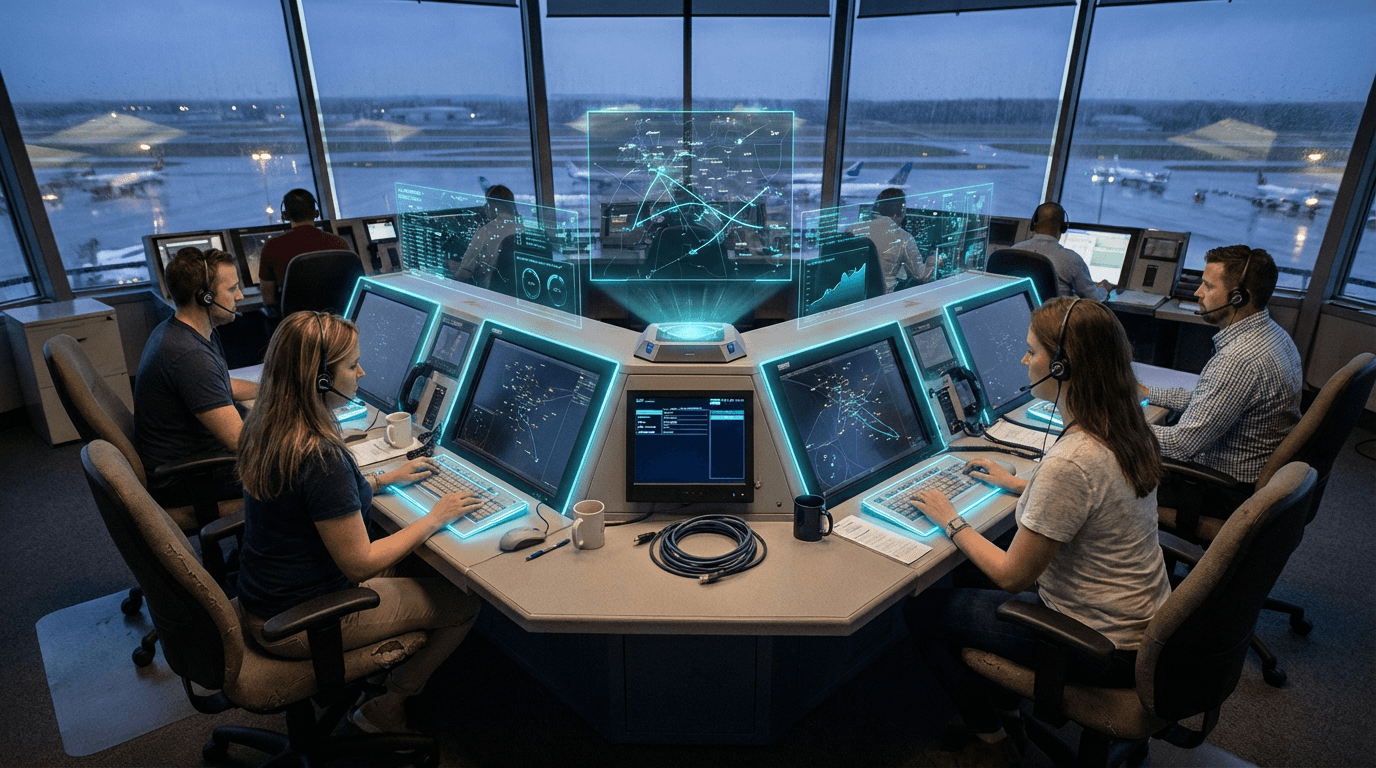
Air-driven Air Traffic Management represents a fundamental shift from traditional rule-based systems to adaptive, intelligent platforms that leverage machine learning algorithms to orchestrate the increasingly complex ballet of aircraft movements. Unlike conventional air traffic control systems that rely on predetermined flight paths and human controllers making decisions based on established protocols, AI-driven ATM employs neural networks and predictive analytics to process vast streams of real-time data from radar systems, weather sensors, aircraft transponders, and satellite communications. These systems continuously analyze patterns in flight trajectories, weather conditions, fuel consumption rates, and airspace congestion to generate optimal routing solutions that would be impossible for human operators to calculate in real-time. The technology operates through sophisticated algorithms that can predict traffic flows hours in advance, identify potential conflicts before they materialize, and dynamically adjust flight paths to maximize efficiency while maintaining rigorous safety margins.
The aviation industry faces mounting pressure from multiple directions: airspace congestion continues to intensify as passenger numbers recover and grow, environmental regulations demand reduced fuel consumption and emissions, and entirely new categories of aircraft—from commercial drones to urban air mobility vehicles—are preparing to share the skies with traditional aviation. AI-driven ATM addresses these converging challenges by enabling what researchers call "four-dimensional trajectory management," where aircraft routes are optimized not just spatially but temporally, allowing for more precise scheduling and tighter separation standards without compromising safety. This capability becomes particularly critical as the industry moves toward concepts like free flight, where aircraft can choose more direct routes rather than following fixed airways. The technology also promises significant economic benefits by reducing fuel burn through optimized climb profiles and continuous descent approaches, minimizing delays through better flow management, and increasing overall airspace capacity without requiring expensive new infrastructure.
Early implementations of AI-driven ATM are already demonstrating measurable improvements in operational efficiency. Aviation authorities in Europe and North America have initiated trials where machine learning systems assist controllers with conflict detection and resolution suggestions, while research programs explore fully autonomous traffic management for specific airspace sectors during off-peak hours. The technology shows particular promise in managing the integration of urban air mobility operations, where the sheer volume of potential flights—imagine hundreds of air taxis operating in a single metropolitan area—would overwhelm traditional control methods. Industry analysts note that the transition to AI-driven systems will likely be gradual, with algorithms initially serving as decision-support tools for human controllers before progressively assuming greater autonomy in routine operations. As computational power increases and training datasets grow richer, these systems are expected to become increasingly sophisticated, potentially enabling a future where airspace capacity expands dramatically while safety standards continue to improve, fundamentally reshaping how we think about the limits of air transportation.
Related Organizations

Pan-European civil-military organization dedicated to supporting European aviation.

A major European satellite manufacturer leading the ASCEND feasibility study.

Spanish information technology and defense systems company.


Provider of Remote Digital Tower solutions utilizing AI for video processing and object detection on runways.

Supplier of communication and information systems for control centers, actively developing UTM solutions for Austria and Norway.
Defense company producing the Barracuda advanced camouflage systems.

A joint venture between Boeing and SparkCognition building a blockchain-enabled airspace management system.

Aviation analytics company providing data and analytics to the travel industry.

Provides UTM software enabling authorities to visualize and manage drone traffic in their airspace.
Supporting Evidence
Research this in Signals
Signals turns a topic into a sourced research record you can inspect and rerun. Your first scan is free, and this one starts with AI-Driven Air Traffic Management already loaded, so edit it or scan as is.