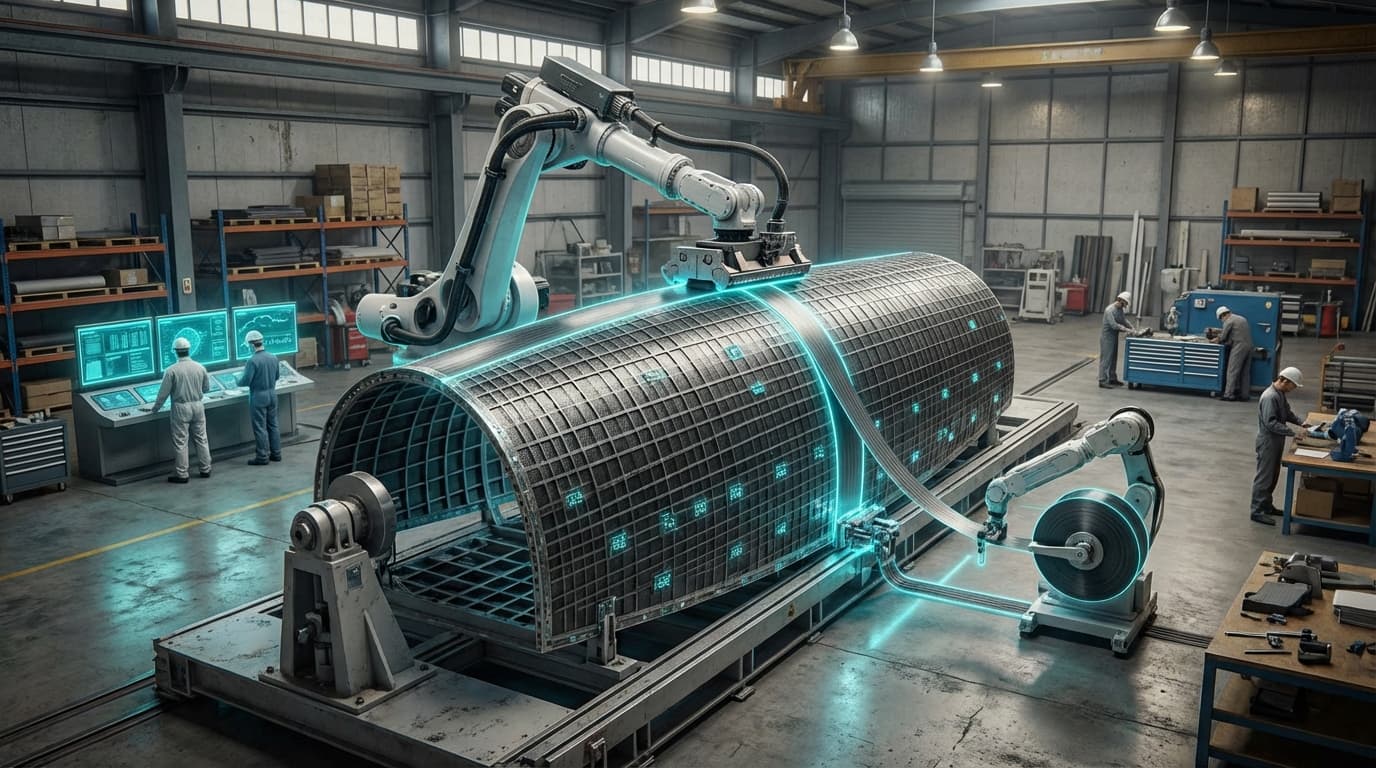
Thermoplastic Composites & Recyclable Airframes
Thermoplastic composites represent a fundamental shift in aerospace materials science, moving away from the thermoset resins that have dominated aircraft construction for decades. Unlike traditional thermoset composites—which undergo an irreversible chemical curing process—thermoplastic composites use polymer matrices that can be repeatedly melted and reformed without degrading their structural properties. This reversibility stems from the physical rather than chemical bonding within the material: when heated above their glass transition temperature, thermoplastic matrices become pliable, allowing components to be welded together rather than bonded with adhesives. The most promising aerospace-grade thermoplastics include polyetheretherketone (PEEK), polyetherketoneketone (PEKK), and polyphenylene sulfide (PPS), each offering distinct combinations of strength, temperature resistance, and processability. These materials are typically reinforced with continuous carbon fibers, creating composites that match or exceed the mechanical performance of thermoset equivalents while introducing entirely new manufacturing possibilities.
The aerospace industry faces mounting pressure to reduce both production costs and environmental impact as global aircraft demand continues to climb. Traditional thermoset composite manufacturing involves lengthy autoclave curing cycles—often eight hours or more—that create production bottlenecks and consume significant energy. Thermoplastic composites address this constraint through out-of-autoclave processing methods, including automated fiber placement with in-situ consolidation, where material is laid down and welded in a single pass. This approach can reduce component manufacturing time from days to hours, directly addressing the production rate challenges that plague modern aircraft programs. Beyond speed, the weldability of thermoplastics enables modular construction techniques and simplified repairs: damaged sections can be cut out and replacement pieces fusion-welded in place, rather than requiring complex bonded patches. Perhaps most significantly, thermoplastic composites offer genuine end-of-life recyclability. As the first generation of composite-heavy aircraft approaches retirement, the industry confronts a looming waste crisis—thermoset components currently face limited options beyond landfill or energy recovery through incineration.
Early commercial adoption is already underway, with several aircraft manufacturers incorporating thermoplastic components into current production programs, particularly for secondary structures like fairings, floor panels, and interior components. Research programs are now targeting primary structures, including fuselage sections and wing components, where the combination of rapid manufacturing and damage tolerance could prove transformative. The recyclability dimension is attracting particular attention from regulators and airlines alike, as extended producer responsibility frameworks increasingly require manufacturers to account for end-of-life material flows. Industry analysts note that successful scaling of thermoplastic airframe technology could fundamentally alter aircraft economics: faster production supports higher delivery rates, while material recovery at end-of-life creates residual value that offsets initial costs. As fleet sizes expand globally and sustainability mandates intensify, thermoplastic composites position themselves not merely as an alternative material system but as an enabling technology for circular aerospace manufacturing.
Related Organizations

Major supplier of thermoplastic composite materials (Cetex brand) for aerospace.

Daher
France · Company
Aircraft manufacturer and equipment supplier pioneering thermoplastic structural parts.

Advanced materials and specialty chemicals company producing PVDF and other piezoelectric polymers.

Manufacturer of PEEK polymer solutions specifically for aerospace composites.


Leading research institute for thermoplastic composite manufacturing and repair.

Aerostructures supplier specializing in CFRP and thermoplastic components.

Conducting R&D on thermoplastic fuselage panels and induction welding.

9T Labs
Switzerland · Startup
Provides additive fusion technology for manufacturing thermoplastic composite parts.

Builds Automated Fiber Placement (AFP) machines capable of processing thermoplastics.
Supporting Evidence
Research this in Signals
Signals turns a topic into a sourced research record you can inspect and rerun. Your first scan is free, and this one starts with Thermoplastic Composites & Recyclable Airframes already loaded, so edit it or scan as is.