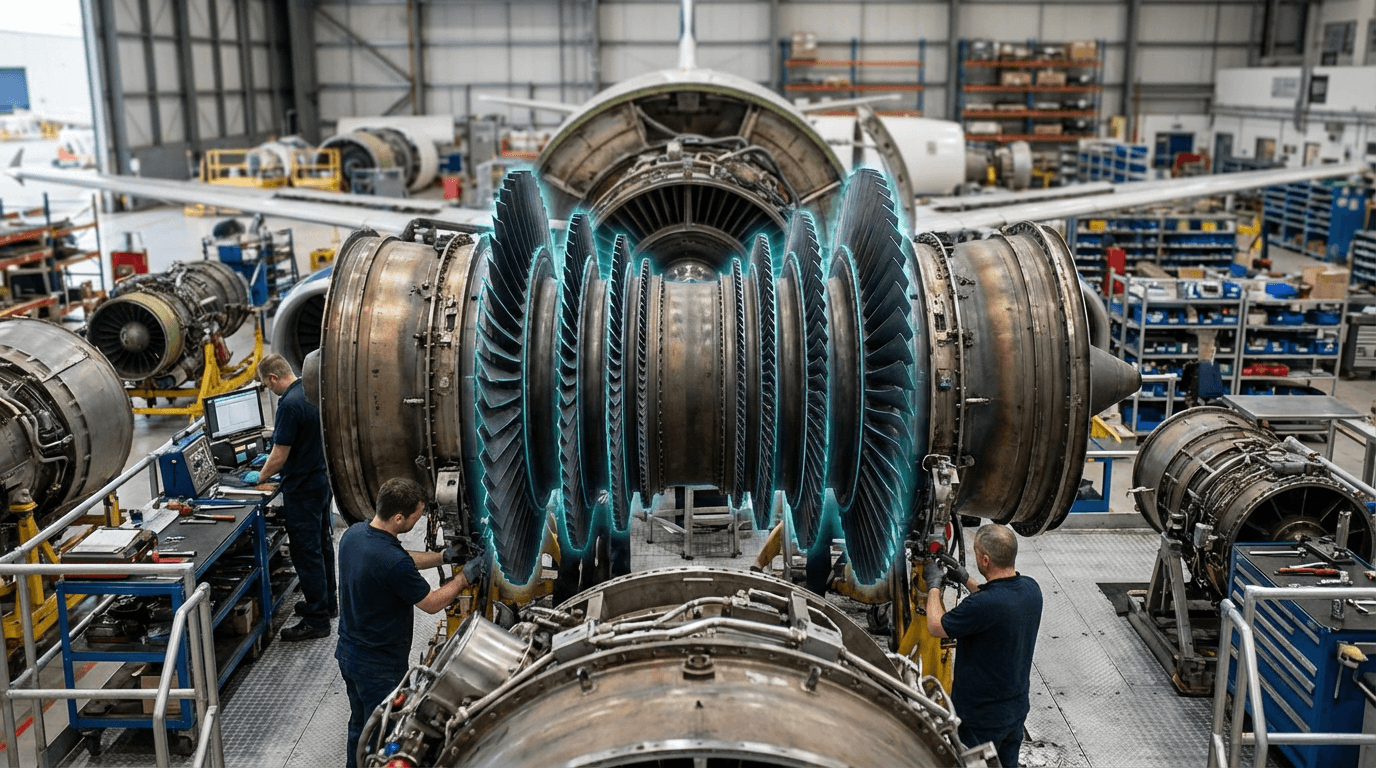
Ceramic Matrix Composites (CMCs) for Turbines
Ceramic Matrix Composites represent a fundamental shift in turbine materials engineering, addressing one of the most persistent constraints in jet engine design: the temperature ceiling of metal alloys. Traditional nickel-based superalloys, despite decades of refinement through advanced cooling schemes and thermal barrier coatings, begin to soften and degrade above approximately 1,150°C. CMCs, by contrast, combine ceramic fibers—typically silicon carbide—with a ceramic matrix, creating a material that maintains structural integrity at temperatures exceeding 1,300°C while weighing roughly one-third as much as equivalent metal components. This combination of extreme temperature tolerance and reduced mass fundamentally alters the thermodynamic possibilities within a gas turbine's hot section, where even modest temperature increases translate directly into improved fuel efficiency through higher pressure ratios and reduced parasitic cooling flows.
The aviation industry has long pursued higher turbine inlet temperatures as the most direct path to improved fuel economy and reduced emissions, but conventional superalloys demand elaborate internal cooling passages that divert 20 to 25 percent of compressed air away from combustion. CMCs enable a dramatic reduction in this cooling penalty, as components can operate closer to their material limits without the complex film cooling and internal channels that add weight, manufacturing complexity, and aerodynamic losses. Early commercial deployments have focused on high-pressure turbine shrouds and combustor liners—stationary components where the technology's benefits could be proven with manageable risk. These initial applications have demonstrated double-digit percentage improvements in specific fuel consumption on certain engine models, validating the business case for broader adoption despite the materials' higher unit costs and more demanding manufacturing processes involving chemical vapor infiltration and polymer impregnation and pyrolysis techniques.
Industry analysts note that the next phase of CMC integration will extend to rotating airfoils—turbine blades and vanes—where the combination of extreme temperatures, high centrifugal loads, and vibrational stresses presents formidable engineering challenges. Research efforts are concentrated on improving the materials' resistance to environmental degradation from water vapor and particulates, developing non-destructive inspection methods capable of detecting subsurface flaws in opaque ceramic structures, and establishing repair protocols that can extend component life beyond initial service intervals. As engine manufacturers pursue ever-higher bypass ratios and pressure ratios to meet increasingly stringent emissions targets, CMCs are becoming less an experimental technology and more a necessary enabler of next-generation propulsion architectures, positioning these advanced materials as central to the aviation industry's pathway toward more sustainable flight.
Related Organizations

World-leading provider of jet and turboprop engines.

Manufacturer of Hi-Nicalon silicon carbide fibers, a critical raw material for CMCs.

Safran
France · Company
Manufacturer of the FELIN future soldier system for the French Army, which includes physiological monitoring capabilities.

Pratt & Whitney
United States · Company
Pioneered the Geared Turbofan (GTF) architecture, a key enabler for ultra-high bypass ratios.

Developing micro-reactors for nuclear thermal and nuclear electric propulsion in space.

Japanese heavy industry and aero-engine manufacturer heavily investing in CMC R&D.

Conducting R&D on thermoplastic fuselage panels and induction welding.

Produces 'Tyranno' silicon carbide fibers used in high-temperature ceramic matrix composites.

Diversified technology company producing industrial, safety, and consumer products.

Industrial reinforcement player that acquired Axiom Materials, a supplier of CMC prepregs.

Produces NAS (sodium-sulfur) batteries, a mature high-capacity battery technology used globally for grid stabilization.
Supporting Evidence
Research this in Signals
Signals turns a topic into a sourced research record you can inspect and rerun. Your first scan is free, and this one starts with Ceramic Matrix Composites (CMCs) for Turbines already loaded, so edit it or scan as is.