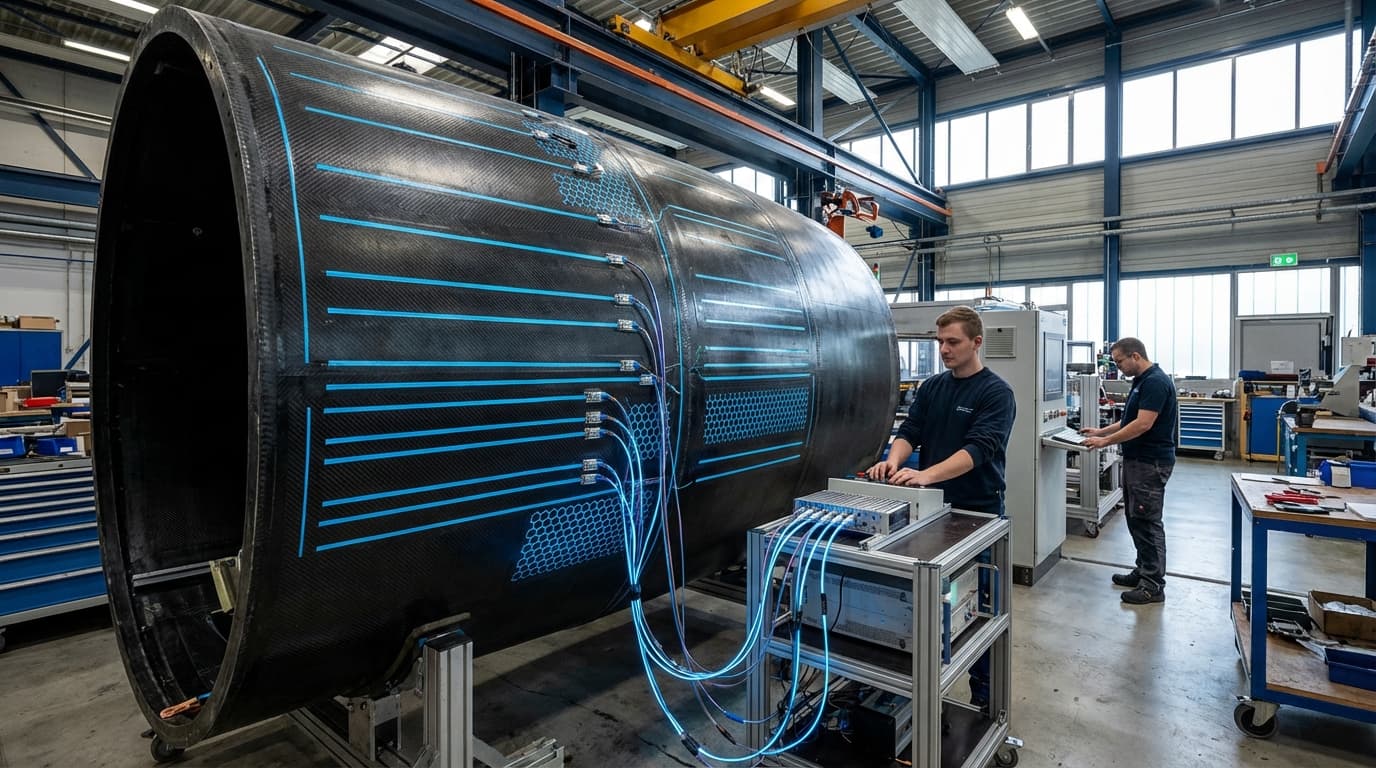
Structural Energy Storage Composites
Structural energy storage composites represent a radical departure from conventional aircraft design by embedding energy storage capabilities directly into load-bearing structural elements. Rather than treating batteries as parasitic mass that must be carried alongside the airframe, these materials combine the mechanical properties of advanced carbon fiber composites with the electrochemical functionality of batteries or supercapacitors. The technology typically employs carbon fiber reinforcements that serve dual roles: providing tensile strength and stiffness while also acting as electrodes in an energy storage system. Between these fiber layers, researchers integrate solid-state or semi-solid electrolytes, separator materials, and current collectors, creating a laminate structure that can simultaneously bear aerodynamic and structural loads while storing and releasing electrical energy. This integration fundamentally challenges the traditional separation between structure and power systems in aerospace engineering.
The aviation industry faces a critical challenge in electrification: batteries are heavy, and aircraft are exquisitely sensitive to weight penalties. Every kilogram added to an aircraft requires additional energy to lift, creating a vicious cycle that has long constrained electric flight to small demonstrators and short-range applications. Structural energy storage composites address this limitation by eliminating the distinction between structural mass and energy storage mass. When the fuselage skin, wing spars, or tail surfaces can store energy while performing their primary structural functions, the effective energy density of the system increases dramatically without adding parasitic weight. This approach could enable electric aircraft to achieve ranges and payloads previously thought impossible, potentially unlocking regional electric aviation and making sustainable air travel economically viable. Beyond pure weight savings, this technology also offers packaging advantages, freeing up internal volume currently occupied by battery packs for cargo, passengers, or additional systems.
Early research prototypes have demonstrated the fundamental feasibility of structural batteries, with academic institutions and aerospace research organizations reporting composite laminates that can bear meaningful structural loads while storing energy at densities approaching conventional lithium-ion cells. However, significant engineering challenges remain before commercial deployment. Ensuring crashworthiness is paramount—structural batteries must not only survive impact loads but also prevent thermal runaway and fire propagation in accident scenarios. Certification authorities will require extensive testing to validate that these materials maintain structural integrity throughout thousands of charge-discharge cycles, temperature extremes, and exposure to aviation environments including moisture, vibration, and electromagnetic interference. Current development efforts focus on solid-state electrolyte chemistries that offer improved safety profiles compared to liquid electrolytes, though these typically sacrifice some energy density. As electric propulsion systems mature and regulatory frameworks evolve to accommodate novel airframe technologies, structural energy storage composites are positioned to become a cornerstone technology for next-generation sustainable aviation, potentially appearing first in unmanned aerial vehicles and urban air mobility platforms before scaling to larger commercial aircraft.
Related Organizations

Home to the Wallenberg Centre for Quantum Technology, where researchers actively develop wideband TWPAs and Josephson junction circuits.

The Centre for Cold Matter develops portable quantum accelerometers for navigation without satellite support.

Leads the SABERS (Solid-state Architecture Batteries for Enhanced Rechargeability and Safety) project.

Partner in the EuroQCI initiative, working on the space segment of the European quantum communication infrastructure.

Swedish technical university collaborating with Chalmers on the mechanical aspects of structural battery composites.

Conducts military research on pilot state monitoring and neural interfaces.

Defense and aerospace company known for the ADAPTIV thermal camouflage system.
Composite Technology Center (CTC) GmbH
Germany · Company
Airbus subsidiary specializing in the development of advanced composite manufacturing technologies.

Research institute in Madrid developing structural supercapacitors and multifunctional composites.
University of Michigan
United States · University
US university researching bio-inspired structural battery electrolytes and mechanics.
Supporting Evidence
Research this in Signals
Signals turns a topic into a sourced research record you can inspect and rerun. Your first scan is free, and this one starts with Structural Energy Storage Composites already loaded, so edit it or scan as is.