Circular Economy & Sustainable Aircraft Decommissioning
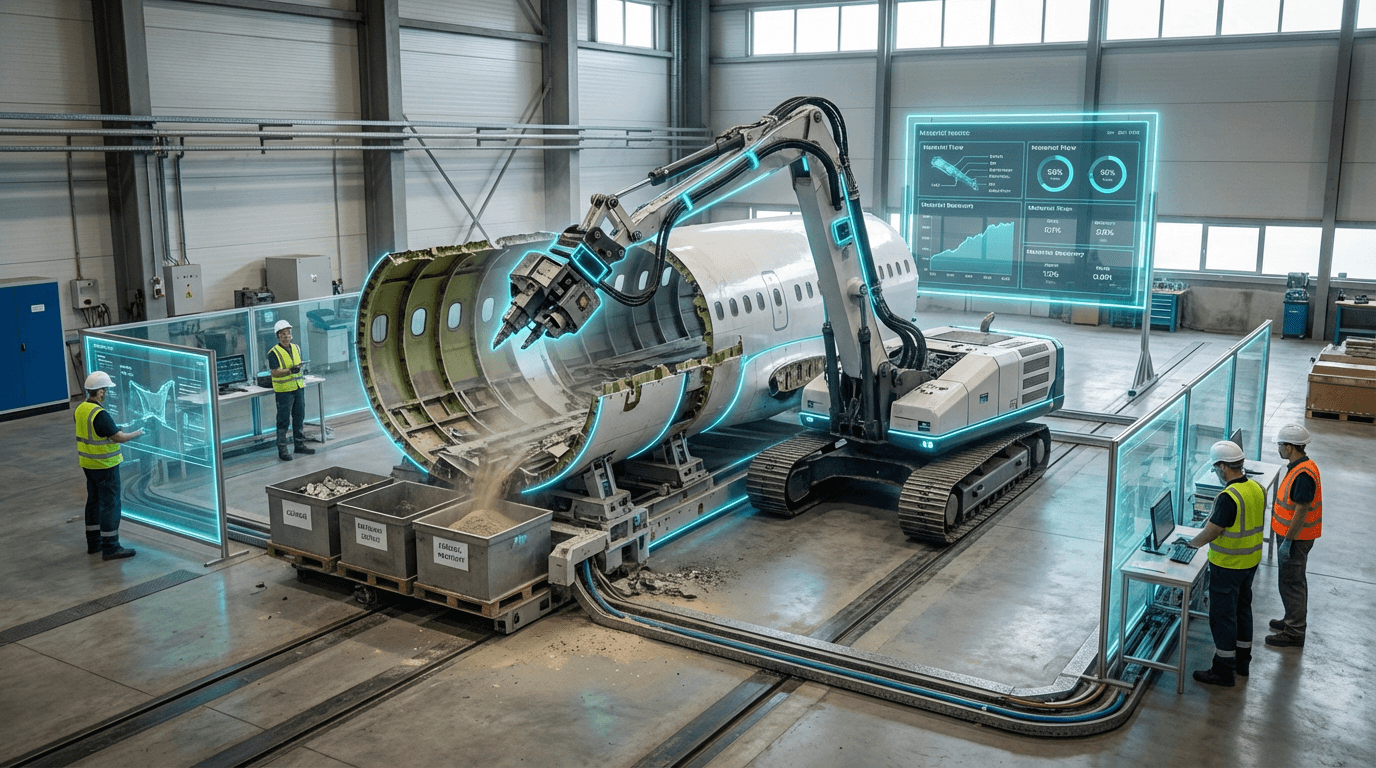
The aviation industry faces a mounting environmental challenge as thousands of aircraft reach the end of their operational lives each year. Traditional decommissioning practices have focused primarily on harvesting high-value components such as engines, avionics, and landing gear for resale or parts support, while the bulk of the airframe—comprising advanced composite materials, aluminum alloys, and specialty metals—has historically been destined for landfills or low-value scrap. This linear approach to aircraft disposal conflicts with growing sustainability imperatives and represents a significant waste of embedded energy and materials. Modern commercial aircraft contain substantial quantities of carbon fiber reinforced polymers, titanium, and other materials that required energy-intensive manufacturing processes, making their disposal both environmentally problematic and economically inefficient. The technical challenge lies in the fact that aerospace-grade composites, unlike metals, cannot be easily melted down and reformed, while the stringent safety and certification requirements of aviation make the reuse of structural components far more complex than in other industries.
Circular economy principles offer a transformative framework for aircraft decommissioning, shifting the industry from a take-make-dispose model to one that prioritizes material recovery, component remanufacturing, and design-for-disassembly. Advanced recycling technologies such as pyrolysis and solvolysis are emerging as viable methods for breaking down composite materials into constituent fibers and resins that can be reintroduced into manufacturing supply chains. Pyrolysis uses controlled heating in oxygen-free environments to recover carbon fibers, while solvolysis employs chemical processes to dissolve resin matrices. Beyond material recovery, the circular approach encompasses remanufacturing of components to original equipment manufacturer specifications, creating certified parts that can re-enter service at a fraction of the environmental footprint of new production. This model also influences upstream design decisions, with manufacturers increasingly considering end-of-life disassembly during the initial engineering phase, using modular construction techniques and material choices that facilitate future recovery.
Several aerospace companies and specialized recycling facilities have begun implementing circular decommissioning programs, though widespread adoption faces economic and regulatory hurdles. The financial viability of these initiatives remains closely tied to commodity prices for recovered materials, the costs of reverse logistics networks to transport retired aircraft to processing facilities, and the development of certification pathways that allow aviation authorities to approve remanufactured or recycled components for flight-critical applications. Early programs have demonstrated technical feasibility, with recovered carbon fibers finding applications in automotive and sporting goods industries when aerospace reuse proves uneconomical. As environmental regulations tighten and the industry confronts its carbon footprint, circular economy approaches to aircraft decommissioning are likely to transition from niche sustainability initiatives to standard practice, supported by evolving design standards that treat end-of-life recovery as an integral consideration rather than an afterthought.
Related Organizations

Global trade association dedicated to sustainable aircraft end-of-life management.
The biggest European aircraft storage, maintenance, and recycling company.

Global player in aircraft storage, disassembly, and recycling.

Deeptech startup recycling carbon fiber composites from aircraft into high-performance materials.

Canadian company specializing in environmentally responsible aircraft dismantling.
Provider of aircraft dismantling and recycling services.
ELG Carbon Fibre
United Kingdom · Company
Recycler of carbon fiber, converting waste from the aerospace industry into usable non-woven mats.

Advanced materials company specializing in carbon fiber recycling.

Global commercial aerospace company offering leasing, MRO, and disassembly services.
Supporting Evidence
Research this in Signals
Signals turns a topic into a sourced research record you can inspect and rerun. Your first scan is free, and this one starts with Circular Economy & Sustainable Aircraft Decommissioning already loaded, so edit it or scan as is.