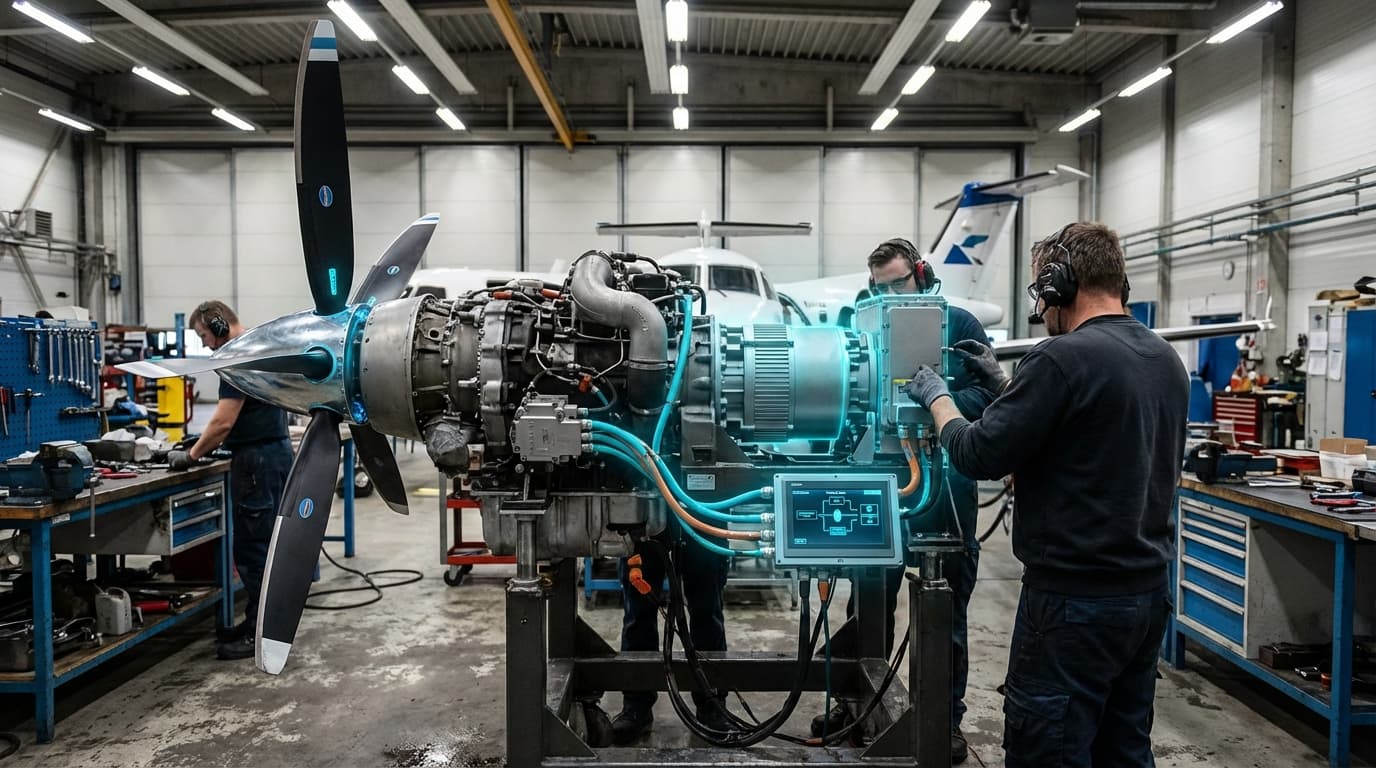
Hybrid-Electric Propulsion
Hybrid-electric propulsion represents a fundamental shift in aircraft power architecture, blending conventional gas turbine engines with electric motors and energy storage systems to optimise performance across different flight phases. Unlike traditional jet engines that operate at suboptimal efficiency during certain segments of flight, hybrid systems can dynamically allocate power between thermal and electrical sources. In turbo-electric configurations, gas turbines drive generators that power electric motors distributed along the airframe, while serial and parallel hybrid arrangements allow engines and motors to work independently or in tandem. This architectural flexibility enables designers to right-size thermal engines for cruise conditions rather than peak takeoff thrust, potentially reducing overall fuel consumption by 10–30% on regional and short-haul routes. The technology relies on advances in high-power-density electric machines, wide-bandgap semiconductors for power conversion, and thermal management systems capable of dissipating megawatts of waste heat in the constrained environment of an aircraft nacelle or fuselage.
The aviation industry faces mounting pressure to reduce its carbon footprint, which currently accounts for approximately 2–3% of global CO₂ emissions, alongside significant contributions of nitrogen oxides and particulate matter at altitude. Hybrid-electric propulsion addresses these challenges by enabling more efficient flight profiles and creating pathways toward sustainable aviation fuels and, eventually, hydrogen or battery-electric systems. By decoupling thrust generation from a single propulsion point, distributed electric propulsion can improve aerodynamic efficiency through boundary layer ingestion and enable novel aircraft configurations such as blended wing bodies or high-aspect-ratio designs previously constrained by engine placement. The technology also promises operational benefits including reduced noise signatures during approach and departure, lower maintenance costs due to fewer high-cycle turbine components, and the potential for emergency power redundancy. However, certification authorities require rigorous demonstration of fault tolerance, electromagnetic interference mitigation, and thermal runaway prevention before these systems can enter commercial service.
Several aerospace manufacturers and research consortia are actively developing hybrid-electric demonstrators, with regional aircraft emerging as the most viable near-term application due to their shorter range requirements and lower power demands. NASA's X-57 Maxwell and the European Clean Sky initiative have validated key subsystems, while airframers are targeting entry-into-service dates in the late 2020s for commuter aircraft in the 19–50 seat category. Parallel efforts focus on retrofitting existing turboprop platforms with hybrid powertrains to accelerate market adoption and build operational experience. As battery energy density improves and power electronics mature, hybrid architectures are expected to scale toward narrowbody aircraft, serving as a critical bridge technology between today's kerosene-burning fleets and the net-zero aviation ecosystem envisioned for mid-century. The integration of hybrid propulsion with advanced materials, active flow control, and digital twin-based predictive maintenance positions this technology at the intersection of multiple decarbonisation strategies reshaping the future of flight.
Related Organizations

Develops hybrid-electric powertrain upgrades for existing aircraft (e.g., Eco Caravan).

Developing a hybrid-electric eSTOL aircraft using blown lift technology.


Developing micro-reactors for nuclear thermal and nuclear electric propulsion in space.

Developing the Cassio family of aircraft with a proprietary hybrid-electric power module.

Collins Aerospace
United States · Company
A major aerospace and defense contractor, a subsidiary of RTX Corporation.

Developing the ES-30, a regional aircraft with reserve-hybrid turbogenerators.

Safran
France · Company
Manufacturer of the FELIN future soldier system for the French Army, which includes physiological monitoring capabilities.

Manufactures regenerative turbogenerators for hybrid-electric aircraft.

Develops hybrid-electric powertrain systems (generators) for aerospace.
Supporting Evidence
Research this in Signals
Signals turns a topic into a sourced research record you can inspect and rerun. Your first scan is free, and this one starts with Hybrid-Electric Propulsion already loaded, so edit it or scan as is.