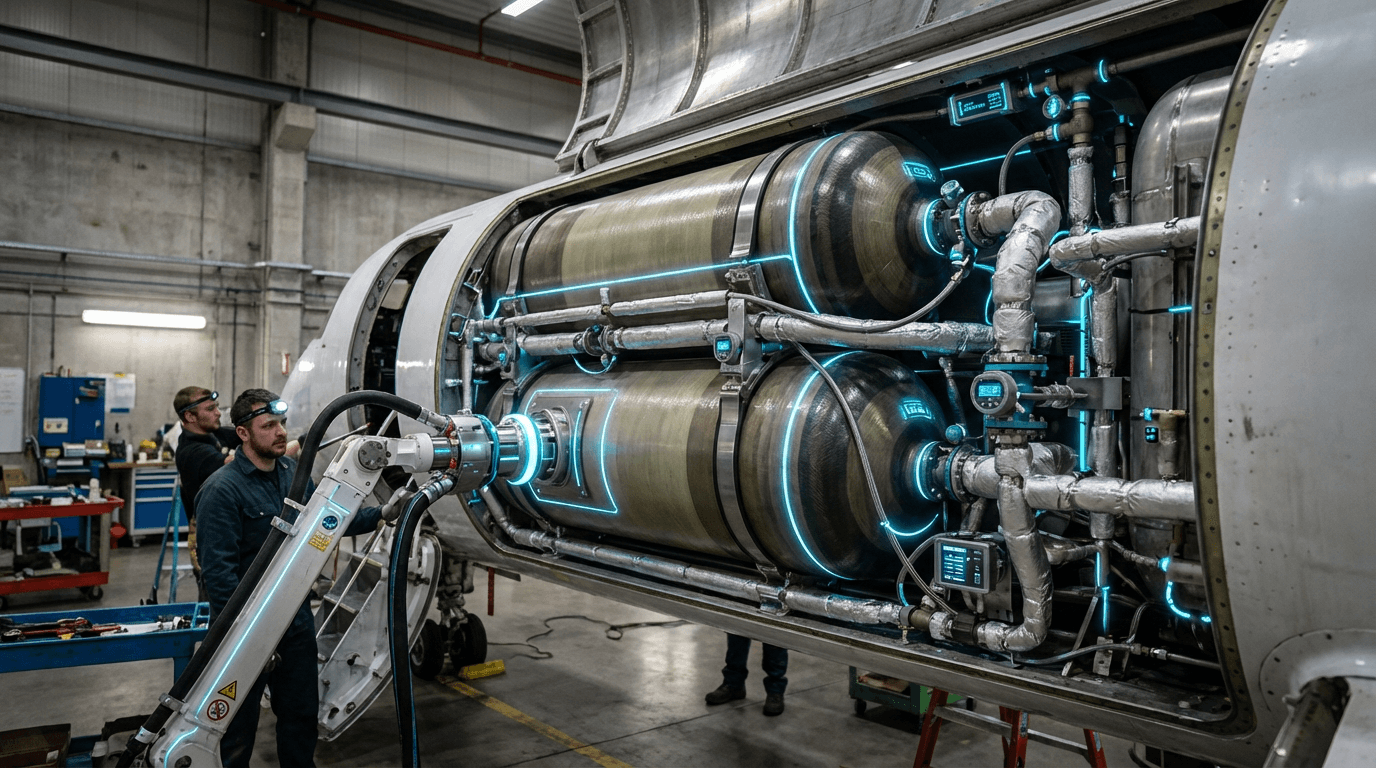
Liquid Hydrogen Storage & Fuel Systems
Liquid hydrogen storage and fuel systems represent a critical enabling technology for zero-emission aviation, addressing the fundamental challenge of storing hydrogen at cryogenic temperatures (−253°C) aboard aircraft. Unlike conventional jet fuel, liquid hydrogen (LH2) requires specialized double-walled vacuum-insulated tanks, typically constructed from lightweight composite materials or aluminum alloys with advanced multi-layer insulation (MLI) systems to minimize heat ingress. The fuel system architecture encompasses not only the primary storage tanks but also complex networks of cryogenic pumps, vaporizers, pressure regulators, and distribution lines designed to maintain hydrogen in its liquid state while safely delivering it to fuel cells or combustion engines. Boil-off management systems continuously monitor and control the inevitable evaporation of hydrogen, either by venting excess gas or recapturing it for use, while sophisticated leak detection sensors and inerting systems ensure that any escaped hydrogen cannot accumulate in dangerous concentrations within the aircraft structure.
The aviation industry faces acute pressure to decarbonize, yet the energy density requirements of flight make electrification impractical for most commercial routes beyond short regional hops. Liquid hydrogen offers a compelling alternative, providing three times the gravimetric energy density of jet fuel, though its volumetric energy density is roughly four times lower, meaning LH2 tanks occupy significantly more space than conventional fuel tanks. This volume challenge drives fundamental aircraft redesign, often requiring fuselage modifications or entirely new airframe configurations to accommodate the bulkier tanks without compromising passenger capacity or cargo space. Beyond the storage challenge, these systems must maintain thermal integrity over flight durations spanning multiple hours, during which external temperatures can vary dramatically from ground operations through high-altitude cruise. The certification pathway presents additional hurdles, as aviation regulators require fault-tolerant architectures with multiple redundancies, rigorous testing protocols for cryogenic component reliability, and comprehensive safety demonstrations covering scenarios from minor leaks to catastrophic tank failures.
Several aerospace manufacturers and research consortia have initiated demonstration programs exploring hydrogen propulsion, with modified regional aircraft serving as testbeds for cryogenic fuel system integration. Ground infrastructure development proceeds in parallel, as airports must install specialized LH2 refueling equipment, storage facilities, and safety protocols distinct from conventional jet fuel operations. Early deployments indicate that while the technology is maturing, significant engineering refinement remains necessary to achieve the weight, volume, and cost targets required for commercial viability. The trajectory of this technology aligns with broader industry commitments to achieve net-zero emissions by mid-century, positioning liquid hydrogen systems as a cornerstone of sustainable long-haul aviation alongside sustainable aviation fuels and hybrid-electric propulsion for shorter routes.
Related Organizations

Partner in the EuroQCI initiative, working on the space segment of the European quantum communication infrastructure.
Chart Industries
United States · Company
Global manufacturer of cryogenic equipment, including liquid hydrogen tanks for aviation.

GKN Aerospace
United Kingdom · Company
Leads the H2GEAR program developing liquid hydrogen fuel systems.

Developer of hydrogen-electric powertrain systems for aircraft, acquired by Joby Aviation.

World leader in gases, technologies, and services for industry and health.

Developing the K-RACER, a heavy-lift unmanned helicopter for logistics.

Developing the Flying Fuel Cell (FFC) and liquid hydrogen fuel systems.

A dedicated robotaxi project founded by Mate Rimac, developing a purpose-built autonomous vehicle ecosystem.

Tier 1 aerostructures supplier developing liquid hydrogen storage tanks.

Developing air supply systems and thermal management for hydrogen fuel cells.
Supporting Evidence
Research this in Signals
Signals turns a topic into a sourced research record you can inspect and rerun. Your first scan is free, and this one starts with Liquid Hydrogen Storage & Fuel Systems already loaded, so edit it or scan as is.