Modern Cargo Airships
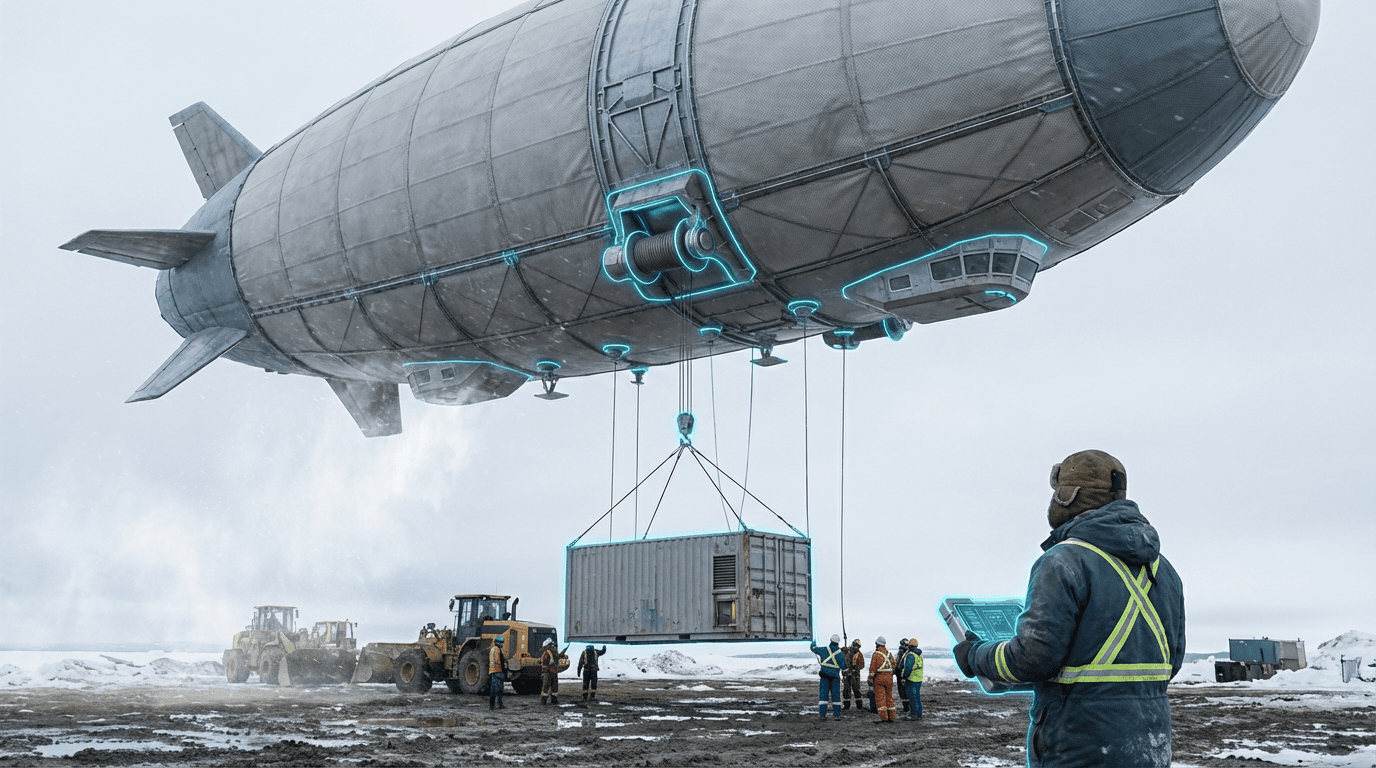
Modern cargo airships represent a revival of lighter-than-air technology, reimagined through contemporary materials science and hybrid propulsion systems. Unlike traditional rigid airships, these vehicles combine aerostatic lift from inert helium gas with aerodynamic lift generated by their hull shape and forward motion, creating what engineers term "hybrid lift." The fundamental architecture typically features a pressurised envelope filled with non-flammable helium, providing 60–80% of total lift, while the remaining lift comes from the vehicle's aerodynamic profile and vectored thrust systems. Advanced composite fabrics for the envelope offer improved durability and reduced helium permeability compared to historical designs, while modern avionics and fly-by-wire controls address the handling challenges that plagued earlier generations. The hybrid approach allows these craft to adjust their buoyancy dynamically, becoming heavier-than-air for landing and loading operations, then returning to neutral or positive buoyancy for flight.
The aviation and logistics industries face persistent challenges in serving remote locations where traditional infrastructure is absent or prohibitively expensive to build. Helicopters can access these sites but carry limited payloads at high operating costs, often exceeding $5–10 per ton-kilometre for heavy-lift operations. Fixed-wing aircraft require prepared runways, eliminating most remote destinations from consideration. Modern cargo airships address this infrastructure gap by offering payload capacities ranging from 20 tons in near-term designs to over 200 tons in proposed larger variants, all while requiring only minimal ground facilities—essentially a cleared landing zone and basic mooring equipment. This capability proves particularly valuable for resource extraction industries operating in Arctic regions, mountainous terrain, or tropical forests where road construction would be environmentally destructive or economically unfeasible. The technology also presents compelling applications in humanitarian logistics, enabling direct delivery of shelter materials, medical supplies, and heavy equipment to disaster-affected areas where airports and roads have been damaged or never existed.
Several development programmes have advanced beyond the conceptual stage, with prototype vehicles conducting test flights and limited commercial operations. Early deployments have focused on proving the fundamental airworthiness of hybrid designs and validating operational procedures for loading, flight, and landing in varied conditions. The primary technical hurdles centre on demonstrating consistent performance across diverse weather conditions, as airships remain more susceptible to wind and turbulence than conventional aircraft, and establishing maintenance protocols that ensure long-term envelope integrity and helium retention. Economic viability depends on achieving utilisation rates that justify the substantial capital investment required for each vehicle, which industry analysts note could be competitive with helicopter operations for distances beyond 300–500 kilometres to sites requiring repeated heavy deliveries. As climate considerations intensify pressure to reduce aviation emissions, the inherently fuel-efficient nature of airship transport—consuming a fraction of the fuel per ton-kilometre compared to helicopters or cargo planes—positions this technology as part of a broader shift toward lower-carbon logistics solutions, particularly for applications where speed is less critical than cost and environmental impact.
Related Organizations

Developing the LCA60T, a rigid airship solution for transporting up to 60 tons of heavy cargo.

UK-based developer of the Airlander 10, a hybrid airship designed for passenger and logistics use.

Airship company backed by Sergey Brin, developing the Pathfinder series of rigid airships for humanitarian aid and cargo.


Israeli company developing the ATLANT fleet of cargo airships capable of vertical takeoff and landing.

French company developing the Solar Airship One for zero-emission logistics.

UK company designing variable buoyancy aluminum airships for heavy cargo.

Canadian company developing transport airships for remote northern logistics.

Material science company developing high-altitude platform stations.

Finnish company manufacturing small, hydrogen-powered airships for continuous aerial monitoring.
Supporting Evidence
Research this in Signals
Signals turns a topic into a sourced research record you can inspect and rerun. Your first scan is free, and this one starts with Modern Cargo Airships already loaded, so edit it or scan as is.