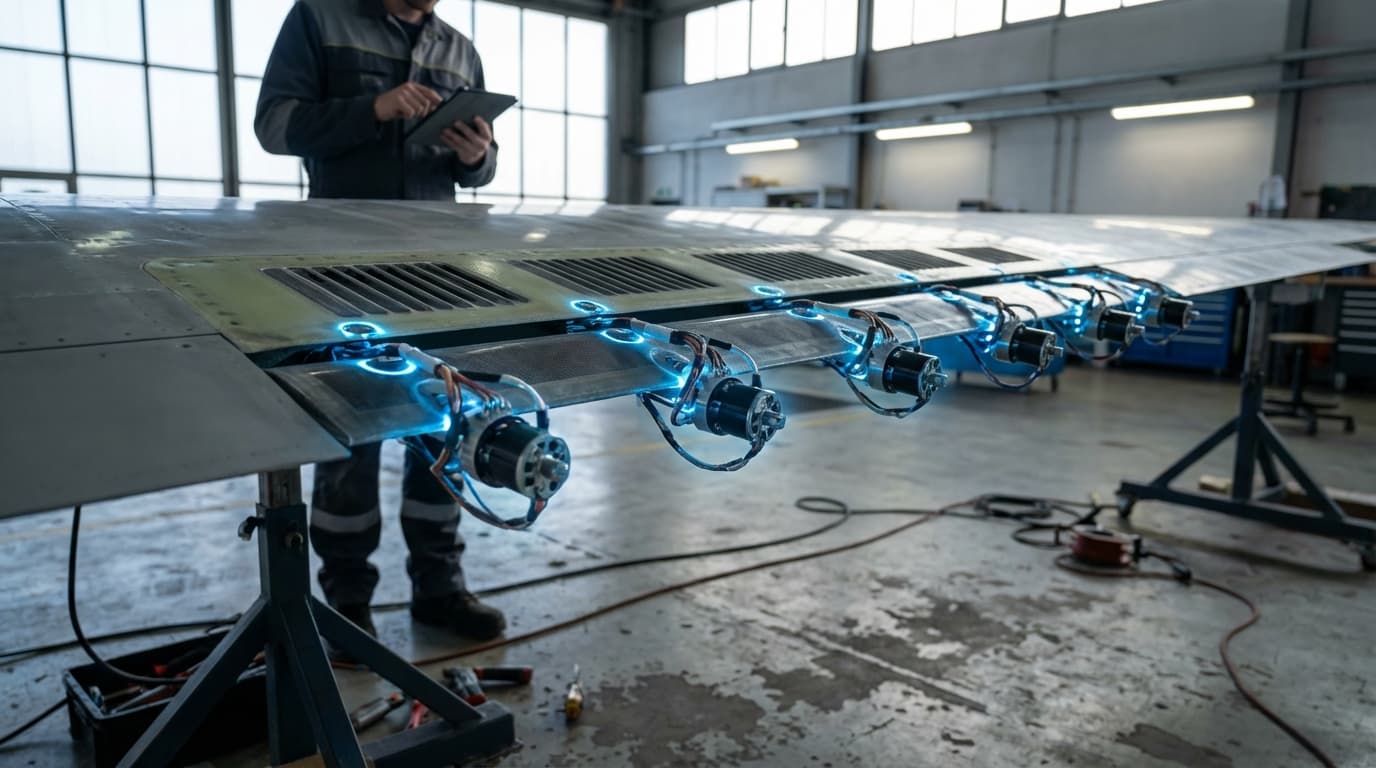
Distributed Electric Propulsion (DEP)
Distributed Electric Propulsion represents a fundamental departure from conventional aircraft design by replacing traditional centralized engines with arrays of smaller electric motors strategically positioned across the airframe. Unlike conventional propulsion systems that rely on one or two large turbofan engines mounted under the wings or at the fuselage tail, DEP distributes thrust generation across multiple points along the wing's leading edge, trailing edge, or even the fuselage surface. This architecture leverages electric motors' compact size, precise controllability, and ability to operate independently or in coordinated groups. The technology works by ingesting the slow-moving boundary layer air that forms along aircraft surfaces—air that would otherwise create drag—and re-energizing it through the propulsors. This boundary layer ingestion effect reduces overall drag while simultaneously improving lift characteristics, particularly at low speeds where conventional aircraft are most vulnerable to stalling. The distributed nature of the system also enables differential thrust control, where individual motors can be throttled independently to provide yaw control without traditional rudders, and blown lift configurations that direct propulsor exhaust over wing surfaces to enhance lift generation during critical flight phases.
The aerospace industry faces mounting pressure to reduce fuel consumption, emissions, and noise while maintaining or improving aircraft performance and safety. DEP addresses these challenges by enabling aircraft configurations that would be aerodynamically impossible with conventional propulsion. The improved stall margins allow for smaller, lighter wing designs that reduce structural weight and drag during cruise flight. The ability to re-energize boundary layers means aircraft can operate efficiently across a wider range of speeds and altitudes, potentially opening new mission profiles for regional aviation and urban air mobility applications. However, significant engineering obstacles remain before widespread adoption becomes feasible. Fault tolerance presents a critical challenge—with dozens of motors operating simultaneously, the system must gracefully handle individual motor failures without compromising flight safety. Thermal management becomes increasingly complex as heat from multiple motors must be dissipated efficiently without adding excessive weight. Electromagnetic interference from numerous electric motors and their associated power electronics can disrupt avionics and communication systems, requiring careful shielding and filtering strategies.
Several research programs and aerospace manufacturers are actively exploring DEP configurations, particularly for hybrid-electric and fully electric aircraft concepts. NASA's X-57 Maxwell experimental aircraft serves as a prominent testbed, featuring fourteen electric motors along its wing to demonstrate the viability of distributed propulsion for general aviation applications. Early results from wind tunnel testing and computational simulations suggest that DEP can achieve double-digit percentage improvements in aerodynamic efficiency compared to conventional designs. The technology shows particular promise for short-haul regional aircraft and emerging urban air mobility vehicles, where the benefits of improved low-speed performance and reduced noise align well with operational requirements. As battery energy density continues to improve and power electronics become more compact and efficient, DEP is positioned to play a central role in the transition toward more sustainable aviation. The technology's success will depend on solving the integration challenges with hybrid-electric power systems, where DEP arrays must coordinate seamlessly with onboard generators, batteries, and energy management systems to deliver reliable, efficient propulsion across all flight phases.
Related Organizations

Developing a hybrid-electric eSTOL aircraft using blown lift technology.

Developing an all-electric vertical takeoff and landing aircraft for commercial passenger service.

Lilium
Germany · Company
Developing the Lilium Jet, an eVTOL using ducted electric vectoring fans for regional mobility.

Leads the SABERS (Solid-state Architecture Batteries for Enhanced Rechargeability and Safety) project.

Manufacturer of the 'Midnight' eVTOL aircraft, focused on urban air mobility networks.

Prime contractor for the NASA X-57 Maxwell, specializing in DEP integration.

Developing ultra-quiet electric ducted fans specifically designed for distributed propulsion integration.

Manufacturer of electric propulsion units (EPUs) for commercial aviation.

Developing micro-reactors for nuclear thermal and nuclear electric propulsion in space.

Safran
France · Company
Manufacturer of the FELIN future soldier system for the French Army, which includes physiological monitoring capabilities.
Supporting Evidence
Research this in Signals
Signals turns a topic into a sourced research record you can inspect and rerun. Your first scan is free, and this one starts with Distributed Electric Propulsion (DEP) already loaded, so edit it or scan as is.