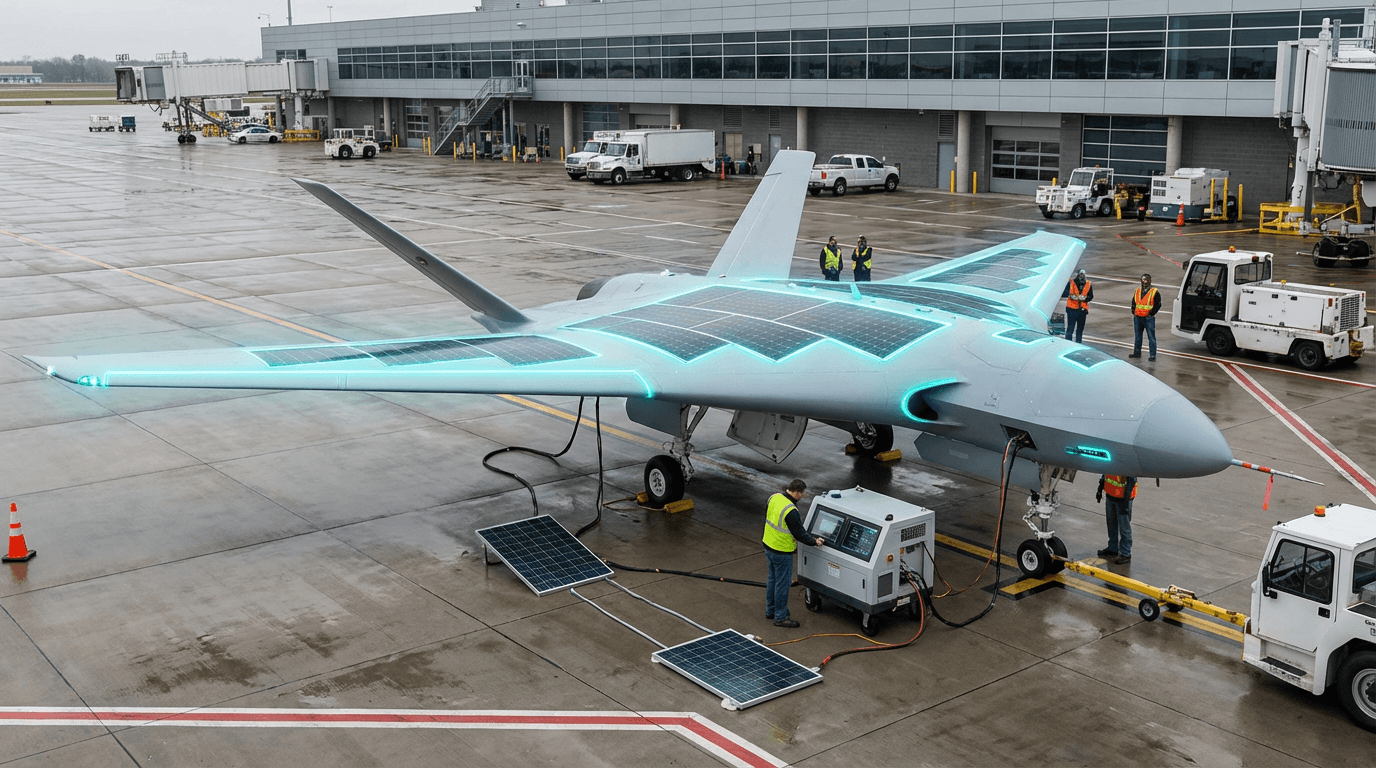
Blended Wing Body (BWB) & Novel Airframes
The Blended Wing Body represents a fundamental departure from the tube-and-wing configuration that has dominated commercial aviation since the jet age began. Unlike conventional aircraft where the fuselage serves primarily as a non-lifting payload container, BWB designs merge the wing and fuselage into a single, continuous lifting surface that generates aerodynamic lift across nearly the entire airframe. This integration eliminates the sharp distinction between wing and body, creating a flattened, triangular planform that more closely resembles a flying wing. The aerodynamic advantage stems from reduced wetted surface area and interference drag—the turbulence created where traditional wings meet a cylindrical fuselage. By distributing payload and fuel across a wider, flatter structure, BWB aircraft achieve significantly improved lift-to-drag ratios, typically cited at 15-20% better than comparable conventional designs. This efficiency translates directly into reduced fuel consumption per passenger-mile, a critical metric as the aviation industry confronts mounting pressure to reduce carbon emissions while managing volatile fuel costs.
The aviation sector faces an existential challenge: demand for air travel continues to grow while regulatory and public pressure to decarbonize intensifies. Conventional airframe improvements have reached a point of diminishing returns, with each percentage point of efficiency gain requiring exponentially greater engineering effort. BWB designs offer one of the few remaining pathways to step-change efficiency improvements using existing propulsion technology. Beyond fuel savings, the wide fuselage cross-section enables novel cabin configurations and potentially quieter operations, as engines can be mounted atop the airframe, shielding ground populations from noise. However, the radical geometry introduces formidable challenges that have prevented commercial adoption despite decades of research. The wide, flat cabin creates zones far from windows, raising passenger comfort concerns and complicating emergency evacuation—current regulations assume passengers can reach exits within certain distances and times. The airframe's structural design must handle bending loads differently than tube-and-wing aircraft, requiring new materials, manufacturing techniques, and certification approaches. Existing airport infrastructure, from gates to hangars to taxiway clearances, assumes conventional dimensions.
Major aerospace programs are now pushing BWB concepts toward reality after years of wind tunnel models and subscale testing. NASA's X-48 demonstrator program validated handling qualities and control systems for the unconventional shape, while more recent Transonic Truss-Braced Wing and Sustainable Flight Demonstrator initiatives explore adjacent efficiency-focused geometries. Airbus has announced plans for a BWB demonstrator aircraft, positioning the concept as a potential successor to narrow-body jets in the 2030s or beyond. Chinese aerospace manufacturers have similarly invested in BWB research as part of broader efforts to establish domestic commercial aviation capabilities. The technology aligns with parallel developments in sustainable aviation fuels, hybrid-electric propulsion, and advanced manufacturing techniques like automated fiber placement for composite structures. While passenger BWB aircraft remain years from commercial service, the design principles are already influencing military tanker and cargo programs where passenger comfort concerns are absent. The convergence of environmental imperatives, maturing enabling technologies, and sustained research investment suggests that novel airframe geometries may finally transition from aerospace curiosity to operational reality, fundamentally reshaping what commercial aircraft look like in the coming decades.
Related Organizations

Developing a Blended Wing Body aircraft for commercial and military tanker markets, recently awarded a major USAF contract.

Designing a fleet of autonomous blended wing body (BWB) cargo aircraft.

Leads the SABERS (Solid-state Architecture Batteries for Enhanced Rechargeability and Safety) project.

A leading technical university known for research into self-healing asphalt using steel wool and induction heating.

Partner in the EuroQCI initiative, working on the space segment of the European quantum communication infrastructure.

Conducting flight testing on the EcoJet research project, a blended wing body demonstrator.

Conducts extensive research on Hybrid Laminar Flow Control (HLFC) and suction systems.

Major defense contractor developing Reciprocal Quantum Logic (RQL) for cryogenic computing.

A British postgraduate public research university specializing in science, engineering, design, technology, and management.

Funding and partnering with TU Delft on the Flying-V research project.
Supporting Evidence
Research this in Signals
Signals turns a topic into a sourced research record you can inspect and rerun. Your first scan is free, and this one starts with Blended Wing Body (BWB) & Novel Airframes already loaded, so edit it or scan as is.