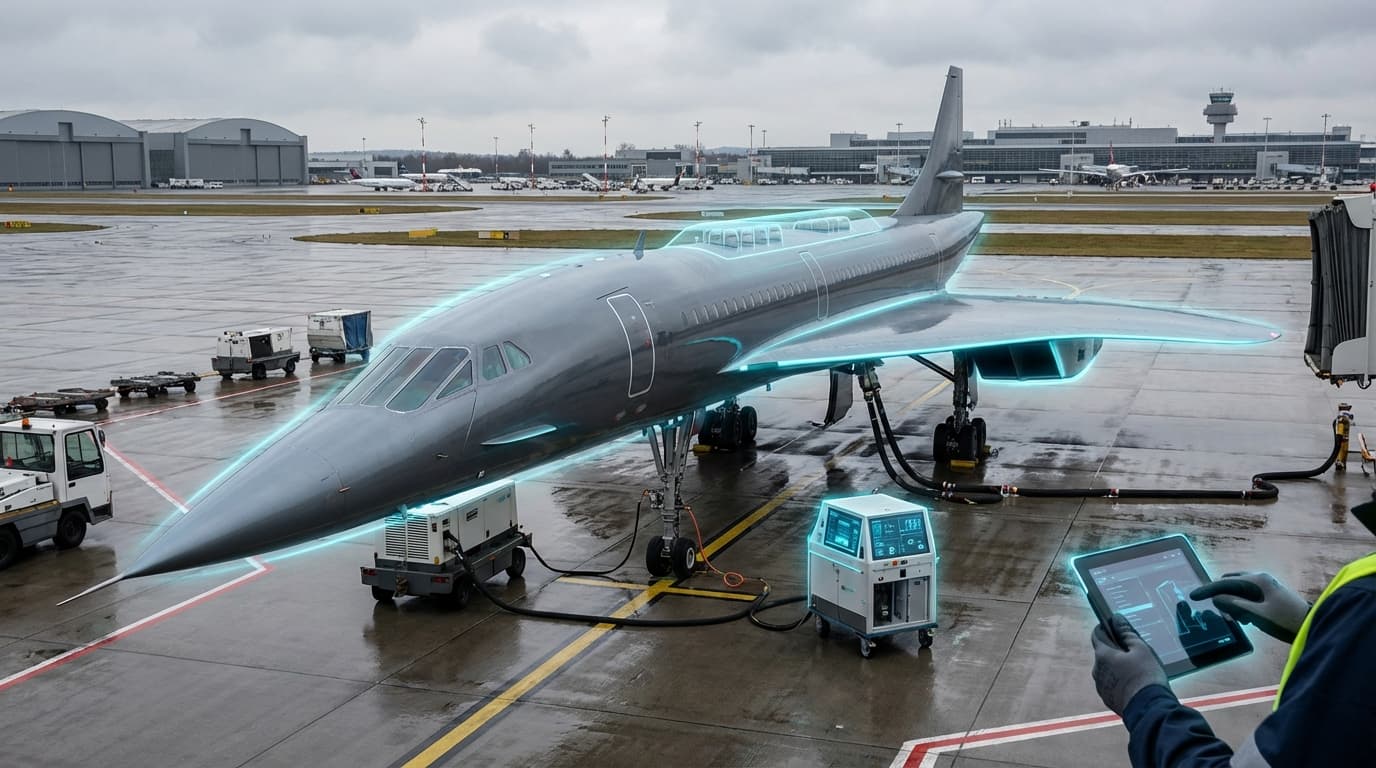
Supersonic Commercial Travel
Supersonic commercial travel represents a technological renaissance in aviation, building upon the legacy of the Concorde while addressing the fundamental limitations that grounded the first generation of supersonic passenger aircraft. At its core, this technology leverages advanced aerodynamic principles and computational fluid dynamics to achieve speeds exceeding Mach 1.0—typically ranging from Mach 1.4 to Mach 2.2—while dramatically reducing the intensity of sonic booms. Traditional supersonic aircraft generate powerful shock waves that merge into disruptive sonic booms audible on the ground, which led to regulatory restrictions prohibiting supersonic flight over land in most jurisdictions. Next-generation designs employ carefully sculpted fuselages, optimized wing configurations, and precise shaping of the aircraft's nose and tail sections to distribute shock waves in ways that prevent them from coalescing into a single, thunderous boom. Instead, these designs produce a softer "sonic thump" or series of smaller pressure signatures that research suggests may be acceptable for overland flight, potentially measured at 75 perceived decibels or lower compared to the 105-110 decibels of conventional supersonic aircraft.
The aviation industry faces mounting pressure to reduce travel times while simultaneously addressing environmental concerns and expanding global connectivity. Supersonic commercial travel directly tackles the time-cost equation that has remained largely unchanged since the introduction of subsonic jet aircraft in the 1950s. By enabling flight times that are 50-65% shorter than current commercial aircraft, this technology addresses the opportunity costs associated with long-haul business travel and opens possibilities for same-day intercontinental trips. The ability to fly supersonically over land—contingent upon regulatory approval of quieter designs—would unlock routes that were never economically viable for the Concorde, which was restricted to transoceanic corridors. This capability could transform business aviation by connecting major economic centers across continents in unprecedented timeframes. Additionally, modern supersonic designs incorporate more fuel-efficient engines and explore sustainable aviation fuels to address the environmental challenges that plagued earlier supersonic programs, where fuel consumption per passenger-mile was significantly higher than subsonic alternatives.
Several aerospace manufacturers and startups have advanced beyond conceptual designs to wind tunnel testing and prototype development, with industry analysts noting renewed investor interest following decades of dormancy in supersonic passenger aviation. Demonstration flights of scaled prototypes have validated key noise-reduction principles, while regulatory bodies have begun establishing frameworks for certifying supersonic aircraft and potentially revising restrictions on overland supersonic flight. Proposed applications range from business-class-only configurations serving premium transcontinental routes to larger aircraft designs that could eventually democratize supersonic travel beyond executive transport. The technology aligns with broader aviation trends toward personalized, time-efficient travel and represents a potential inflection point in how distance and connectivity are conceptualized in an increasingly globalized economy. As computational design tools, advanced materials, and propulsion technologies continue to mature, supersonic commercial travel stands poised to redefine the upper echelon of air transportation, offering a glimpse of a future where the world becomes measurably smaller through dramatically reduced flight times.
Related Organizations

Developing 'Overture', a sustainable supersonic airliner capable of flying at Mach 1.7.

Leads the SABERS (Solid-state Architecture Batteries for Enhanced Rechargeability and Safety) project.


Leading long-term research into SBSP, with plans to demonstrate power transmission from orbit by 2025.
Reaction Engines
United Kingdom · Company
Developing the SABRE engine and precooler technology to enable high-speed supersonic and hypersonic flight.
Developing the Spike S-512, a quiet supersonic business jet designed to fly at Mach 1.6 without a sonic boom.

Startup developing hypersonic aircraft capable of Mach 5 flight using a turbine-based combined cycle engine.

Destinus
Switzerland · Startup
A European company developing hydrogen-powered hypersonic aircraft.


Developing a new electric-adaptive jet engine for efficient supersonic flight.
Supporting Evidence
Research this in Signals
Signals turns a topic into a sourced research record you can inspect and rerun. Your first scan is free, and this one starts with Supersonic Commercial Travel already loaded, so edit it or scan as is.