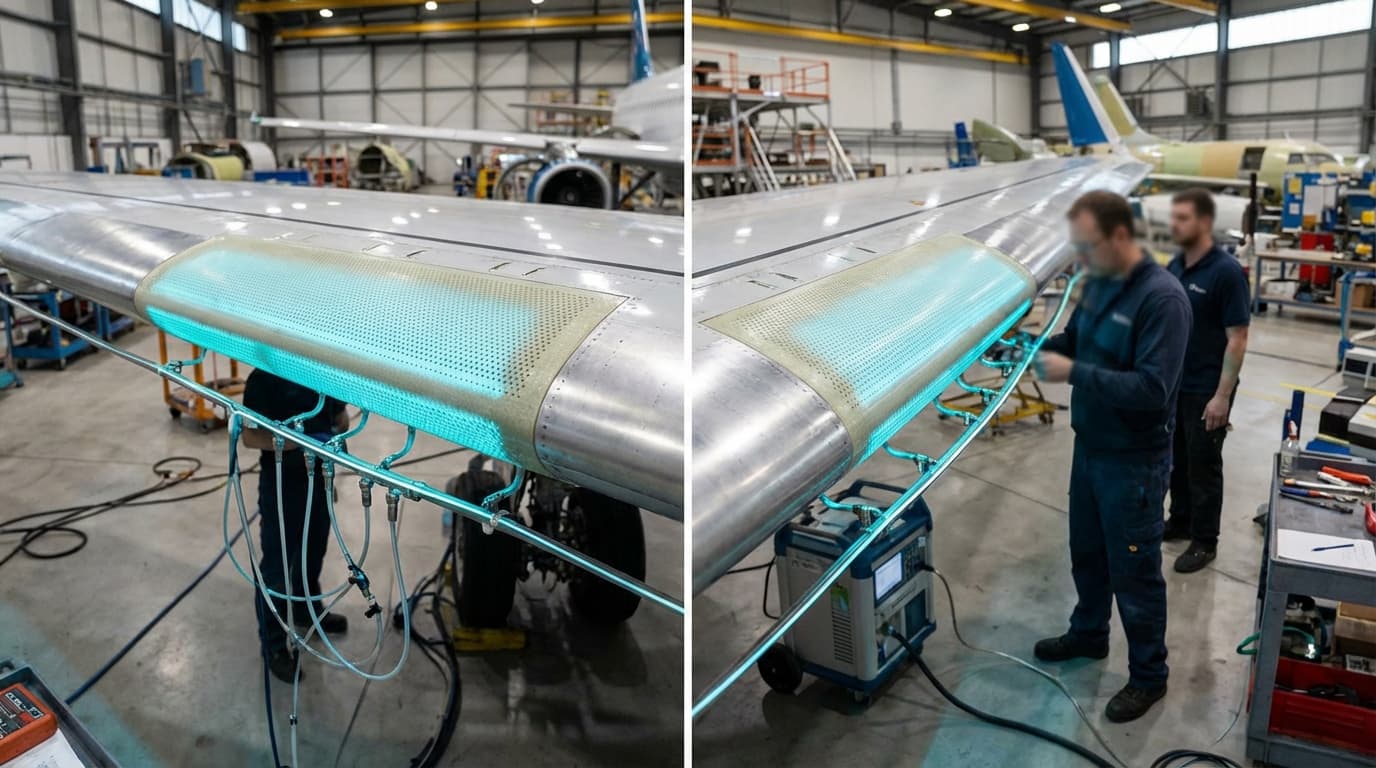
Laminar Flow & Active Boundary-Layer Control
Laminar flow represents a state of smooth, orderly airflow over an aircraft surface, in contrast to turbulent flow where air moves in chaotic, swirling patterns. When air flows laminarly across a wing or nacelle, the boundary layer—the thin region of air immediately adjacent to the surface—remains stable and generates significantly less skin friction drag than turbulent flow. Traditional aircraft designs accept that most surfaces will experience turbulent flow, but maintaining laminar conditions even over portions of the wing can reduce drag by 10 to 20 percent in those regions. The challenge lies in controlling the transition point where laminar flow breaks down into turbulence, a phenomenon influenced by surface roughness, pressure gradients, Reynolds number, and environmental contamination. Active boundary-layer control employs suction through micro-perforated surfaces or carefully designed slots to remove the low-momentum air near the surface, stabilising the boundary layer and delaying the onset of turbulence. Complementary techniques include plasma actuators, synthetic jets, and adaptive surfaces that respond to real-time flow conditions, all aimed at extending the laminar region further aft along the chord.
The aerospace industry has long recognised that fuel represents one of the largest operating costs for airlines, and even modest drag reductions translate directly into substantial savings and emissions cuts over an aircraft's service life. Research suggests that widespread adoption of laminar flow technology could reduce fleet-wide fuel consumption by several percentage points, a significant gain given the scale of global aviation. However, practical implementation has been hindered by the extreme sensitivity of laminar flow to surface imperfections. Insects impacting the leading edge during takeoff and climb, ice accumulation in flight, paint degradation, and even minor manufacturing tolerances can trip the boundary layer into turbulence, negating the aerodynamic benefits. Active control systems address these limitations by continuously monitoring flow conditions through embedded sensors and adjusting suction rates or actuator settings to maintain laminar conditions despite real-world contamination. Advances in composite manufacturing now enable the production of ultra-smooth surfaces with integrated suction panels, while distributed sensor networks and edge computing allow for responsive, localised flow management without prohibitive weight or complexity penalties.
Flight tests on modified business jets and regional aircraft have demonstrated the viability of hybrid laminar flow control, where natural laminar flow is maintained over the forward portion of the wing and active suction extends the laminar region further aft. Industry analysts note growing interest in applying these techniques to next-generation narrow-body and wide-body aircraft, particularly as regulatory pressure to reduce aviation emissions intensifies. The technology is especially promising for long-range operations where cruise efficiency dominates the mission profile, and the fuel savings can justify the added system complexity and maintenance requirements. Beyond commercial aviation, laminar flow control is being explored for unmanned aerial vehicles, where extended endurance is critical, and for supersonic transports, where wave drag reduction complements skin friction benefits. As computational fluid dynamics tools become more sophisticated and manufacturing techniques continue to mature, the integration of active boundary-layer control into mainstream aircraft design appears increasingly feasible, positioning laminar flow technology as a key enabler of the industry's transition toward more sustainable flight.
Related Organizations

Partner in the EuroQCI initiative, working on the space segment of the European quantum communication infrastructure.

Global aerospace company and manufacturer of the Starliner spacecraft.

Uses laminar flow wing designs on their Falcon business jets to increase range and efficiency.

Conducts extensive research on Hybrid Laminar Flow Control (HLFC) and suction systems.
GKN Aerospace
United Kingdom · Company
Leads the H2GEAR program developing liquid hydrogen fuel systems.

Leads the SABERS (Solid-state Architecture Batteries for Enhanced Rechargeability and Safety) project.

The French aerospace lab developing mobile quantum gravimeters for airborne and maritime applications.

European Union public-private partnership funding the development of UltraFan and Open Fan technologies.

Defense company producing the Barracuda advanced camouflage systems.

Conducting R&D on thermoplastic fuselage panels and induction welding.
Supporting Evidence
Research this in Signals
Signals turns a topic into a sourced research record you can inspect and rerun. Your first scan is free, and this one starts with Laminar Flow & Active Boundary-Layer Control already loaded, so edit it or scan as is.