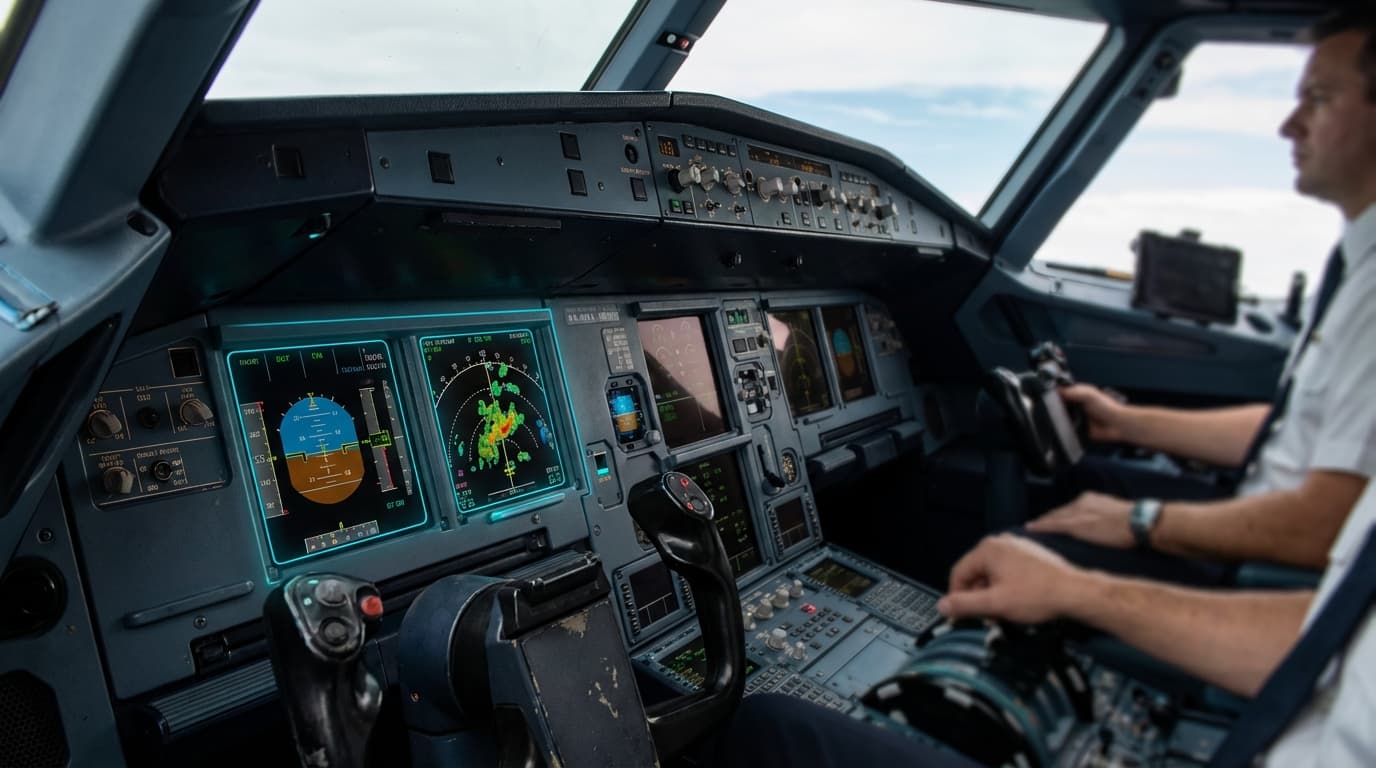
ML Weather & Turbulence Nowcasting
Machine learning-based weather and turbulence nowcasting represents a significant advancement in aviation meteorology, addressing the critical challenge of predicting atmospheric hazards with minimal lead time. Traditional weather forecasting models, while effective for longer-range predictions, often struggle with the rapid evolution of localized phenomena such as clear-air turbulence, convective storms, icing conditions, and wind shear events that can develop within minutes. This solution employs sophisticated machine learning algorithms—including neural networks, random forests, and ensemble methods—to process and synthesize diverse data streams in near-real-time. By integrating inputs from weather radar networks, geostationary and polar-orbiting satellites, Aircraft Meteorological Data Relay (AMDAR) and Aircraft Communications Addressing and Reporting System (ACARS) transmissions, and pilot reports (PIREPs), these systems create a comprehensive, continuously updated picture of atmospheric conditions. The algorithms learn to recognize subtle patterns and correlations across these heterogeneous data sources that human forecasters or conventional numerical models might miss, enabling predictions with horizons ranging from minutes to a few hours—the critical "nowcast" window where actionable decisions must be made.
The aviation industry faces substantial operational and safety challenges from unexpected weather phenomena, with turbulence alone causing hundreds of injuries annually and costing airlines millions in delays, diversions, and aircraft inspections. Traditional turbulence forecasts often lack the spatial and temporal resolution needed for tactical flight planning, forcing pilots to rely on conservative routing that increases fuel consumption and flight times. Machine learning nowcasting systems address these limitations by providing granular, frequently updated hazard assessments that enable dynamic route optimization. Airlines can use these predictions to adjust flight paths in real-time, avoiding developing storm cells or turbulent zones while minimizing deviations from optimal routes. This capability is particularly valuable for managing convective weather during summer months and clear-air turbulence in jet stream regions, both of which are notoriously difficult to predict using conventional methods. The fusion of multiple data sources also helps overcome the limitations of any single observation system, such as radar's inability to detect clear-air turbulence or satellite imagery's challenges in penetrating thick cloud layers.
Early implementations of machine learning nowcasting systems are already showing promise in operational environments, with several aviation weather service providers and research institutions developing prototype systems. These platforms typically update predictions every few minutes, providing flight dispatchers and pilots with continuously refreshed hazard maps that can be accessed through electronic flight bags or ground-based planning tools. The technology has demonstrated particular effectiveness in reducing turbulence-related injuries on flights equipped with real-time data links, as crews can receive updated forecasts during flight and adjust altitude or routing accordingly. As the volume of aircraft-based observations continues to grow—with modern fleets transmitting atmospheric data automatically—the accuracy and resolution of these nowcasting systems are expected to improve substantially. This trend aligns with broader industry movements toward predictive operations and data-driven decision-making, positioning machine learning weather nowcasting as an essential component of next-generation air traffic management systems and contributing to the vision of more resilient, efficient, and safer aviation operations in an era of increasing weather volatility.
Related Organizations

Developed the Graphical Turbulence Guidance (GTG) product and researches AI applications for convective weather prediction.

Crowdsources turbulence data from iPad accelerometers on aircraft to generate real-time turbulence maps using ML.

Operates proprietary radar satellites and uses generative AI ('Gale') for weather intelligence.


A data and insights company that acquired Spensa Technologies, the developers of the Z-Trap.

Manages the 'Turbulence Aware' platform, a global data repository enabling airlines to share anonymized turbulence data.
IT subsidiary of Lufthansa Group developing 'NetLine/Ops ++' which includes AI-driven disruption management.

A major provider of In-Flight Entertainment and Connectivity (IFEC) systems for commercial airlines.

Uses a constellation of nanosatellites to collect radio occultation data, fed into ML models for forecasting.

Developing foundation models for robotics (Project GR00T) and vision-language models like VILA.
Supporting Evidence
Research this in Signals
Signals turns a topic into a sourced research record you can inspect and rerun. Your first scan is free, and this one starts with ML Weather & Turbulence Nowcasting already loaded, so edit it or scan as is.