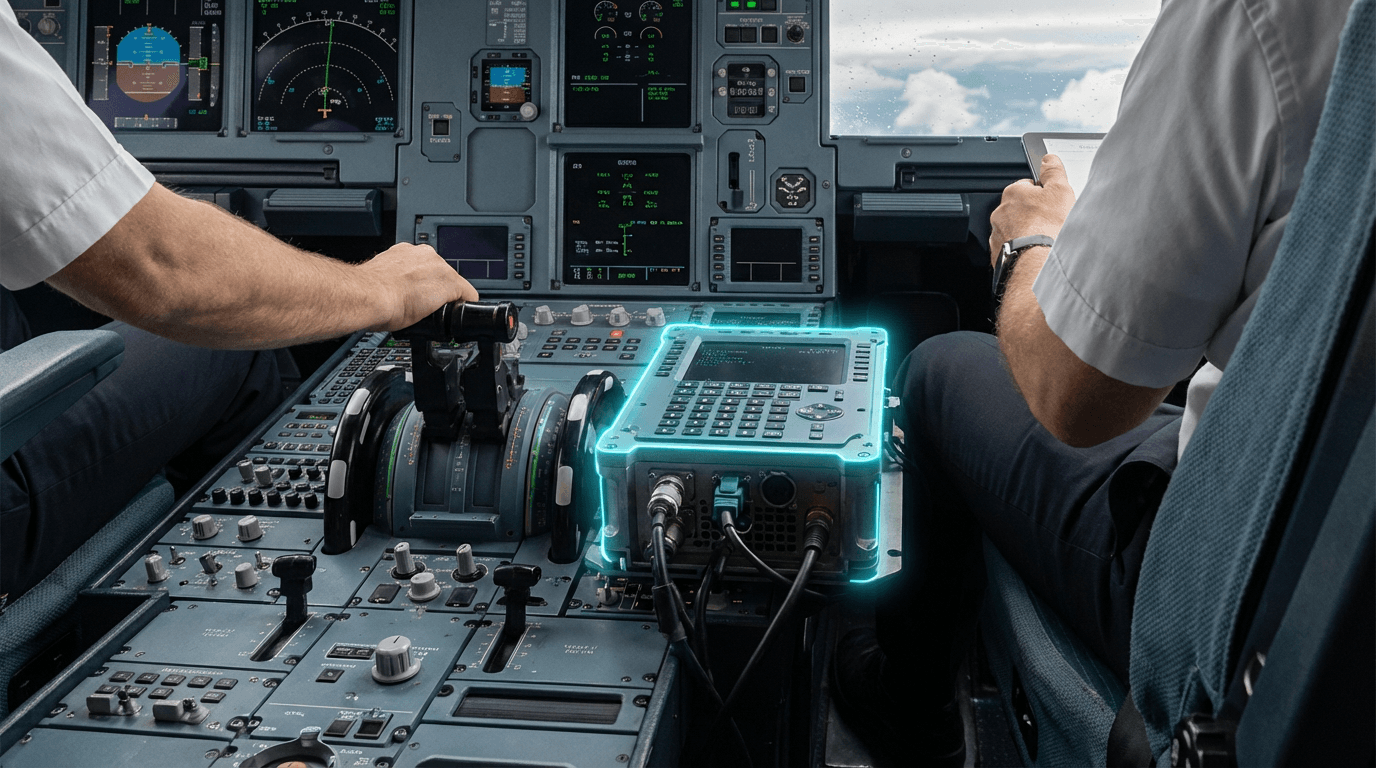
Edge AI for Real-Time Onboard Decisions
Edge AI for real-time onboard decisions represents a fundamental shift in how aircraft process critical flight data and make autonomous decisions. Unlike traditional cloud-based artificial intelligence systems that require constant connectivity and introduce latency through data transmission, edge AI deploys machine learning models directly onto aircraft avionics hardware. This architecture enables inference—the process of applying trained neural networks to new data—to occur locally within milliseconds, a crucial capability for safety-critical functions where delays could prove catastrophic. The technology relies on specialized hardware accelerators, such as field-programmable gate arrays (FPGAs) or application-specific integrated circuits (ASICs), designed to execute neural network computations efficiently within the strict power, weight, and thermal constraints of aerospace environments. These processors must perform complex matrix operations and activation functions while meeting aviation-grade reliability standards, often requiring redundant processing paths and built-in error detection mechanisms.
The aerospace industry faces mounting pressure to enhance aircraft autonomy, improve operational safety, and reduce pilot workload, particularly as air traffic density increases and aircraft systems grow more complex. Edge AI addresses these challenges by enabling real-time collision avoidance systems that can process sensor data from radar, lidar, and cameras to detect potential conflicts and execute evasive maneuvers faster than human reaction times allow. Similarly, onboard anomaly detection systems can continuously monitor thousands of aircraft parameters, identifying subtle patterns that indicate emerging mechanical issues or system degradation before they escalate into failures. This capability transforms maintenance from reactive to predictive, potentially preventing in-flight emergencies and reducing unscheduled downtime. However, integrating learned components into safety-critical avionics introduces unprecedented certification challenges. Aviation authorities require that software meet rigorous DO-178C standards and hardware comply with DO-254 processes, frameworks originally designed for deterministic systems with fully traceable logic. Neural networks, by contrast, operate as statistical approximators whose decision boundaries emerge from training data rather than explicit programming, complicating traditional verification approaches and demanding new assurance methodologies.
Early implementations of edge AI in aviation have focused on non-safety-critical applications, such as cabin service optimization and predictive maintenance alerts, allowing the industry to gain experience with the technology before deploying it in flight-critical roles. Research programs are now exploring hybrid architectures that combine traditional rule-based systems with neural network components, providing fallback mechanisms and interpretability layers that satisfy certification requirements. A significant concern involves ensuring model robustness against adversarial inputs—subtle perturbations to sensor data that could cause misclassification—and managing dataset drift, where the statistical properties of operational data diverge from training conditions over an aircraft's decades-long service life. As regulatory frameworks evolve to accommodate machine learning in certified systems and hardware accelerators become more capable, edge AI is positioned to enable increasingly sophisticated autonomous functions, from automated taxi operations to advanced envelope protection systems that prevent loss-of-control accidents. This trajectory aligns with broader industry movements toward urban air mobility and autonomous cargo operations, where onboard intelligence becomes not merely advantageous but essential to safe operation.
Related Organizations

A leading provider of secure, ruggedized mission-critical processing subsystems for aerospace and defense.

Developing foundation models for robotics (Project GR00T) and vision-language models like VILA.

Provides safety-critical graphics and compute drivers for avionics.

Curtiss-Wright Defense Solutions
United States · Company
Supplier of ruggedized embedded computing modules for aerospace applications.

Specialist in open architecture computing and electronic systems for aerospace and defense (now part of AMETEK).

Provider of rugged embedded systems for military, aerospace, and space applications.

Develops the RDNA architecture with Ray Accelerators, powering ray tracing on PC and current-gen consoles (PS5, Xbox Series X).

Developer of the INTEGRITY-178 tuMP RTOS, focusing on high-assurance security and DO-178C compliance for avionics.


Manufacturer of thermal imaging cameras and sensors used on monitoring drones.
Supporting Evidence
Research this in Signals
Signals turns a topic into a sourced research record you can inspect and rerun. Your first scan is free, and this one starts with Edge AI for Real-Time Onboard Decisions already loaded, so edit it or scan as is.