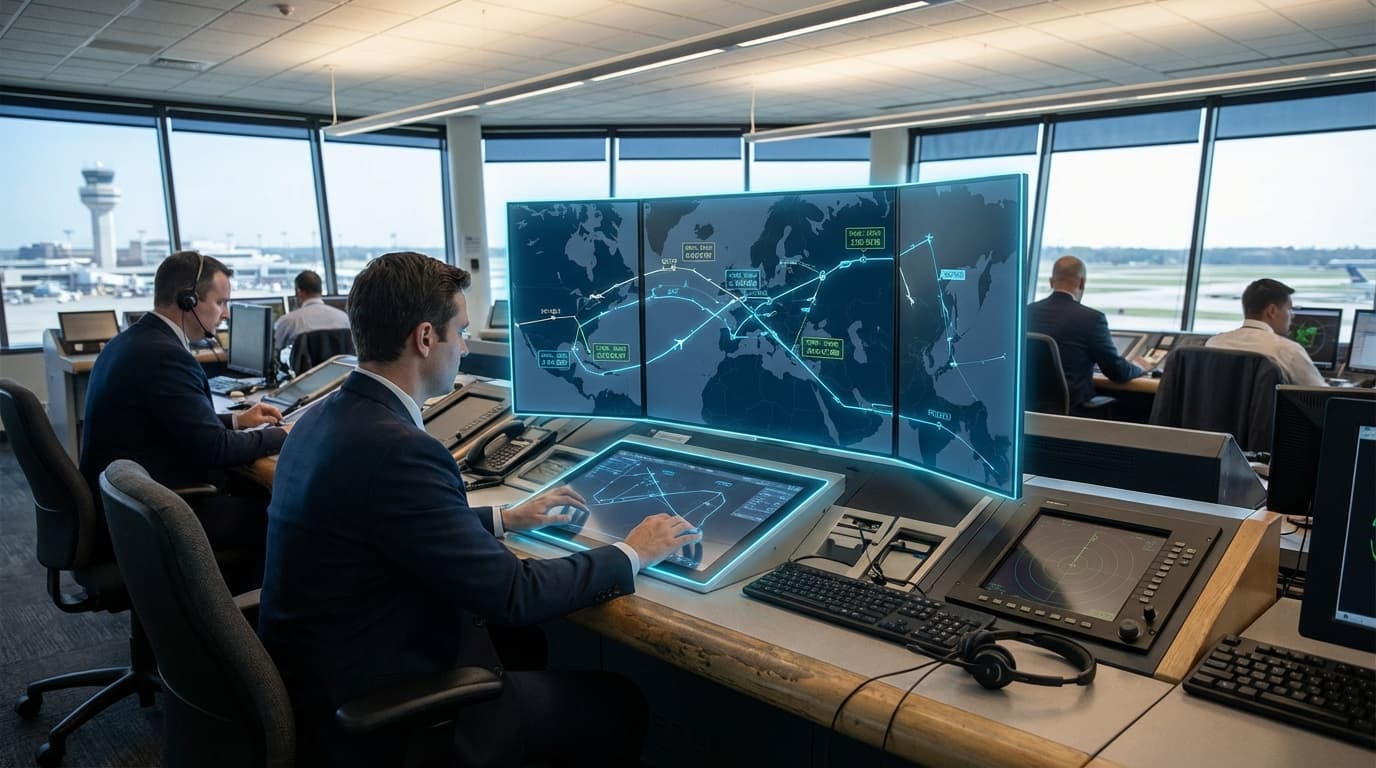
Trajectory-Based Operations (4D Trajectory Management)
Trajectory-Based Operations represents a fundamental shift in how air traffic is managed, moving from traditional clearance-based control to a collaborative, intent-driven system built around four-dimensional flight paths. Unlike conventional air traffic management, which relies on controllers issuing discrete clearances for altitude, heading, and speed, this approach treats each flight as a continuous trajectory defined by latitude, longitude, altitude, and crucially, time. The system works by establishing a shared digital representation of each aircraft's intended path from gate to gate, which is continuously updated and synchronized between the aircraft's flight management system, the airline's operations center, and air navigation service providers. This shared 4D trajectory becomes the foundation for all planning and coordination decisions, enabling automated conflict detection, optimized sequencing, and dynamic route adjustments that account for weather, traffic density, and airport capacity constraints. The technical architecture depends on robust data link communications, standardized trajectory exchange protocols, and sophisticated ground-based automation tools that can process thousands of trajectories simultaneously while maintaining safety separation standards.
The aviation industry faces mounting pressure to accommodate growing traffic volumes within increasingly congested airspace, particularly around major metropolitan areas and busy terminal zones. Traditional air traffic control methods, which evolved in an era of lower traffic density and limited computing power, struggle to deliver the precision and efficiency modern operations demand. Flights often spend excessive time in holding patterns, follow circuitous routes to maintain separation, and experience unpredictable delays that cascade through airline networks. Trajectory-Based Operations addresses these limitations by enabling far more precise coordination of aircraft movements. When controllers and automation systems can see not just where an aircraft is, but exactly where it intends to be at specific future times, they can sequence arrivals with minimal spacing buffers, identify optimal merge points for converging flows, and proactively adjust trajectories to avoid conflicts before they develop. This predictability extends beyond individual flights to benefit entire airline networks, as more reliable arrival times reduce the need for schedule padding and improve connection reliability. The approach also supports more efficient fuel burn profiles, as aircraft can fly closer to their optimal speeds and altitudes rather than accepting tactically imposed restrictions.
Early implementations of trajectory-based concepts are already underway in several regions, with Europe's SESAR program and the FAA's NextGen initiative both incorporating 4D trajectory management as a core capability. Initial deployments focus on specific operational scenarios such as arrival management in terminal airspace, where the benefits of time-based metering are most immediately apparent. Airlines equipped with compatible avionics can negotiate preferred trajectories that better match their operational needs, while controllers gain decision support tools that suggest optimal clearances based on predicted aircraft positions. Research suggests that mature trajectory-based systems could increase effective airspace capacity by 10-15 percent while simultaneously reducing fuel consumption and emissions through more direct routing and continuous descent approaches. However, realizing the full potential requires substantial investment in ground infrastructure, aircraft equipage, and procedural harmonization across borders. As air traffic continues its post-pandemic recovery and long-term growth trajectory, the aviation industry's ability to scale capacity without proportional increases in delays or environmental impact will increasingly depend on this more intelligent, data-driven approach to managing the sky. The transition represents not just a technological upgrade but a fundamental reimagining of how aircraft, airlines, and air traffic services collaborate to use shared airspace as efficiently and safely as possible.
Related Organizations

Coordinates the research and implementation of the Single European Sky ATM Research, with TBO as a central pillar.
A subsidiary of Airbus providing Air Traffic Flow Management (ATFM) solutions that enable trajectory-based operations.

Leads the SABERS (Solid-state Architecture Batteries for Enhanced Rechargeability and Safety) project.

Partner in the EuroQCI initiative, working on the space segment of the European quantum communication infrastructure.

Global aerospace company and manufacturer of the Starliner spacecraft.
DSNA (Direction des Services de la Navigation Aérienne)
France · Government Agency
The French ANSP, a major partner in SESAR, implementing 4D trajectory trials in one of Europe's busiest airspaces.


Swiss ANSP pioneering the 'Virtual Centre' concept and trajectory-based operations in complex alpine airspace.

Implements TBO in the Asia-Pacific region through the CARATS (Collaborative Actions for Renovation of Air Traffic Systems) initiative.

Defense company producing the Barracuda advanced camouflage systems.
Supporting Evidence
Research this in Signals
Signals turns a topic into a sourced research record you can inspect and rerun. Your first scan is free, and this one starts with Trajectory-Based Operations (4D Trajectory Management) already loaded, so edit it or scan as is.