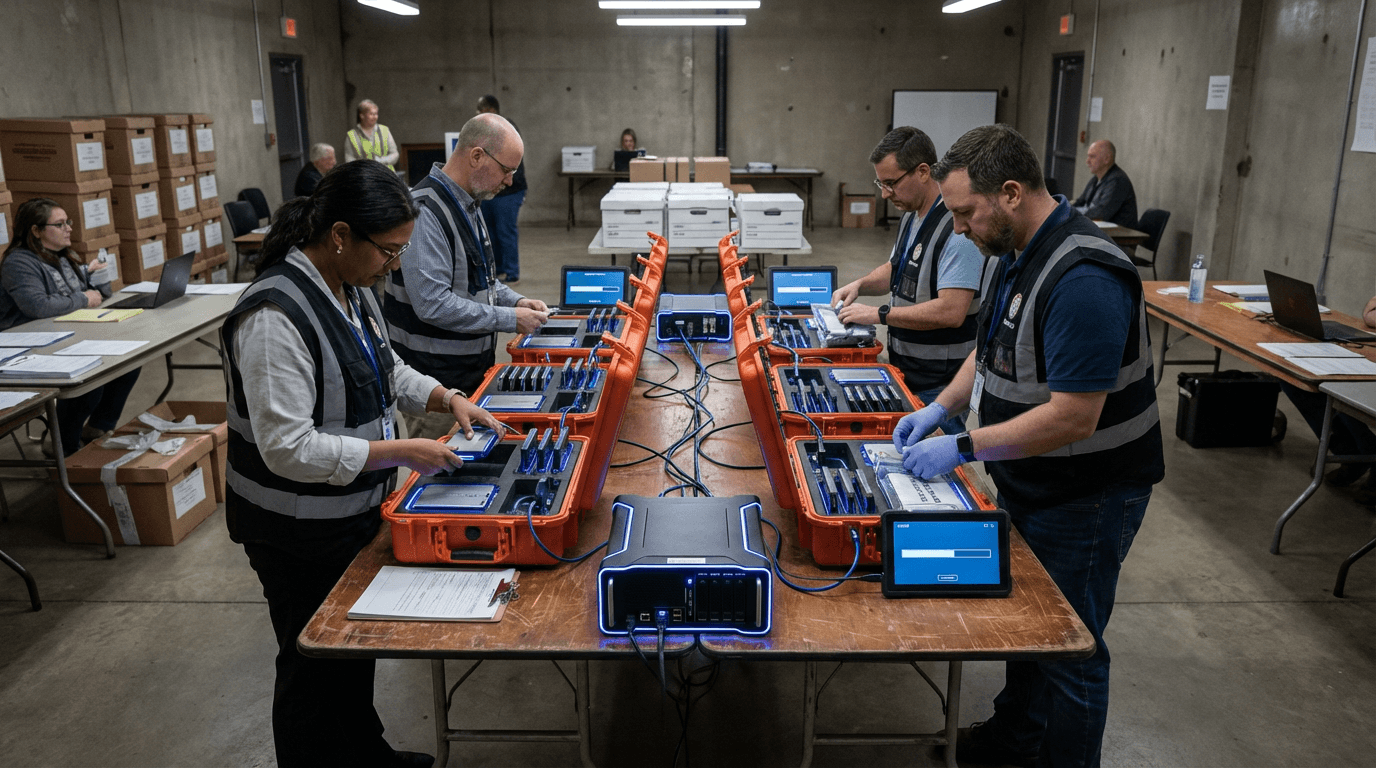
Air-Gapped Results Transfer Kits
In democratic systems, the integrity of election results depends critically on preventing unauthorized access or tampering during the vote-counting process. Traditional approaches have relied on network-connected systems to transmit tabulation data from polling stations to central counting facilities, creating potential vulnerabilities to cyber intrusion, data manipulation, or system compromise. Air-gapped results transfer kits address this challenge by physically isolating the transfer of election artifacts—such as vote tallies, audit logs, and cryptographic signatures—from any network infrastructure. These kits typically incorporate write-once optical media (such as WORM DVDs or specialized memory cards with hardware write-protection), tamper-evident sealed containers with unique serial numbers, and controlled USB bridges that enforce one-way data flow. The underlying principle is simple but powerful: by eliminating network connectivity during the most sensitive phase of vote counting, these systems remove entire categories of remote attack vectors and force any potential interference to require physical access, which is far easier to monitor, audit, and deter.
The adoption of air-gapped transfer protocols represents a fundamental shift in how election administrators balance operational efficiency against security requirements. While networked transmission offers speed and convenience, it introduces dependencies on complex security infrastructure—firewalls, encryption protocols, intrusion detection systems—each of which can fail or be compromised. Air-gapped kits formalize what election security experts call "sneakernet" procedures, transforming ad-hoc physical transfer practices into standardized, auditable workflows with clear chain-of-custody documentation. This approach enables jurisdictions to maintain high security standards even when lacking sophisticated cybersecurity resources or expertise. The kits also support hybrid verification models, where results transmitted electronically can be independently validated against physically transferred artifacts, providing redundancy without requiring full duplication of infrastructure. For election officials facing heightened scrutiny and evolving threat landscapes, these systems offer a tangible, comprehensible security measure that can be explained to stakeholders and verified through direct observation.
Several jurisdictions have begun piloting air-gapped transfer protocols as part of broader election security modernization efforts, particularly in contexts where public confidence in digital systems remains fragile. The technology aligns with growing recognition among election security researchers that "defense in depth" strategies—combining multiple independent safeguards rather than relying on any single protective measure—provide the most robust protection against both technical failures and deliberate attacks. As concerns about election infrastructure security continue to drive policy discussions worldwide, air-gapped transfer kits represent a practical middle ground: they preserve the efficiency gains of digital vote tabulation while imposing physical constraints that make large-scale, undetected manipulation significantly more difficult. This approach also complements emerging trends in risk-limiting audits and end-to-end verifiable voting systems, which similarly prioritize transparency and physical verification over trust in opaque technical systems. By grounding digital processes in physical artifacts that can be independently examined, air-gapped transfer protocols help bridge the gap between technological capability and democratic legitimacy.
Related Organizations

Manufacturer of high-security, hardware-encrypted USB flash drives and data storage.

Specializes in data diode technology and cross-domain solutions.

Manufacturer of hardware-encrypted USB drives and storage devices with keypad authentication.

OPSWAT
United States · Company
Critical infrastructure protection cybersecurity company.

European provider of cybersecurity solutions, focusing on network segmentation and data diodes.

Nonprofit responsible for the CIS Controls and the Elections Infrastructure Information Sharing and Analysis Center (EI-ISAC).

Provider of advanced encryption solutions for portable storage media.

Cybersecurity company known for high-end security solutions including data diodes.

A non-partisan organization advocating for legislation and regulation that promotes accuracy, transparency, and verifiability of elections.
Supporting Evidence
Research this in Signals
Signals turns a topic into a sourced research record you can inspect and rerun. Your first scan is free, and this one starts with Air-Gapped Results Transfer Kits already loaded, so edit it or scan as is.