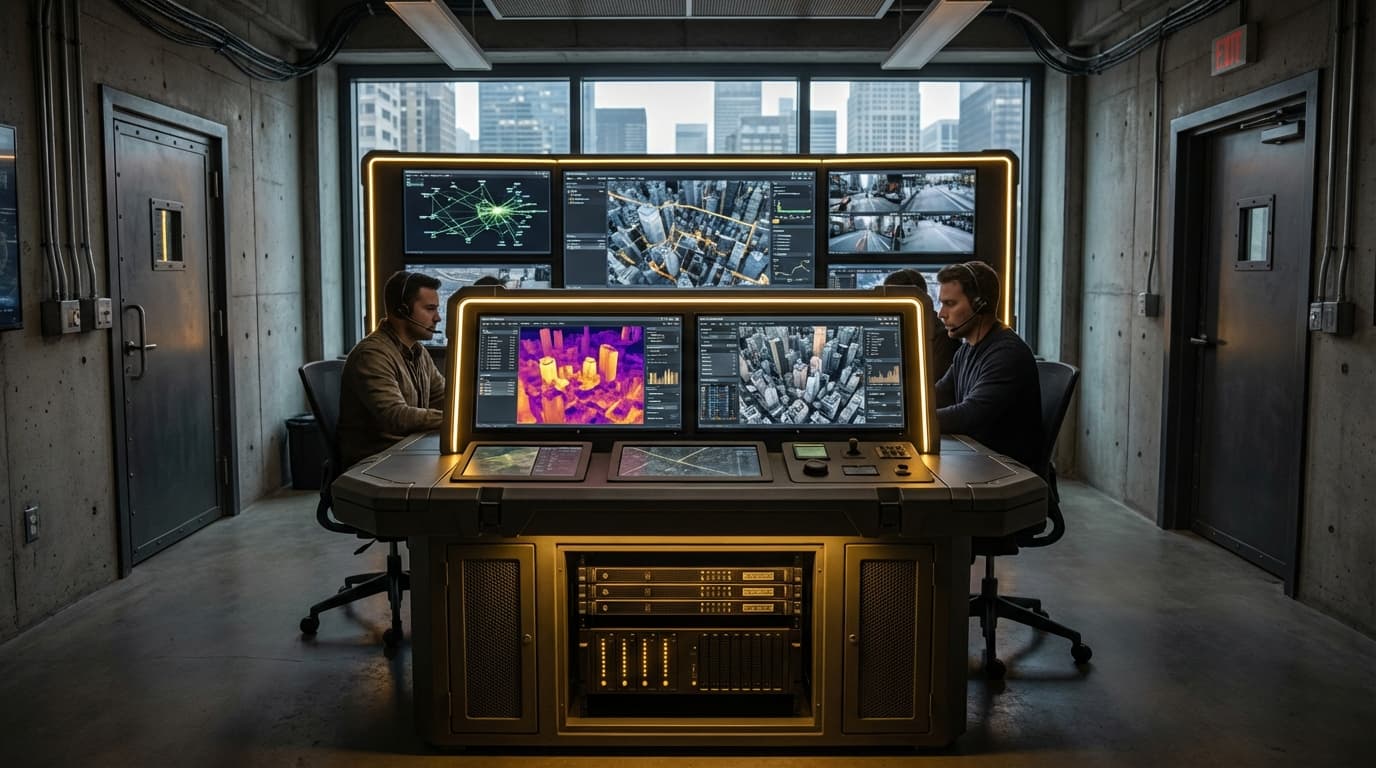
Urban Security & Megacity Operations Platforms
Urban Security & Megacity Operations Platforms represent a convergence of advanced sensing technologies, artificial intelligence, and integrated command systems designed to manage the unprecedented complexity of modern megacities. These platforms synthesize data from diverse sources—including surveillance cameras, traffic sensors, social media feeds, emergency call systems, and environmental monitors—into unified operational pictures that enable coordinated responses across multiple agencies and jurisdictions. At their technical core, these systems employ sophisticated algorithms for pattern recognition, anomaly detection, and predictive modeling, processing vast streams of real-time data to identify potential security threats, public safety incidents, or infrastructure failures before they escalate. The platforms typically integrate geographic information systems with dynamic crowd modeling capabilities, allowing operators to visualize how people, vehicles, and resources move through urban spaces and predict how interventions might affect these flows.
The fundamental challenge these platforms address is the growing difficulty of maintaining security and operational efficiency in cities where populations exceed ten million people and traditional command-and-control approaches become overwhelmed by scale and complexity. Megacities face unique vulnerabilities: dense populations create cascading risks where single incidents can rapidly affect millions, while the sheer volume of daily activities makes distinguishing genuine threats from routine urban noise increasingly difficult. These platforms enable what military strategists call "common operating pictures," breaking down information silos between police, fire services, emergency medical teams, transportation authorities, and utility providers. By coordinating responses across these traditionally separate domains, cities can respond more effectively to everything from terrorist attacks and natural disasters to major traffic accidents and public health emergencies. The systems also support resource optimization, ensuring that limited emergency assets are deployed where they can have maximum impact.
Several major metropolitan areas have deployed variants of these platforms, with implementations ranging from integrated traffic and emergency management centers to comprehensive urban operations hubs that monitor everything from air quality to social media sentiment. Research suggests these systems can significantly reduce emergency response times and improve coordination during major incidents, though their deployment raises important questions about privacy, surveillance, and the balance between security and civil liberties. Industry analysts note a growing emphasis on incorporating privacy-preserving technologies and establishing clear governance frameworks that define when and how these powerful capabilities can be employed. As urbanization accelerates globally and more cities cross the megacity threshold, these platforms are likely to become standard infrastructure, evolving to incorporate emerging technologies like autonomous vehicles, drone networks, and advanced biometric systems while grappling with the ongoing challenge of maintaining democratic oversight and public trust.
Related Organizations

A global leader in public safety and enterprise security.

Leader in body-worn cameras for law enforcement, increasingly integrating AI for situational awareness and threat detection.

A public safety technology company formerly known as ShotSpotter.

Multinational company designing and building electrical systems and providing services for the aerospace, defence, transportation and security markets.


Elbit Systems
Israel · Company
Major defense contractor developing AI-driven autonomous swarms (Legion-X) and target acquisition systems.

Unified security platform blending IP security, video surveillance, and access control.

Hexagon AB
Sweden · Company
A global leader in sensor, software, and autonomous solutions, providing reality capture for digital twins.

Develops Vector Annealing, a quantum-inspired simulated annealing service running on high-performance vector supercomputers.

Supporting Evidence
Research this in Signals
Signals turns a topic into a sourced research record you can inspect and rerun. Your first scan is free, and this one starts with Urban Security & Megacity Operations Platforms already loaded, so edit it or scan as is.