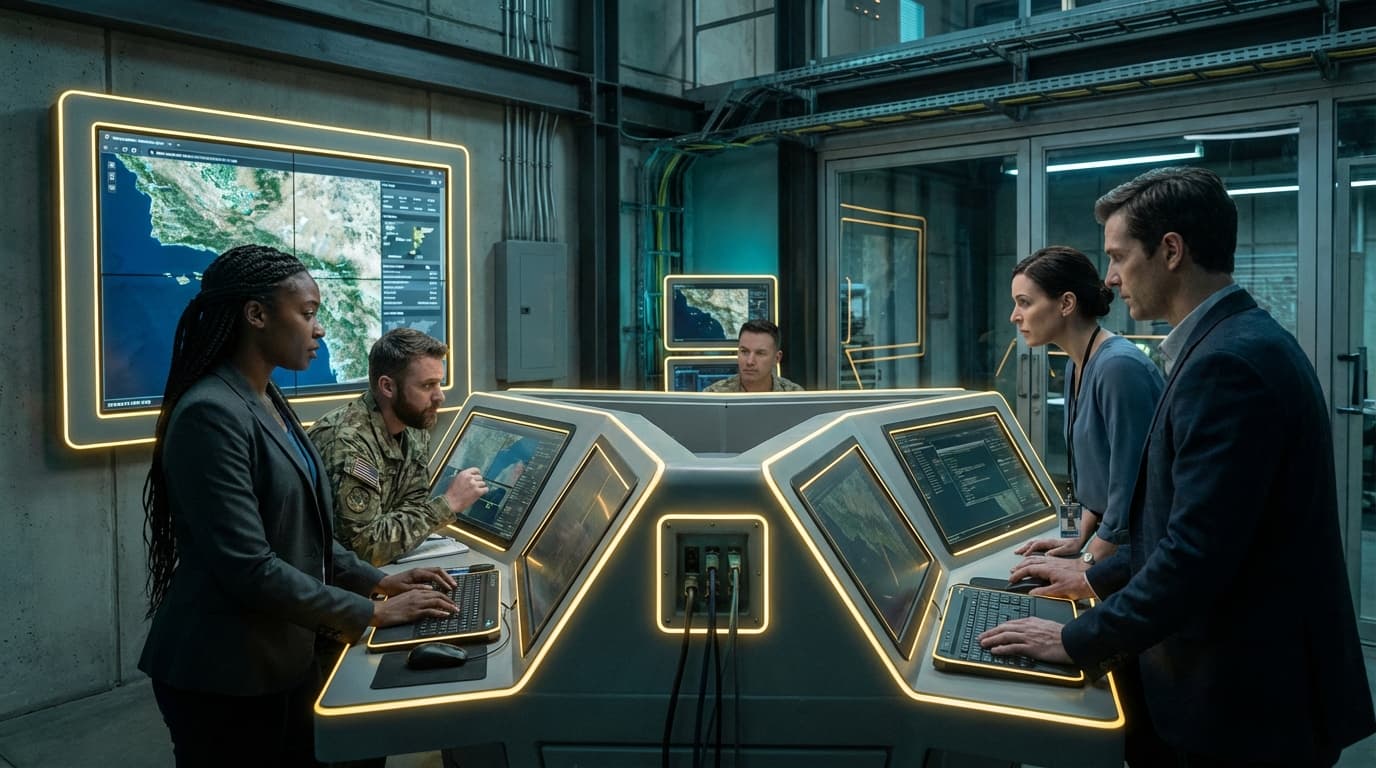
Command Operating System Platforms
Command Operating System platforms are integrated web-based workspaces that unify live operational data, agentic workflows (AI-driven automated processes), decision intelligence, and collaborative authoring into a single resilient environment for defense operations planning and execution. These platforms use a card-based information architecture where information is stored in cards that can be accessed, moved, and embedded anywhere, with real-time collaboration and synchronization across all cards. They enable importing traditional files and converting them into structured cards, and can generate various deliverables including slide decks, timelines, charts, and maps. The platforms operate across classified networks including NIPR, SIPR, JWICS, and coalition networks, providing a continuously updated operational picture that ensures commanders and staffs operate from the same live dataset. AI-enabled workflows transform static products into living systems that anticipate needs and adapt in real time, while resilient, DDIL-ready (Disconnected, Disrupted, Intermittent, and Limited bandwidth) architecture ensures continuity and synchronization across degraded networks, distributed teams, and dynamic threats. These systems enable commands to decide faster, synchronize better, and operate continuously under contested conditions, achieving significant time savings through automation of coordination, analysis, and updates.
This innovation addresses the need for unified command and control systems that can operate across multiple security classifications and network conditions, where traditional planning tools are fragmented and don't adapt to changing operational needs. By providing a single integrated workspace with real-time synchronization, these platforms enable faster decision-making and better coordination. Defense technology companies are developing and deploying these systems.
The technology is particularly significant for modern military operations, where speed of decision-making and synchronization across echelons can determine mission success. As operations become more distributed and contested, integrated command platforms become increasingly critical. However, ensuring security, managing complexity, and maintaining performance under degraded conditions remain challenges. The technology represents an important evolution in command and control systems, with platforms like Onebrief already operational and demonstrating significant impact, including saving hundreds of hours in exercises and enabling months of work to be completed in days. Command Operating System platforms are mature technology that is transforming how military commands plan, decide, and operate.
Related Organizations

Builds software that empowers organizations to integrate their data, decisions, and operations (Foundry and AIP).

Develops Lattice OS, an AI-powered operating system that fuses sensor data to automate command and control across autonomous systems.
Major defense contractor developing Reciprocal Quantum Logic (RQL) for cryogenic computing.

Builds mission engineering software that uses AI to process data for decision advantage in defense and national security.

A key contractor for the Advanced Battle Management System (ABMS), developing the connectivity and software layers.
Multinational company designing and building electrical systems and providing services for the aerospace, defence, transportation and security markets.
Defense technology company building Hivemind, an AI pilot for autonomous drone swarms and aircraft operating without GPS or comms.

Provides AI-powered decision dominance solutions that model complex environments for military planning.
A technology company specializing in directed-energy weapons, unmanned systems, and satellite communications.

Develops AI/ML software for the US Intelligence Community to modernize mission applications and data visualization.

Enterprise AI software provider with a dedicated suite for predictive maintenance across energy, defense, and manufacturing.
Supporting Evidence
Research this in Signals
Signals turns a topic into a sourced research record you can inspect and rerun. Your first scan is free, and this one starts with Command Operating System Platforms already loaded, so edit it or scan as is.