Emergency Response & Civil Defense
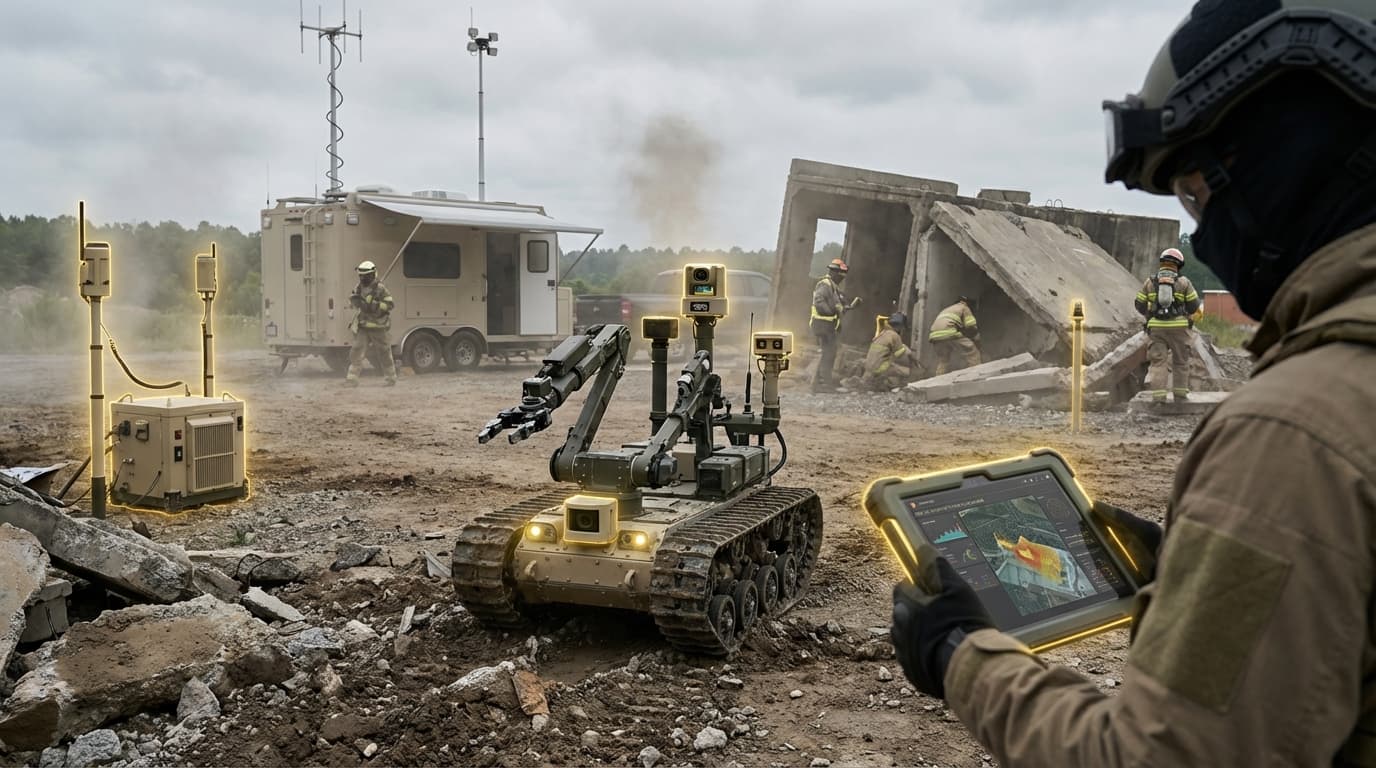
Emergency response and civil defense technologies represent a critical convergence of robotics, artificial intelligence, and predictive analytics designed to protect civilian populations during crises. At the technical core, these systems integrate rapid-deployment robotic platforms capable of operating in environments too dangerous for human responders—collapsed structures, chemical spills, radiation zones, and flood-affected areas. These robots employ advanced sensor arrays including thermal imaging, gas detection, LIDAR mapping, and communication relay systems to locate survivors, assess structural integrity, and establish situational awareness. Simultaneously, disaster prediction systems synthesize vast streams of data from seismic monitoring networks, meteorological satellites, ocean buoys, and increasingly, social media sentiment analysis and mobile phone location patterns. Machine learning algorithms process these diverse inputs to identify precursor signals of earthquakes, tsunamis, hurricanes, and even civil unrest, generating probabilistic forecasts that enable preemptive action. The integration of edge computing allows these systems to function even when traditional communication infrastructure fails, with distributed processing nodes maintaining operational continuity during the chaos of actual disasters.
The fundamental challenge these technologies address is the critical time gap between disaster onset and effective response—a window measured in hours or even minutes that determines survival outcomes for thousands. Traditional emergency response has been hampered by information scarcity, hazardous access conditions, and the difficulty of coordinating resources across fragmented jurisdictions. Rapid-deployment robotics overcome physical barriers that delay human responders, providing eyes and ears in contaminated zones while simultaneously delivering emergency supplies, establishing communication links, or performing preliminary structural assessments. Predictive systems transform emergency management from reactive to proactive, enabling authorities to pre-position medical supplies, evacuate vulnerable populations before impact, and optimize the deployment of limited response assets. This shift is particularly valuable in resource-constrained environments where every ambulance, fire truck, and trained responder must be allocated with precision. Furthermore, these technologies enable new coordination models, creating shared operational pictures that unite municipal, regional, and national response agencies with real-time data rather than fragmented radio reports.
Current deployments span from established programs in earthquake-prone regions of Japan and California, where seismic early-warning systems now provide seconds to minutes of advance notice, to pilot programs testing drone swarms for wildfire monitoring and robotic systems for urban search-and-rescue training exercises. Military and civilian agencies increasingly collaborate on dual-use platforms, with technologies developed for battlefield reconnaissance finding application in hurricane aftermath assessment. The integration of these capabilities into broader smart city infrastructure represents a growing trend, with sensor networks originally deployed for traffic management or environmental monitoring now contributing to disaster resilience. As climate change intensifies the frequency and severity of extreme weather events, and as urbanization concentrates vulnerable populations in megacities, the trajectory points toward increasingly automated, AI-driven emergency response systems that can scale beyond human coordination capacity. The evolution toward predictive civil defense—where communities receive hours or days of warning rather than minutes—promises to fundamentally reshape how societies prepare for and survive catastrophic events.
Related Organizations

Famous for Spot and Atlas, now integrating reinforcement learning for dynamic movement.

Administers grants (BRIC, HMGP) that fund property acquisitions (buyouts) and community resilience projects.

Manufacturer of thermal imaging cameras and sensors used on monitoring drones.


Resilience-as-a-Service solution for disaster prediction.

US drone manufacturer specializing in autonomous flight and 3D scan software.


Hexagon AB
Sweden · Company
A global leader in sensor, software, and autonomous solutions, providing reality capture for digital twins.

A global leader in public safety and enterprise security.

Develops highly mobile, dexterous industrial robots and exoskeletons like the Guardian XO.

Operates the world's largest autonomous drone delivery network, specializing in medical supplies and e-commerce delivery.
Supporting Evidence
Research this in Signals
Signals turns a topic into a sourced research record you can inspect and rerun. Your first scan is free, and this one starts with Emergency Response & Civil Defense already loaded, so edit it or scan as is.