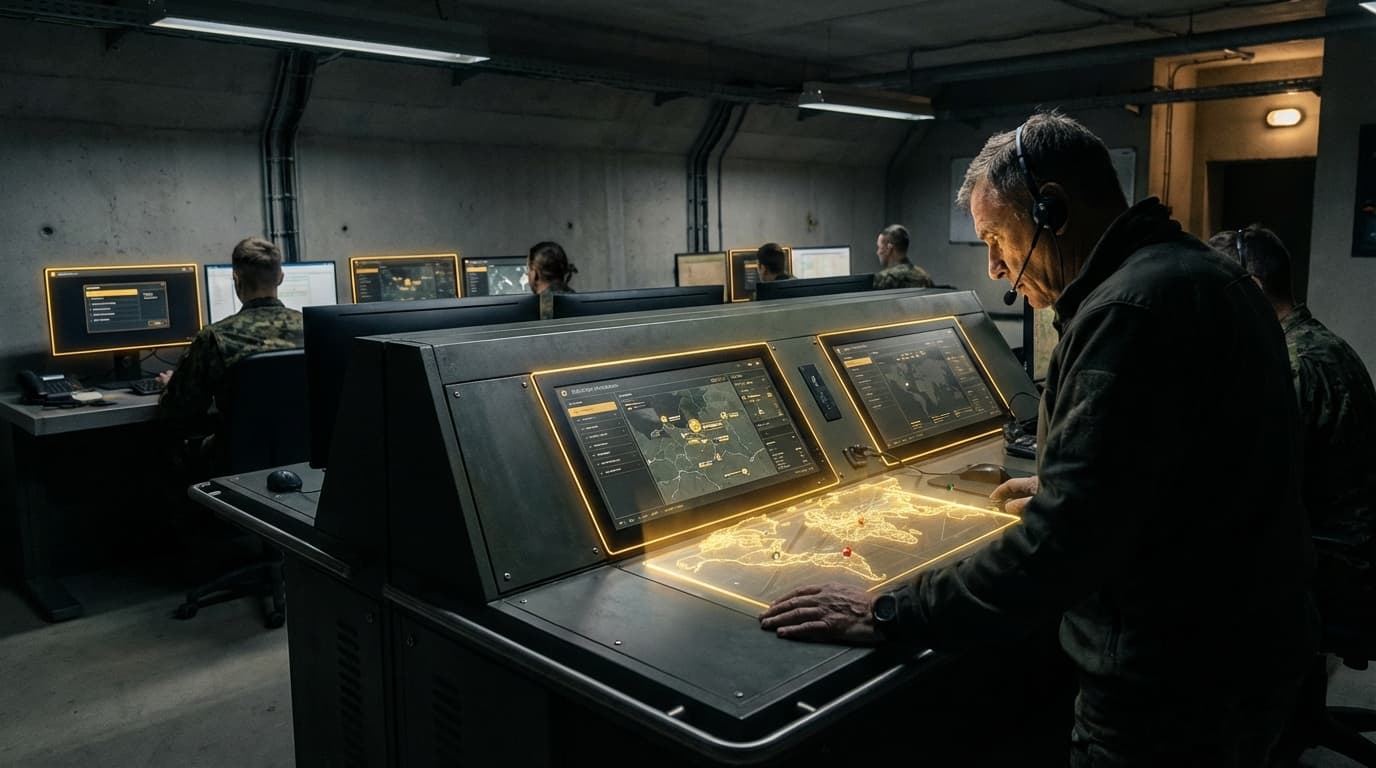
AI-Native Command & Control
AI-Native Command & Control represents a fundamental shift in military decision-making architecture, moving beyond traditional software tools that merely assist human operators to systems where artificial intelligence serves as the foundational layer for strategic and tactical planning. Unlike legacy command systems that treat AI as an add-on feature, these platforms are built from the ground up with machine learning models that continuously process and synthesize multiple data streams—satellite imagery, signals intelligence, weather patterns, supply chain logistics, and threat assessments—into coherent operational pictures. The technology employs advanced neural networks trained on historical military operations, wargaming scenarios, and real-world conflict data to identify patterns and generate strategic options that account for the complex interdependencies between terrain, logistics, timing, and adversary capabilities. These systems can process vastly more variables simultaneously than human planners, recalculating optimal courses of action in seconds as battlefield conditions evolve.
The defense sector faces mounting challenges in managing the speed and complexity of modern warfare, where decisions must be made across multiple domains—land, sea, air, space, and cyber—often within compressed timeframes that exceed human cognitive bandwidth. Traditional command and control systems struggle with information overload, siloed data sources, and the inability to rapidly adapt plans when assumptions change. AI-Native Command & Control addresses these limitations by providing unified operational frameworks that can ingest disparate intelligence sources, identify emerging threats before they fully materialize, and automatically generate contingency plans for multiple scenarios simultaneously. The integration of automated red-teaming capabilities—where AI systems actively challenge and probe proposed strategies by simulating adversarial responses—helps commanders identify vulnerabilities and blind spots that might otherwise go unnoticed until actual engagement. This adversarial testing approach ensures that plans are robust against adaptive opponents who may employ unconventional tactics or exploit unexpected weaknesses.
Several military organizations have begun piloting these systems in training exercises and simulation environments, with early results suggesting significant improvements in decision quality and response times during complex, multi-domain operations. Current applications focus primarily on logistics optimization, where AI can coordinate supply chains across vast distances while accounting for contested environments, and mission planning, where systems generate multiple courses of action ranked by probability of success and resource requirements. Research suggests these platforms are particularly valuable in scenarios involving distributed operations, where traditional centralized command structures become bottlenecks. As geopolitical tensions increase and potential adversaries develop their own AI-enhanced capabilities, defense establishments are investing heavily in these technologies to maintain decision-making advantages. The trajectory points toward increasingly autonomous systems capable of managing routine operational decisions while escalating only critical choices to human commanders, fundamentally reshaping the relationship between human judgment and machine intelligence in military operations.
Related Organizations

Builds mission engineering software that uses AI to process data for decision advantage in defense and national security.

Defense technology company building Hivemind, an AI pilot for autonomous drone swarms and aircraft operating without GPS or comms.


Major defense contractor developing Reciprocal Quantum Logic (RQL) for cryogenic computing.

A metaverse technology company known for SpatialOS, enabling massive simulations with thousands of concurrent agents.

Builds NLP and computer vision tools to analyze foreign text and data for intelligence and mission planning.

Enterprise AI software provider with a dedicated suite for predictive maintenance across energy, defense, and manufacturing.

Provides data infrastructure for AI, including RLHF (Reinforcement Learning from Human Feedback) and comprehensive model evaluation services.

A technology company specializing in directed-energy weapons, unmanned systems, and satellite communications.
Supporting Evidence
Research this in Signals
Signals turns a topic into a sourced research record you can inspect and rerun. Your first scan is free, and this one starts with AI-Native Command & Control already loaded, so edit it or scan as is.