Operator Cognitive Load Management Systems
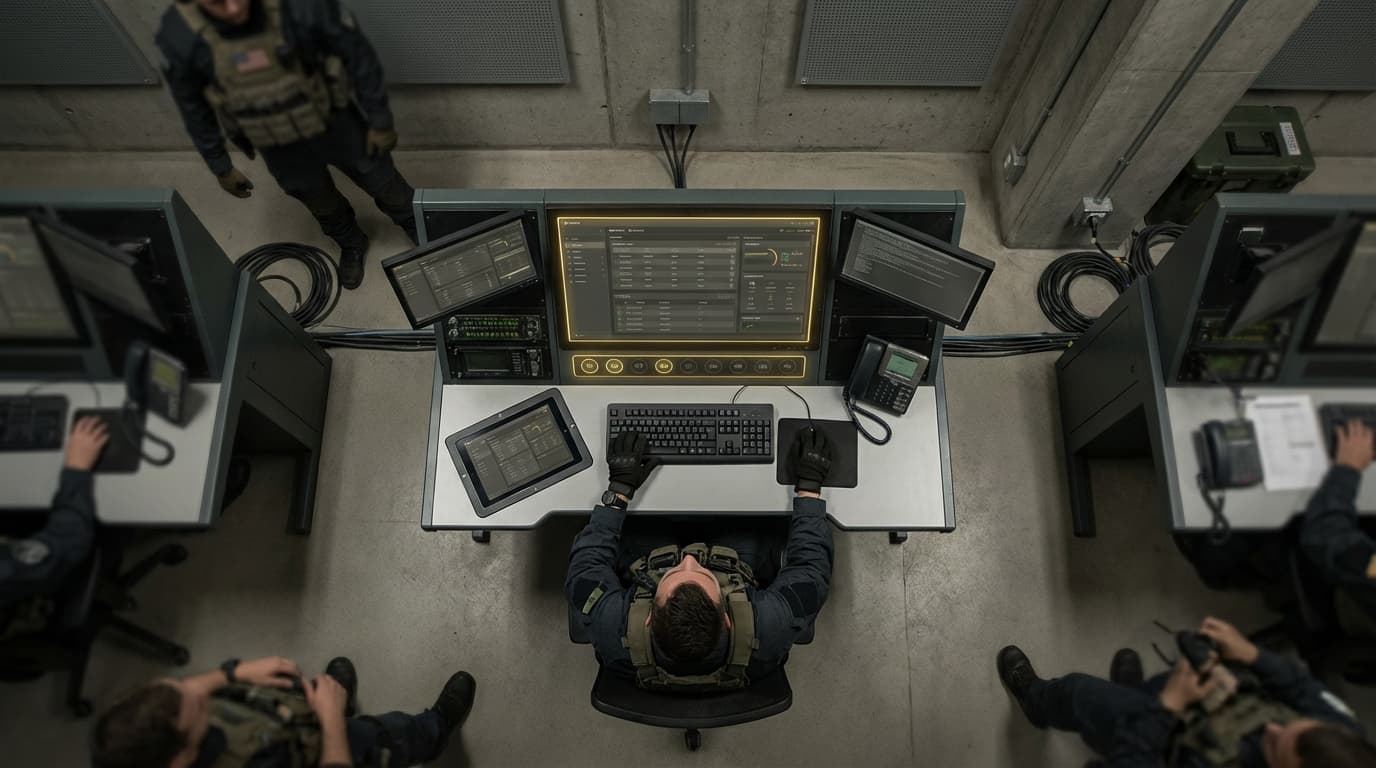
In high-stakes defense and security operations, human operators face an overwhelming influx of information from multiple sensors, communication channels, and monitoring systems simultaneously. Traditional command-and-control interfaces often present raw data streams without contextual filtering, forcing operators to manually synthesize information while making time-critical decisions. Operator Cognitive Load Management Systems address this challenge by employing artificial intelligence and human factors engineering to create adaptive interfaces that understand operational context and operator state. These systems continuously monitor incoming data streams, assess threat priorities based on mission parameters, and present information in cognitively optimized formats. The underlying architecture typically combines machine learning algorithms for pattern recognition, physiological sensors to detect operator stress levels, and intelligent filtering mechanisms that suppress low-priority alerts while escalating critical information. By analyzing historical decision patterns and current operational tempo, these systems can predict which information will be most relevant and present it through streamlined visualizations that reduce mental processing requirements.
The defense and security sectors have long grappled with the paradox that technological advancement often increases rather than decreases operator burden. Modern military platforms generate exponentially more data than their predecessors, yet human cognitive capacity remains constant. This mismatch has contributed to delayed responses, missed threats, and decision errors during critical moments when operators experience information overload. Operator Cognitive Load Management Systems fundamentally transform this dynamic by serving as intelligent intermediaries between complex systems and human decision-makers. Research in military human factors suggests that these systems can reduce decision-making time by filtering irrelevant data and presenting actionable recommendations based on doctrine, rules of engagement, and tactical context. They enable smaller crews to manage increasingly complex operations by automating routine monitoring tasks and allowing operators to focus cognitive resources on strategic thinking and creative problem-solving. This capability proves particularly valuable in cyber defense operations centers, missile defense systems, and intelligence analysis workflows where operators must maintain situational awareness across multiple domains simultaneously.
Early deployments of cognitive load management technology have appeared in next-generation fighter cockpits, naval combat information centers, and integrated air defense systems, where pilot programs demonstrate measurable improvements in operator performance under simulated combat conditions. These systems are increasingly incorporating multimodal interfaces that combine visual displays with spatial audio cues and haptic feedback to distribute information across different sensory channels, preventing any single channel from becoming saturated. As defense operations become more network-centric and data-intensive, the trajectory points toward cognitive load management becoming a standard component of military human-machine teaming architectures. The technology aligns with broader trends toward autonomous systems that augment rather than replace human judgment, recognizing that while machines excel at data processing, humans remain superior at contextual understanding and ethical decision-making in ambiguous situations. Future developments will likely integrate biometric monitoring more deeply, allowing systems to adapt their support level dynamically based on real-time assessment of operator stress, fatigue, and cognitive capacity.
Related Organizations

Specializes in cognitive AI and intelligent user interfaces for the military, focusing on human-machine teaming.

R&D firm developing human-adaptive interfaces and physiological monitoring tools for DARPA and DoD.

Multinational company designing and building electrical systems and providing services for the aerospace, defence, transportation and security markets.

The global leader in eye-tracking technology, providing the sensor stack required for dynamic foveated rendering.

Collins Aerospace
United States · Company
A major aerospace and defense contractor, a subsidiary of RTX Corporation.

A leader in driver monitoring systems that acquired Affectiva, the pioneer of Emotion AI.

Develops FOVIO driver monitoring technology to detect fatigue and distraction using advanced computer vision.

Elbit Systems
Israel · Company
Major defense contractor developing AI-driven autonomous swarms (Legion-X) and target acquisition systems.

A global leader in industrial technology and aerospace manufacturing.
Supporting Evidence
Research this in Signals
Signals turns a topic into a sourced research record you can inspect and rerun. Your first scan is free, and this one starts with Operator Cognitive Load Management Systems already loaded, so edit it or scan as is.