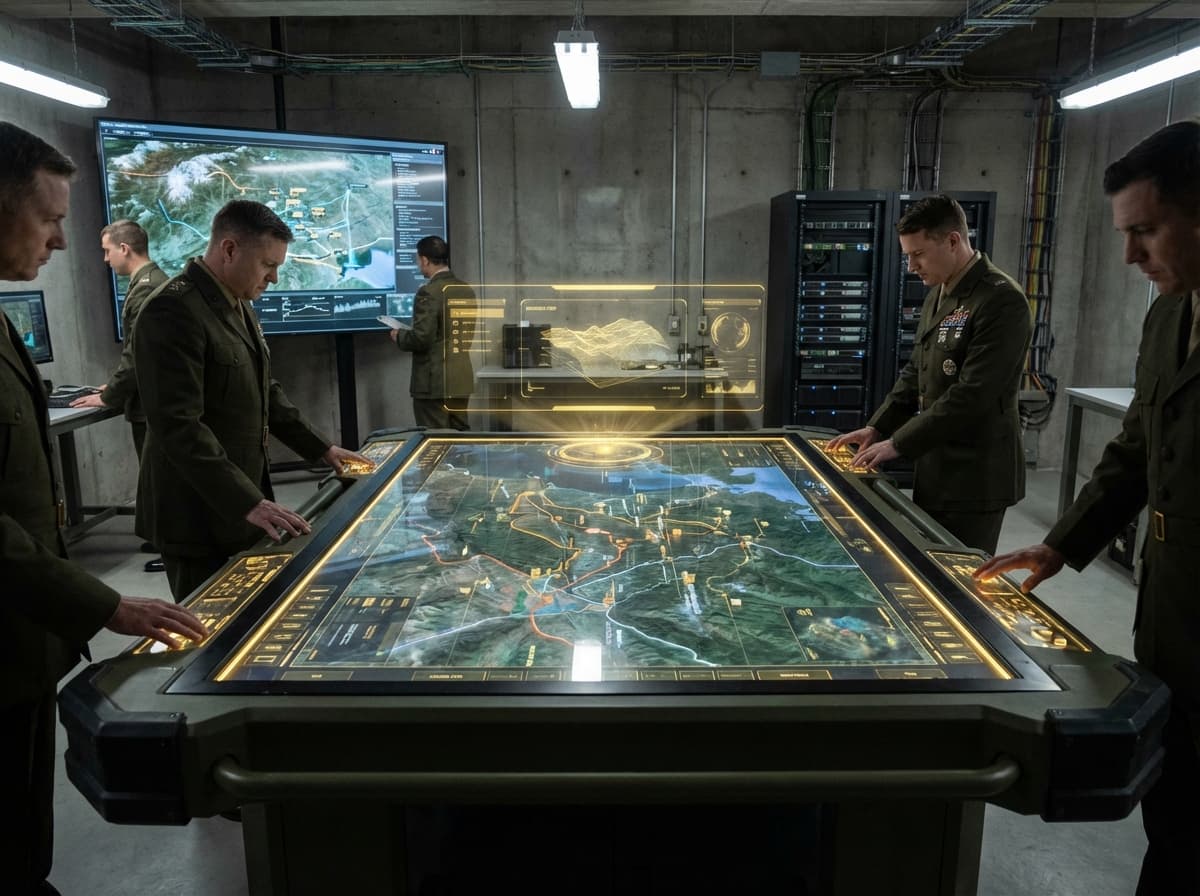
Digital Battlefield Twins
Digital battlefield twins represent an advanced simulation framework that creates dynamic, multi-layered virtual replicas of military theaters and operational environments. Unlike traditional wargaming simulations that operate at fixed resolutions, these systems integrate data across multiple scales—from individual unit movements and equipment status to theater-wide strategic positioning and supply chain dynamics. The technology synthesizes inputs from satellite imagery, sensor networks, logistics databases, and intelligence feeds to construct continuously updated digital representations of battlefield conditions. At the technical core, these systems employ sophisticated modeling engines that can seamlessly transition between different levels of detail, allowing commanders to zoom from strategic overview to tactical granularity while maintaining coherent simulation fidelity. Machine learning algorithms process historical engagement data and current operational parameters to generate probabilistic outcomes, while physics-based models simulate terrain effects, weather impacts, and equipment performance under varying conditions.
The defense sector faces persistent challenges in operational planning, particularly the difficulty of anticipating logistics bottlenecks, resource constraints, and cascading effects of tactical decisions in complex, multi-domain operations. Traditional planning methods often rely on static models that cannot adapt quickly to changing battlefield conditions or incorporate the vast streams of real-time data now available from modern sensor networks and communication systems. Digital battlefield twins address these limitations by providing commanders with a living laboratory for testing strategies, identifying vulnerabilities in supply chains, and exploring alternative courses of action without committing actual resources. The technology enables predictive logistics by modeling fuel consumption, ammunition expenditure, equipment maintenance needs, and personnel requirements across different operational scenarios. This capability proves particularly valuable in contested environments where supply lines may be disrupted or where rapid force repositioning becomes necessary. Furthermore, these systems support collaborative planning by allowing geographically dispersed command elements to interact with the same simulation environment, fostering shared situational awareness and more coordinated decision-making.
Military organizations are increasingly integrating digital twin capabilities into their planning and training infrastructures, with early implementations focusing on logistics optimization and force readiness assessment. Research programs are exploring how these systems can incorporate adversary modeling, using game-theoretic approaches to simulate opponent decision-making and identify potential strategic vulnerabilities. The technology shows promise for pre-deployment mission rehearsal, allowing units to practice operations in virtual replicas of actual deployment zones before arrival. As sensor networks become more pervasive and data processing capabilities expand, digital battlefield twins are evolving toward near-real-time operational support, where simulation and reality converge to provide continuous decision assistance during active operations. This trajectory aligns with broader military modernization efforts emphasizing data-centric warfare, artificial intelligence integration, and the development of decision advantage through superior information processing and predictive analytics.
Related Organizations

Developing foundation models for robotics (Project GR00T) and vision-language models like VILA.

Spatial computing company providing infrastructure for massive virtual worlds.

A metaverse technology company known for SpatialOS, enabling massive simulations with thousands of concurrent agents.

Generates a semantic 3D digital twin of the entire Earth using satellite imagery and AI.

Defense and aerospace company known for the ADAPTIV thermal camouflage system.

Provides high-resolution Earth imagery and geospatial analytics.

Provides the High Definition Render Pipeline (HDRP) which supports real-time ray tracing for gaming and industrial visualization.

Leidos
United States · Company
Integrates digital engineering and digital twin frameworks for major defense programs.

Adapts industrial digital twin technology (Xcelerator) for defense maintenance, logistics, and shipyard operations.

Supporting Evidence
Research this in Signals
Signals turns a topic into a sourced research record you can inspect and rerun. Your first scan is free, and this one starts with Digital Battlefield Twins already loaded, so edit it or scan as is.