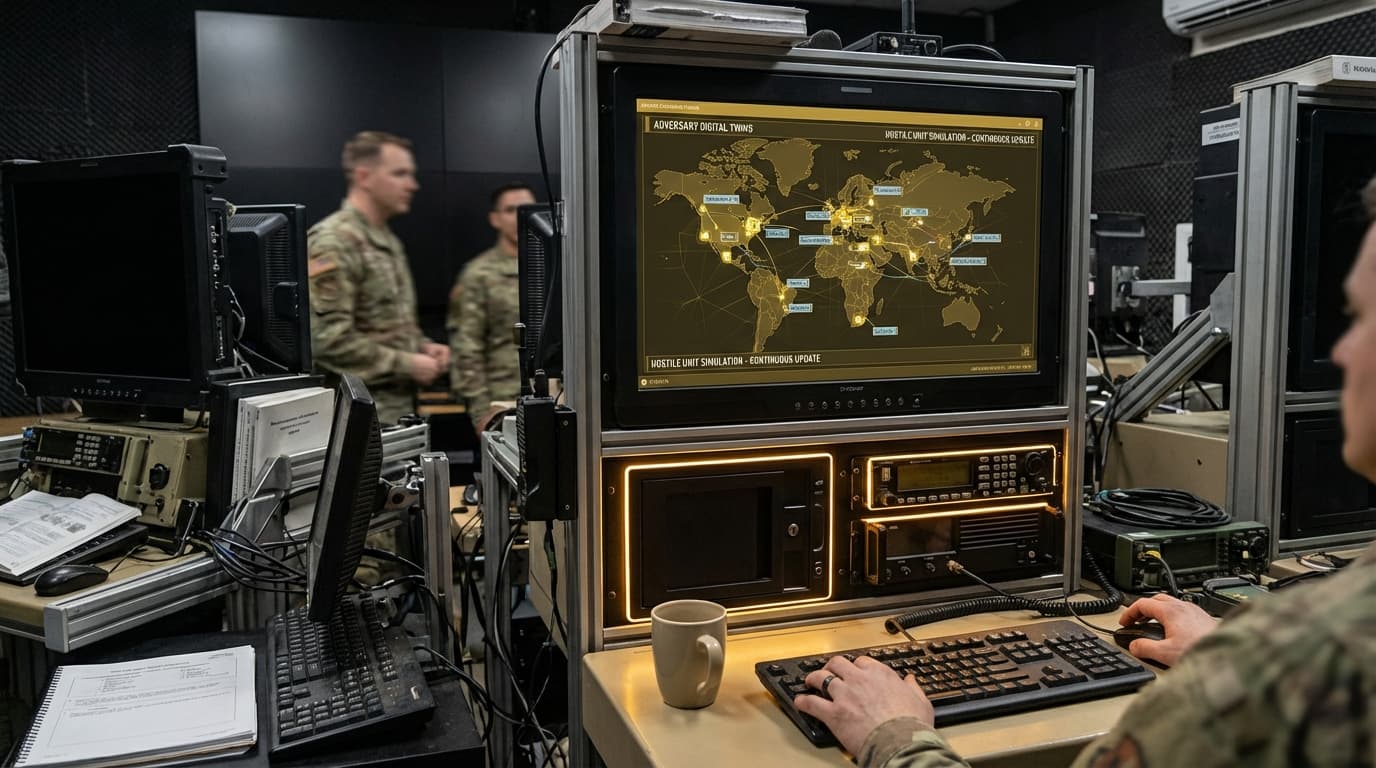
Adversary Digital Twins
Adversary Digital Twins represent a sophisticated approach to military intelligence and strategic planning, creating dynamic, continuously updated virtual representations of opposing forces, their organizational structures, and operational doctrines. Unlike static threat assessments or periodic intelligence reports, these digital twins function as living models that evolve in real-time by integrating multiple intelligence streams—open-source intelligence (OSINT), signals intelligence (SIGINT), human intelligence (HUMINT), and direct battlefield telemetry. The underlying technology combines advanced data fusion algorithms, machine learning models, and behavioral simulation frameworks to create comprehensive representations of how adversary forces organize, communicate, make decisions, and adapt their tactics. These systems process vast quantities of disparate data points—from social media activity and public statements to intercepted communications and observed troop movements—synthesizing them into coherent behavioral models that can predict likely responses to various scenarios. The technical architecture typically includes probabilistic reasoning engines that account for uncertainty in intelligence data, temporal modeling to track doctrinal evolution over time, and network analysis tools to map command structures and information flows within adversary organizations.
The development of Adversary Digital Twins addresses a critical challenge in modern defense planning: the need to anticipate and counter increasingly adaptive and sophisticated opponents in an era of rapid technological change and hybrid warfare. Traditional intelligence analysis, while valuable, often struggles to keep pace with the speed at which modern adversaries can shift tactics, reorganize forces, or adopt new technologies. These digital twins enable defense organizations to conduct extensive scenario testing and wargaming exercises that would be impossible or prohibitively expensive to execute through conventional means. By simulating how adversary forces might respond to different strategic initiatives, operational plans, or emerging technologies, military planners can identify vulnerabilities in their own approaches before committing resources or personnel. The technology also revolutionizes red-teaming exercises, allowing friendly forces to train against realistic, adaptive virtual opponents that exhibit the actual behavioral patterns and decision-making tendencies of real-world adversaries rather than generic threat profiles.
Defense organizations and military research institutions are increasingly incorporating these capabilities into their planning and training infrastructure, with early implementations focusing on modeling peer and near-peer competitors. The technology has proven particularly valuable in preparing for multi-domain operations, where understanding how adversaries might coordinate actions across land, sea, air, space, and cyber domains is essential. Current applications include support for operational planning staffs conducting course-of-action analysis, training environments where commanders can practice decision-making against realistic opposition, and strategic-level assessments of how adversaries might respond to long-term capability development programs. As artificial intelligence and machine learning technologies continue to advance, these digital twins are expected to become increasingly sophisticated in their ability to model not just current adversary behavior but also to anticipate how opposing forces might evolve their doctrine and capabilities in response to changing geopolitical conditions or technological developments. This capability represents a fundamental shift toward more predictive and adaptive defense planning, moving beyond reactive intelligence analysis toward proactive strategic advantage.
Related Organizations

Global developer of military simulation and training software (VBS4).

A metaverse technology company known for SpatialOS, enabling massive simulations with thousands of concurrent agents.

A global leader in simulation and training for civil aviation, defense, and healthcare.

The science and technology arm of the UK Ministry of Defence, actively testing quantum sensors for navigation (PNT) and detection.


Builds space simulation and analytics platforms for training and mission planning.

Spatial computing company providing infrastructure for massive virtual worlds.

Offers the Quantum Engineering Toolkit (QET) and Labber software for instrument control and pulse generation.

Builds software that empowers organizations to integrate their data, decisions, and operations (Foundry and AIP).

Specializes in advanced simulation software for military training.
Supporting Evidence
Research this in Signals
Signals turns a topic into a sourced research record you can inspect and rerun. Your first scan is free, and this one starts with Adversary Digital Twins already loaded, so edit it or scan as is.