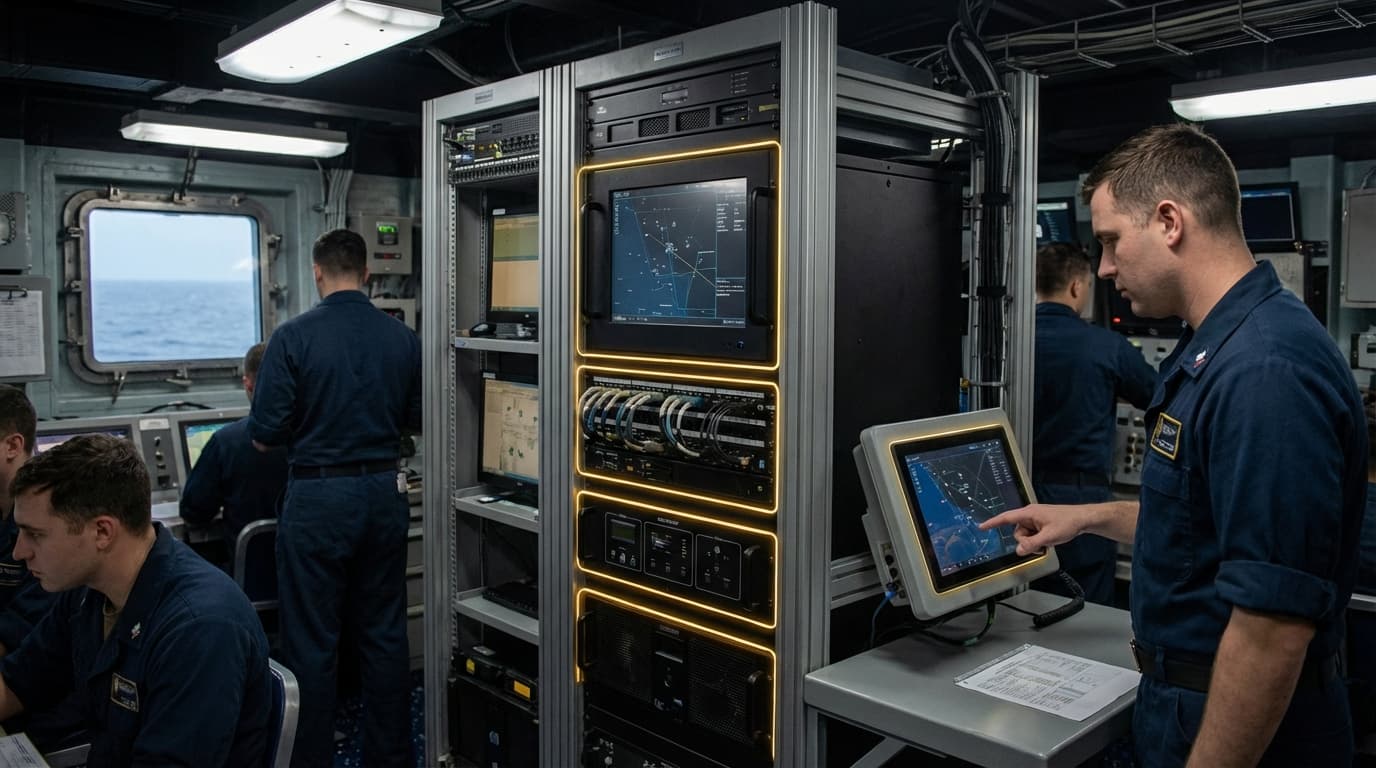
AI-Enabled Electronic Warfare Orchestration
Electronic warfare has evolved from static, pre-programmed countermeasures into a dynamic battlefield domain where split-second decisions can determine mission success or failure. Traditional electronic warfare systems relied on human operators to manually coordinate jamming frequencies, timing sequences, and power levels across multiple platforms—a process too slow for modern threats that can adapt in milliseconds. AI-enabled electronic warfare orchestration addresses this challenge by deploying machine learning algorithms and autonomous decision-making frameworks that can perceive, analyze, and respond to electromagnetic threats faster than any human operator. These systems integrate data from diverse sensors across multiple domains—radar warning receivers, signals intelligence platforms, spectrum analyzers, and cyber reconnaissance tools—to build a comprehensive picture of the electromagnetic battlespace. Advanced neural networks identify patterns in adversary communications, radar emissions, and electronic signatures, while reinforcement learning algorithms continuously refine jamming strategies based on observed effectiveness.
The operational implications of this technology extend far beyond simple automation. Modern military forces face increasingly sophisticated adversaries who employ frequency-hopping radars, adaptive communications networks, and AI-driven counter-countermeasures that can detect and circumvent traditional jamming approaches. AI orchestration platforms solve this problem by coordinating synchronized operations across dozens or even hundreds of assets simultaneously, creating layered deception campaigns that overwhelm adversary decision-making processes. Rather than simply blocking signals, these systems can inject false targets into radar displays, manipulate GPS coordinates to misdirect precision weapons, or selectively degrade portions of enemy communications networks while preserving intelligence collection opportunities. The technology also addresses a critical challenge in coalition operations: preventing friendly fire in the electromagnetic spectrum. By maintaining real-time awareness of allied frequencies and operational patterns, AI systems can optimize disruption effects against adversaries while ensuring minimal interference with friendly communications, navigation systems, and sensor networks.
Early deployments of AI-enabled electronic warfare orchestration are already demonstrating transformative capabilities in military exercises and operational environments. Research programs are exploring applications ranging from autonomous drone swarms that coordinate jamming operations without human intervention to naval battle groups that synchronize electronic attacks across multiple ships and aircraft. The technology shows particular promise in contested environments where adversaries possess advanced air defense systems, as coordinated electronic attacks can create windows of opportunity for strike aircraft or suppress enemy sensors during critical mission phases. Industry analysts note that the integration of quantum sensing technologies and next-generation signal processing could further enhance these systems' ability to operate in increasingly congested electromagnetic environments. As great power competition intensifies and adversaries develop their own AI-driven electronic warfare capabilities, the ability to orchestrate complex, adaptive operations across the electromagnetic spectrum will become essential to maintaining operational advantage in future conflicts.
Related Organizations

Pioneers in deep learning for wireless communications and signal processing.

A research and development agency of the United States Department of Defense.

Tactical AI company developing software for autonomous systems and cognitive sensors.

Major defense contractor developing Reciprocal Quantum Logic (RQL) for cryogenic computing.

A global aerospace and defense technology innovator delivering end-to-end solutions.

A German defense electronics company that has publicly claimed research into quantum radar technology for stealth detection.

A key contractor for the Advanced Battle Management System (ABMS), developing the connectivity and software layers.

Defense company producing the Barracuda advanced camouflage systems.

Applied research arm of the Georgia Institute of Technology.
SRC Inc.
United States · Nonprofit
Not-for-profit research and development company.
Supporting Evidence
Research this in Signals
Signals turns a topic into a sourced research record you can inspect and rerun. Your first scan is free, and this one starts with AI-Enabled Electronic Warfare Orchestration already loaded, so edit it or scan as is.