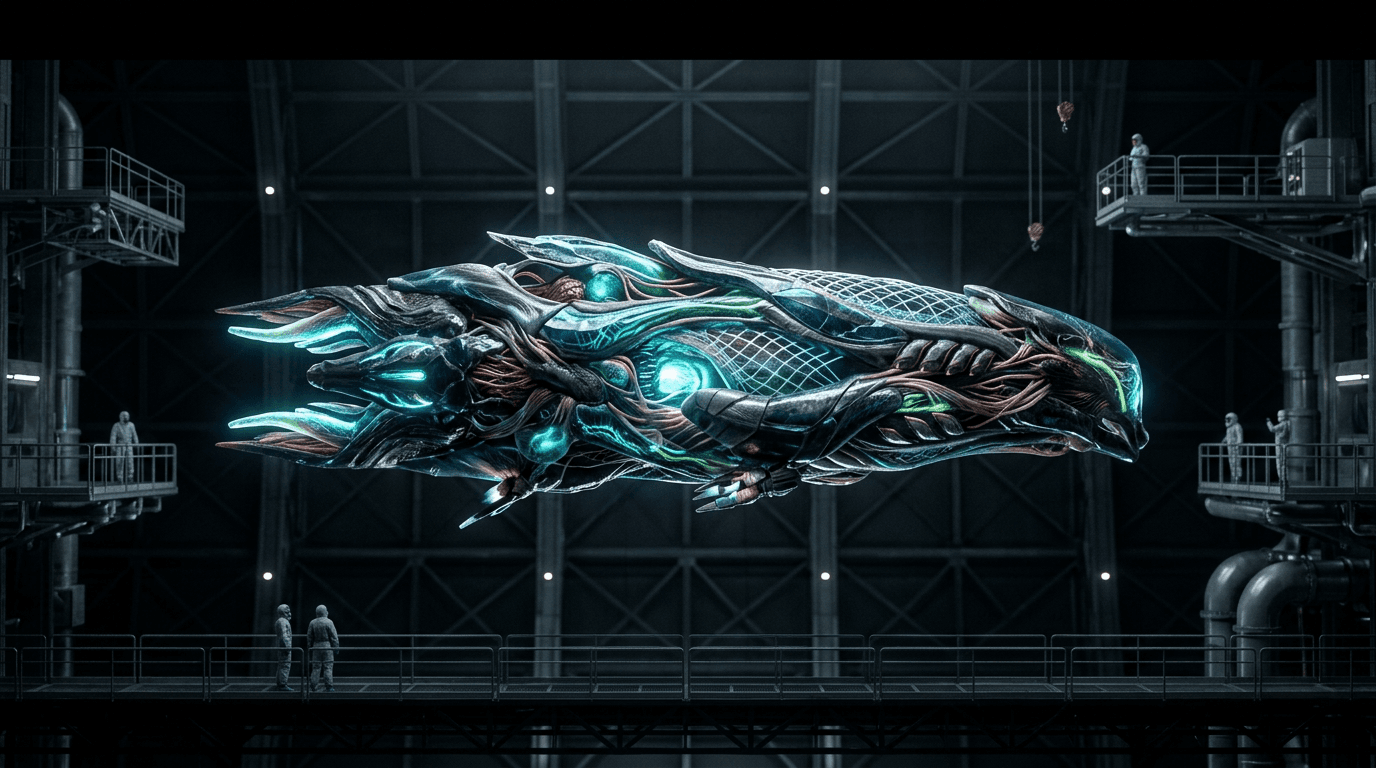
Living Craft
Living craft concepts describe vehicles that blur boundaries between biological organisms and technological artifacts. Reports from abduction research, contactee testimony, and UAP literature describe craft exhibiting characteristics typically associated with living systems: self-repair after damage, growth or adaptation over time, responsiveness to operator consciousness, organic interior surfaces (warm, slightly yielding textures), and apparent autonomous behavior suggesting intelligence or instinct rather than pure programming.
Reported Characteristics
Specific reported features include: surfaces that feel alive or pulse subtly; craft that 'heal' damage without external repair; technology-biology integration where components appear grown rather than manufactured; symbiotic relationships between craft and operators (consciousness-mediated control); and interior environments adapting to occupants' needs. Some accounts describe craft components resembling organs, circulatory systems, or neural networks. The concept connects to speculation about advanced civilizations moving beyond pure mechanical technology toward bio-integrated or fully biological systems.
Engineering Perspective and Challenges
From engineering perspective, bio-hybrid systems are emerging technology—synthetic biology, living materials, and biological computing represent early steps. Self-healing materials using embedded capsules or reversible chemistry exist in laboratory form. However, macroscopic living spacecraft would require: biological systems surviving space environments (radiation, vacuum, temperature extremes); integrating propulsion, structure, and life-support functions into biological substrate; and maintaining complexity without ecological support systems. Known biology struggles with these challenges.
Alternative Explanations
Alternative explanations for reported 'living craft' include psychological projection (attributing life to advanced but purely mechanical systems); metaphorical descriptions of highly responsive autonomous technology; sensory misinterpretation during altered states; or symbolic rather than literal observations. The concept may represent how witnesses describe technology so advanced it appears organic—indistinguishable from life through its complexity and responsiveness. Living craft remains pure testimony-based phenomenon without physical specimens, though it represents intriguing speculation about convergent evolution of technology and biology.
Research this in Signals
Signals turns a topic into a sourced research record you can inspect and rerun. Your first scan is free, and this one starts with Living Craft already loaded, so edit it or scan as is.