Bioregenerative Habitats
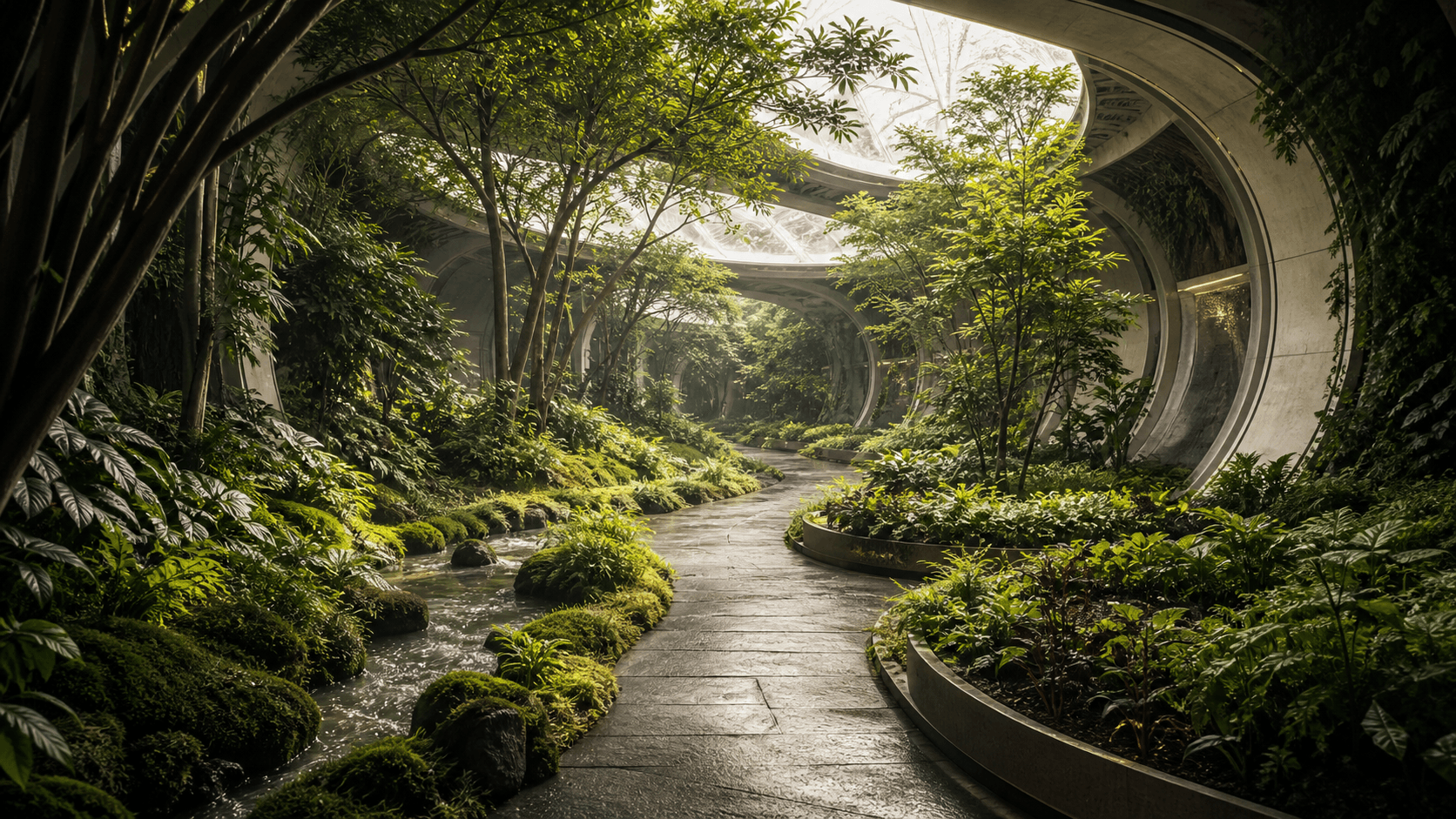
Onboard living biomes describe spacecraft interiors featuring full ecological zones—forests, meadows, water features, and complex plant communities—reported consistently in entity encounter literature (e.g., John Mack) and some contactee accounts. Witnesses describe entering craft and encountering naturalistic environments: trees, moss, flowing water, diffused daylight-like illumination, and ambient sounds, often with air quality and aroma matching outdoor settings. These biomes are portrayed as functional ecosystems rather than decorative elements, suggesting integrated life-support and psychological habitat design.
Testimony Patterns
Reports include: large interior chambers with vegetation-lined pathways; tall trees and layered plant strata resembling temperate forests; humidity- and temperature-controlled microclimates; softly lit canopies with no visible light sources; and air quality perceived as exceptionally clean. Some accounts describe animals or small organisms, though most focus on plant-dominant environments. The consistency across otherwise independent accounts suggests an archetypal or experiential pattern, though physical evidence is absent.
Human Technology Parallels—Bioregenerative Life Support
NASA, ESA, and CNSA have pursued closed-loop life support for long-duration missions
Controlled Ecological Life Support Systems (CELSS), MELiSSA (Micro-Ecological Life Support System Alternative), BIOS-3 (Russia), and Chinese BLSS experiments. Core components include: algal photobioreactors for oxygen generation and CO₂ scrubbing; hydroponic and aeroponic systems for food production; greywater recycling and nutrient loops; and microbial bioprocessors for waste conversion. Advanced variants explore multi-species plant communities to improve system stability and occupant well-being.
Biophilic & Psychophysiological Benefits
Biophilic design research shows that exposure to natural elements improves cognition, mood, immune function, and stress recovery—critical for long-duration confinement. Synthetic gravity limitations, circadian disruption, and sensory monotony in spacecraft can be mitigated with living environments: dynamic lighting mimicking daylight cycles; natural soundscapes; plant volatiles improving perceived air quality; and visual complexity reducing stress. The reported onboard biomes align with biophilic goals, whether literal ecosystems or engineered illusions.
Enabling Technologies
Advanced lighting (tunable-spectrum LEDs for photosynthesis and circadian entrainment; light pipes and diffusers for shadow-free illumination). Habitat control (precise humidity, temperature, and CO₂/O₂ balance; closed-loop water recovery; HEPA and VOC filtration; antimicrobial surfaces). Plant systems (aeroponics/hydroponics; substrate-free root matrices; cultivars for low-light, low-gravity; modular plant walls). Structural design (modular habitat tiles integrating irrigation, lighting, and sensing; acoustic control via plant canopies; vibration isolation for plant stability).
Open Questions & Speculation
Testimonial accounts imply biome scale and complexity beyond current engineering—multi-level forests within compact craft, seamless integration with structural surfaces, and absence of visible mechanical infrastructure. Speculative mechanisms include: high-efficiency invisible environmental systems; metamaterial light distribution; advanced transpiration control; and engineered plant-microbiome consortia auto-regulating climate. Alternatively, some experiences may reflect: induced perception (holographic or neurological), therapeutic staging areas for experiencers, or symbolic/altered-state constructs rather than literal ecosystems.
Onboard living biomes bridge credible near-future habitat engineering (bioregenerative life support, biophilic spacecraft interiors) with encounter testimony describing full ecological spaces inside craft. As mission durations increase (lunar gateways, Mars transits, deep space stations), convergence of closed-loop ecosystems and human-centered habitat psychology makes living biomes technologically plausible at limited scales—though witness-described forests exceed demonstrated capabilities today.
Research this in Signals
Signals turns a topic into a sourced research record you can inspect and rerun. Your first scan is free, and this one starts with Bioregenerative Habitats already loaded, so edit it or scan as is.