Environmental Interaction Effects
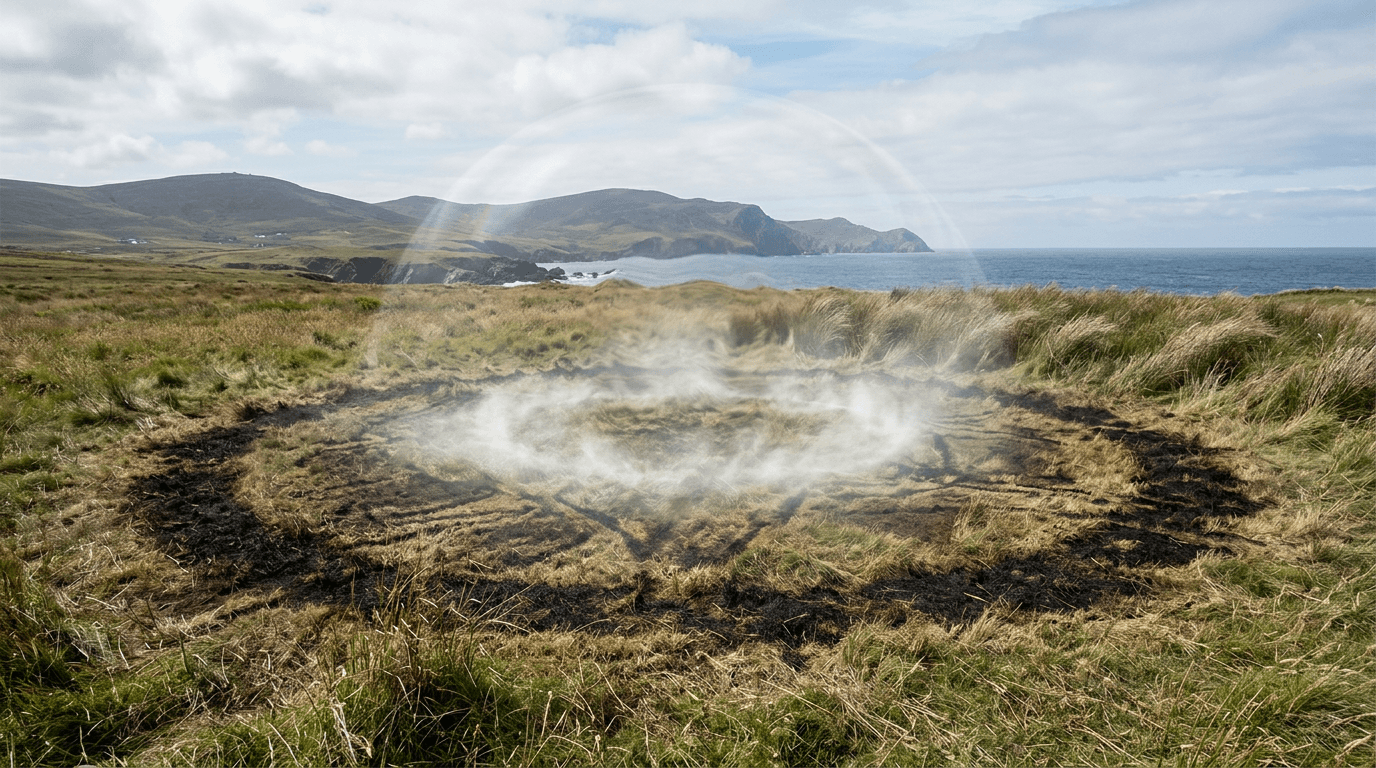
Encounter records describe craft producing tightly bounded environmental effects: localized haze or shimmering without thermal exhaust; lensing-like air distortions near edges; micro-fog or ionization clouds forming and dissipating abruptly; compressed air 'pressure domes'; and ground phenomena including concentric rings, soil glazing, magnetic/compass anomalies at trace sites, vegetation singe, and residual EM coupling detectable by instruments.
Proposed Mechanisms
Proposed mechanisms include: (1) plasma/E-field boundary layers changing refractive index (Schlieren-like mirage); (2) rapid air ionization and recombination creating transient fog or glow; (3) localized pressure gradients from volumetric field coupling; and (4) ground current injection leaving magnetic/chemical signatures. Environmental signatures are useful forensic markers: bounded radii, symmetry aligned to craft geometry, and persistence scales from minutes (air effects) to days/weeks (soil/vegetation). These effects suggest strong near-field EM/plasma management tightly coupled to propulsion and boundary-layer control rather than aerodynamic heating.
Human Technology Parallels
Human analogs are partial—high-voltage corona discharges and plasma actuators can create glow, ozone, and dust repulsion, but not sharp microclimate bubbles. These bounded environmental effects represent sophisticated boundary-layer and field management exceeding current aerospace capabilities.
Research this in Signals
Signals turns a topic into a sourced research record you can inspect and rerun. Your first scan is free, and this one starts with Environmental Interaction Effects already loaded, so edit it or scan as is.