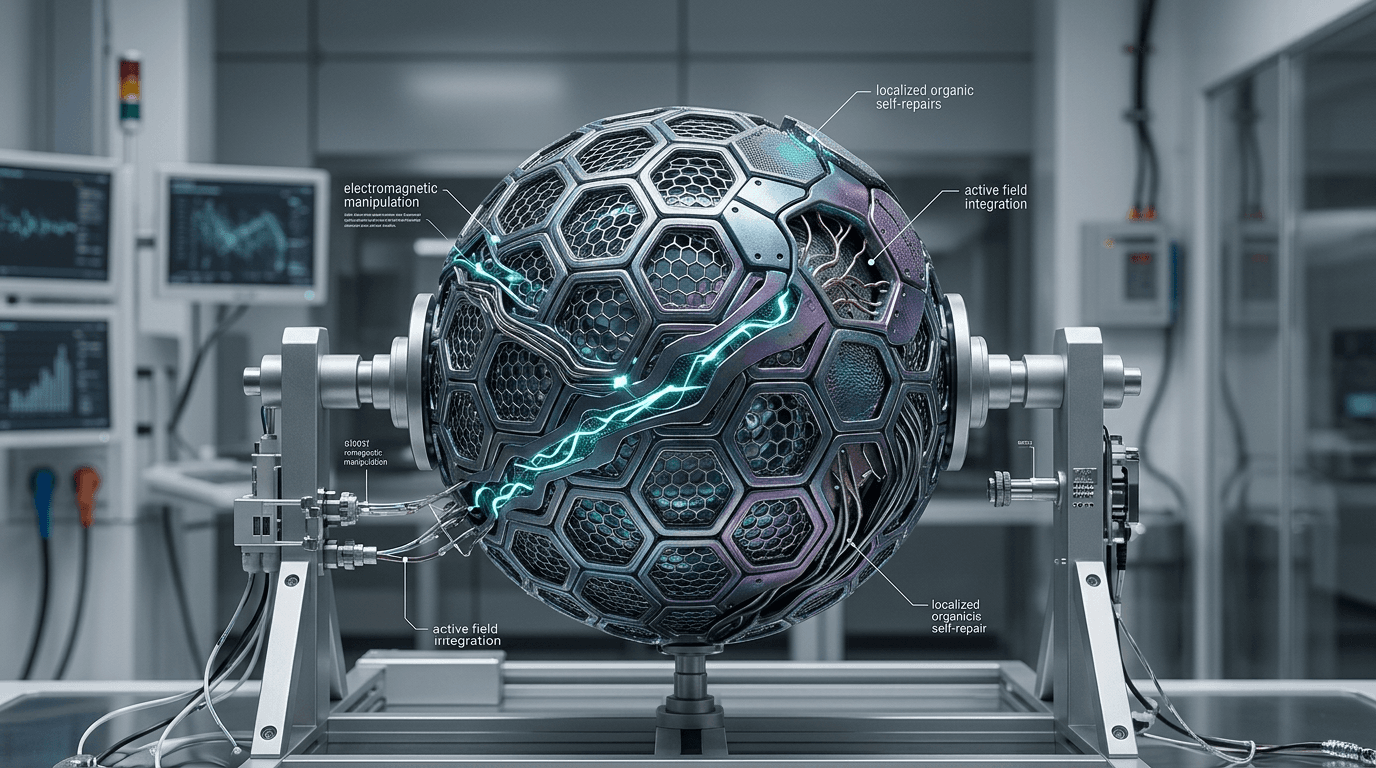
Adaptive Metallic Hull Systems
UAP metallic skin refers to the consistently reported shiny, mirror-like, or polished metallic surfaces observed on unidentified craft, exhibiting properties far exceeding conventional aerospace materials: seamless construction, extraordinary strength-to-weight ratios, thermal resistance, electromagnetic behavior, and possible adaptive or 'living' characteristics. Witness testimony, material fragment analysis, and theoretical extrapolation suggest multiple non-exclusive technological approaches to achieving observed capabilities—from exotic super-alloys and electromagnetic metamaterial skins to quantum-coherent matter, bio-metallic hybrids, and field-integrated façades. These technologies represent hypothetical solutions to engineering challenges of trans-medium travel, extreme acceleration tolerance, stealth, and environmental adaptation.
Observational Patterns & Witness Testimony
UAP reports consistently describe distinctive surface characteristics: highly polished, mirror-like metallic finish (often described as 'chrome' or 'liquid metal'); seamless construction with no visible rivets, welds, or panel gaps; surfaces that appear solid yet sometimes ripple, shimmer, or deform; color/reflectivity changes (silver to dark gray/black, or luminous glow); and materials that show no oxidation, weathering, or conventional wear patterns. Kenneth Arnold's 1947 'flying saucers' were described as bright, mirror-like; Lonnie Zamora's 1964 Socorro encounter noted smooth, polished white metallic surface; the 1965 Kecksburg object had bronze/gold metallic appearance with no seams; and modern military encounters (Nimitz, East Coast) report dark gray/black smooth surfaces or reflective spheres. The consistency across decades and witnesses suggests real material properties rather than misidentification.
Super-Alloy Metallic Skin Hypothesis
The most conservative interpretation posits advanced but conceptually familiar metallurgy—exotic alloys with properties exceeding current materials: ultra-high strength-to-weight ratio (possibly using rare earth elements, intermetallic compounds, or bulk metallic glasses); exceptional thermal resistance (handling atmospheric re-entry heating, propulsion thermal loads, cosmic radiation); corrosion resistance and surface stability (explaining pristine appearance despite alleged age/use); and possible nano-structuring (grain boundary engineering, crystallographic texturing for optimized properties). Human parallels include titanium aluminides, nickel-based superalloys (CMSX, Inconel), amorphous metal alloys, and high-entropy alloys. However, fragment analysis (Ubatuba fragments, Art's Parts, Lonnie Zamora soil samples) shows unusual isotopic ratios, layered micro-structures, and material combinations suggesting fabrication processes beyond current capabilities. The alloy approach explains structural integrity and appearance but doesn't address active EM behavior, seamless construction, or adaptive properties.
Metamaterial / Electromagnetic Skin Hypothesis
This framework treats the metallic skin as an active electromagnetic surface—a metasurface or metamaterial that manipulates light, radar, RF, and potentially gravitational fields: engineered sub-wavelength structures (meta-atoms arranged in patterns to control EM wave interaction); tunable optical properties (controlling reflectivity, absorption, and transmission across spectrum); radar stealth and adaptive camouflage (redirecting or absorbing radar returns, changing visual appearance); and boundary layer control (managing airflow, plasma formation, drag reduction via EM field manipulation). Research into photonic metamaterials, plasmonic metasurfaces, frequency-selective surfaces, and transformation optics demonstrates feasibility of electromagnetic cloaking and wavefront engineering. The UAP skin might function as: a reconfigurable metasurface switching between mirror (high-speed travel) and matte/dark (stealth mode); an active plasma management system (using surface EM fields to ionize boundary layer, reducing friction and radar signature); a radar-absorbing structure (metamaterial layers creating destructive interference for incoming radar); or an optical illusion generator (bending light around craft or projecting false imagery). This explains observed stealth, reflectivity changes, and possible 'shimmer' effects but requires sophisticated power distribution and control systems embedded in hull.
Quantum / Exotic-Matter Skin Hypothesis
More speculative frameworks propose hull composition involving exotic physics: macroscopic quantum coherence (bulk material maintaining quantum state enabling anomalous mechanical properties); quark-gluon conglomerates or strange matter (hypothetical ultra-dense states billions of times stronger than diamond); topological materials (with protected surface states enabling unusual conductivity or field coupling); and programmable matter (atomically-precise structures reconfigurable at quantum level). Some researchers cite fragment analysis showing unusual properties: isotopic ratios inconsistent with terrestrial origin (Mg isotopes in Ubatuba samples); layered bismuth-magnesium structures with unclear purpose (Art's Parts); and micro-crystalline arrangements suggesting directed assembly. The exotic matter hypothesis could explain: impossible strength-to-weight ratios (material bonding at quantum scales); inertial mass modification (hull couples to spacetime geometry via exotic matter properties); energy absorption/redirection (material channels incoming radiation or kinetic energy into quantum states); and rapid reconfiguration (quantum state changes allowing instant repair or shape-shifting). Critical assessment notes lack of confirmed exotic matter samples, unclear manufacturing mechanisms, and theoretical gaps in how macroscopic quantum materials could maintain coherence at operational temperatures.
Hybrid Bio-Metallic / Living Skin Hypothesis
The 'living hull' concept proposes bio-engineered integration of organic and metallic components: cellular or nano-bio-machine infusion (microorganisms or synthetic biology elements within metallic matrix); adaptive sensing and response (bio-sensors detecting environmental conditions, triggering material property changes); self-repair mechanisms (biological healing processes reconstructing damaged hull sections); and consciousness interface potential (hull responding to pilot neural signals or intentions). This framework draws on emerging bio-metallurgy research: bio-mineralization (organisms producing structural materials like nacre, chitin-calcium composites); bacterial metal reduction (microbes depositing pure metal layers); synthetic biology materials (engineered cells producing spider silk proteins, adhesives, composites); and organic electronics (conductive polymers, bio-semiconductors). Encounter testimony occasionally suggests 'living craft' characteristics: surfaces that appear to heal or reform after damage; color/texture changes seemingly responsive to environment or observer; and experiencer reports of craft feeling 'alive' or conscious. The bio-metallic approach explains adaptive properties, self-repair, and possible consciousness interface but raises questions about biological survival in space environments, energy requirements for living systems, and manufacturing complexity.
Surface Field Capsule + Metallic Façade Hypothesis
This model proposes the visible metallic skin is a thin cosmetic layer over a fundamental field-based structure: force-field skeleton (primary structural integrity from coherent electromagnetic, plasma, or exotic fields); metallic veneer (lightweight metal layer providing conventional protection, thermal management, appearance); field-material coupling (metal surface electrically coupled to underlying fields, enabling field-driven shape changes); and adaptive geometry (field modulation causing metal layer to flex, ripple, or reconfigure). The hypothesis explains several observed anomalies: seamless construction (no joints needed if field provides structure); rippling or liquid-like appearance (metal façade flexing over shifting field geometry); rapid shape changes (field reconfiguration with metal following); extreme durability (field absorbs impacts, metal only protects against environmental factors); and fragment ambiguity (recovered metal pieces lack the field technology, appearing mundane). This approach aligns with theoretical force-field physics, plasma containment research (tokamak magnetic fields, z-pinch configurations), and electrohydrodynamic control. The craft's inertial properties, acceleration capabilities, and trans-medium performance might derive from the field structure, with metallic skin simply providing necessary material interface with normal matter environments.
Material Fragment Analysis & Physical Evidence
Several alleged UAP material samples have undergone scientific analysis with intriguing results: Ubatuba fragments (1957 Brazil)—high-purity magnesium with unusual isotopic ratios; Council Bluffs sample (1977)—layered bismuth-magnesium-zinc; Art's Parts (Bob Bigelow collection)—bismuth-magnesium multilayers with ~1-4 micron periodicity; and Roswell debris claims—memory metal descriptions (returns to shape after deformation). Laboratory analysis reveals: isotopic anomalies (difficult to explain via terrestrial processing); precision layering (suggesting advanced deposition techniques); unclear functional purpose (why alternate bismuth-magnesium at micron scale?); and unusual mechanical properties (high strength, low density, thermal characteristics). Skeptical analysis notes: contamination possibilities; terrestrial exotic alloys exist with unusual isotopes; and metamaterial research explores similar layered structures for EM applications. Definitive conclusions remain elusive due to provenance uncertainties, limited sample availability, and incomplete testing.
Human Technology Parallels & Development
Current aerospace and materials research pursues similar objectives: additive manufacturing of aerospace alloys (3D-printed titanium, Inconel components with optimized microstructures); metamaterial radar absorbing structures (stealth aircraft coatings, frequency-selective surfaces); smart materials (shape-memory alloys, piezoelectric composites, electroactive polymers); bio-inspired materials (nacre-mimetic composites, self-healing polymers with embedded capsules or vascular networks); and active flow control surfaces (plasma actuators for boundary layer manipulation, synthetic jets). While approaching individual capabilities, human technology lacks integration, energy efficiency, and performance levels attributed to UAP materials. Key gaps include: true optical-range metamaterial cloaking (demonstrations limited to narrow bands, laboratory scales); structural metamaterials with bulk strength (most metamaterials mechanically fragile); practical self-healing metals (limited to polymers, coatings; not bulk structural metals); and seamless large-scale fabrication (additive manufacturing leaves layer lines, conventional welding creates joints).
Theoretical Integration & System-Level Implications
The various hypotheses aren't mutually exclusive—UAP hull systems might integrate multiple approaches: base structure of exotic super-alloy or quantum-coherent material; metamaterial surface patterning for EM control; bio-metallic self-repair subsystems localized at stress points; and coupling to underlying field systems for structural support and active properties. This multi-layer, multi-function architecture would explain the breadth of observed capabilities no single technology addresses. System-level considerations include: power requirements (active metamaterial skins, field generation, bio-metallic systems need energy—possibly from propulsion system, zero-point extraction, or exotic power sources); thermal management (materials handling propulsion heat, atmospheric friction, internal systems); manufacturing (atomic-precision assembly, possibly via molecular manufacturing, programmed self-assembly, or exotic fabrication); and maintenance (self-repair, field-stabilized integrity, or bio-regeneration reducing need for conventional maintenance).
Critical Assessment & Evidence Limitations
UAP metallic skin remains largely hypothetical due to: limited verified material samples (provenance issues, possible hoaxes, terrestrial contamination); witness testimony variability (descriptions range from mirror-chrome to matte-black, smooth to textured); lack of controlled scientific observation (most encounters brief, unexpected, without instrumentation); and theoretical uncertainties (mechanisms for exotic properties unclear, manufacturability unknown). Skeptical explanations include: conventional aircraft or experimental vehicles (exotic coatings, lighting effects); misidentified natural phenomena (bright meteors, ball lightning); and psychological factors (expectation, cultural conditioning influencing descriptions). Proponents note: consistency across independent witnesses; material fragments with anomalous properties requiring explanation; military sensor confirmations (radar, IR, visual, sonar); and engineering logic (advanced craft would require advanced materials).
The Adaptive Metallic Hull Systems concept represents convergence of materials science, metamaterials, field physics, and speculative bio-engineering—attempting to explain observed UAP surface characteristics through multiple technological pathways. Whether representing genuine xenotechnology, classified human breakthroughs, or misinterpretation of conventional phenomena, the reported properties push boundaries of current materials science and invite systematic investigation.
Research this in Signals
Signals turns a topic into a sourced research record you can inspect and rerun. Your first scan is free, and this one starts with Adaptive Metallic Hull Systems already loaded, so edit it or scan as is.