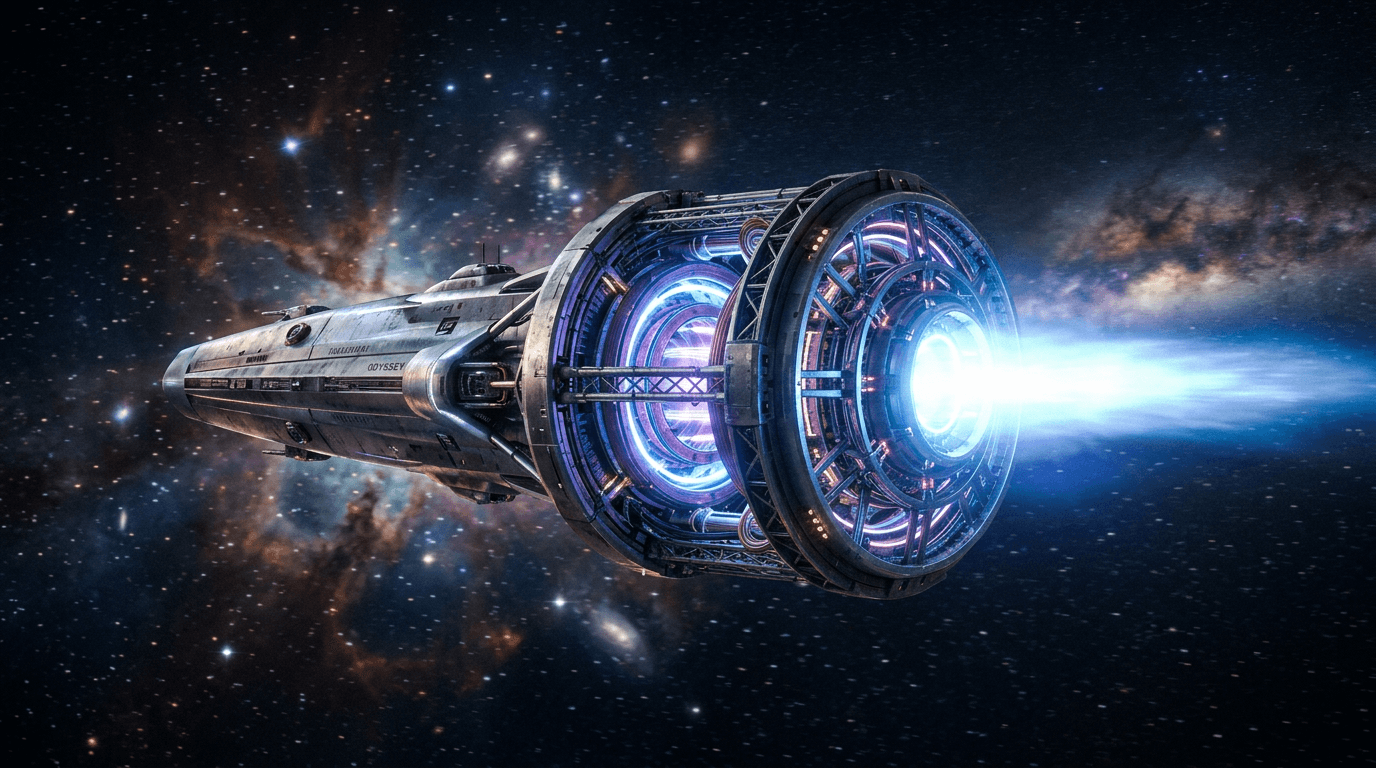
Constant-Acceleration Drive
Constant-acceleration interstellar propulsion concepts propose maintaining steady thrust for weeks rather than brief burns, reaching relativistic speeds (~0.7c) enabling Proxima Centauri missions in ~7 years. The approach requires: compact fusion reactors with specific impulse ~10⁷ seconds (vs. chemical ~400, ion ~20,000); deuterium-lithium or advanced fusion cycles; and power-to-thrust conversion without prohibitive radiator mass.
Advantages and Requirements
Extended acceleration offers advantages over brief-impulse trajectories: higher final velocities; mission time dominated by cruise rather than acceleration; artificial gravity during boost phase; and mid-course maneuverability. Achieving weeks of constant 1g thrust requires reactor power ~terawatts for spacecraft, exhaust velocities approaching c, and propellant efficiency far exceeding current systems.
Current Status
Fusion propulsion is studied concept (NASA, DARPA, private ventures), but demonstrated systems remain distant. Challenges include: achieving breakeven fusion (still elusive terrestrially); compact high-power reactors; efficient thrust conversion; and thermal management. D-Li fusion offers theoretical Isp ~10⁷ through direct energy conversion, but requires advanced confinement. The constant-acceleration approach represents aspirational interstellar architecture—bridging plausible physics with engineering centuries beyond current capabilities.
Research this in Signals
Signals turns a topic into a sourced research record you can inspect and rerun. Your first scan is free, and this one starts with Constant-Acceleration Drive already loaded, so edit it or scan as is.