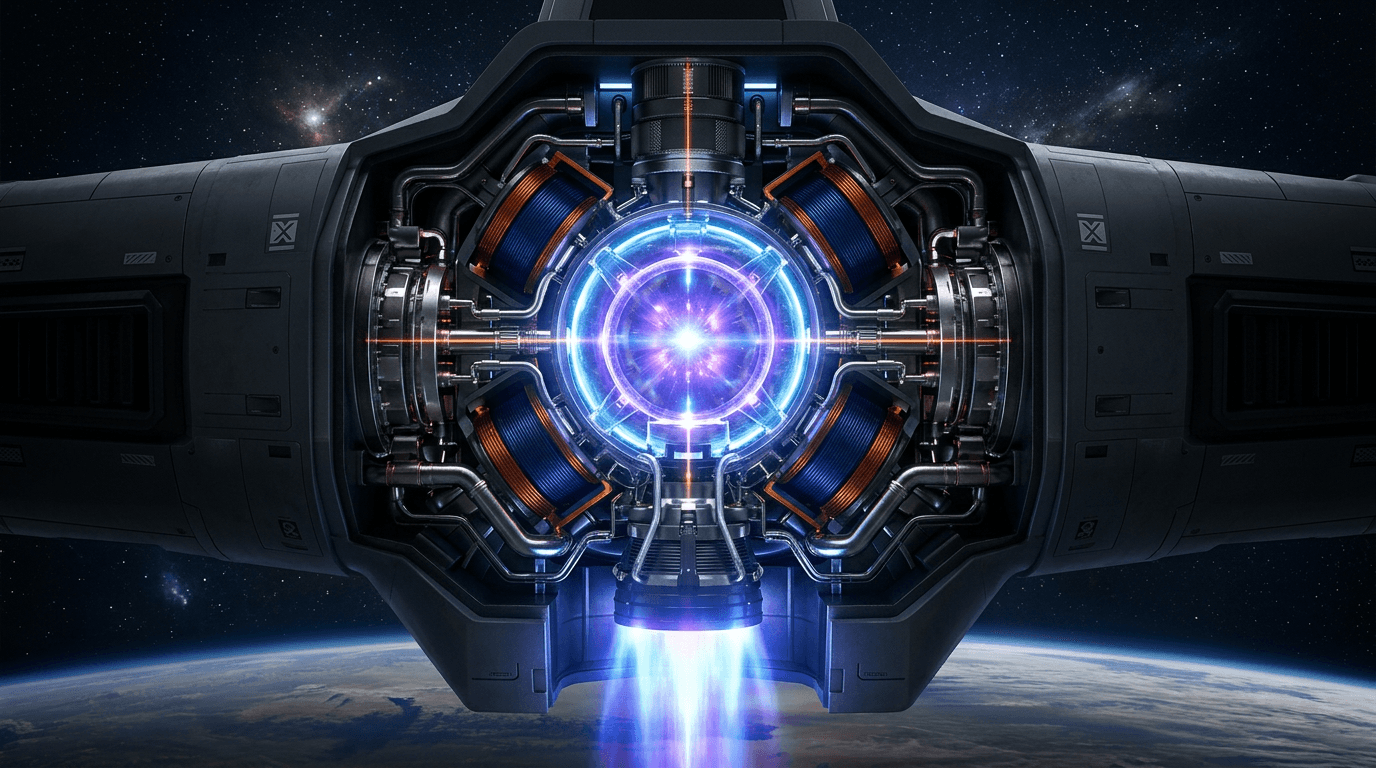
Antimatter Propulsion
Positron aerospace propulsion represents the theoretical pinnacle of chemical energy density—matter-antimatter annihilation converting 100% of mass to energy per E=mc². The DIA's Defense Intelligence Reference Document DIRD-08 (2009, part of AAWSAP/AATIP program) surveyed positron propulsion concepts, production methods, storage challenges, and potential aerospace applications—representing official Pentagon interest in antimatter technology for breakthrough propulsion.
Antimatter Physics & Energy Density
When matter and antimatter meet, they annihilate completely into gamma rays and kinetic energy. A single gram of antimatter-matter reaction releases ~90 terajoules—equivalent to Hiroshima bomb energy, or 21 kilotons TNT. For propulsion, this translates to theoretical specific impulse exceeding 10 million seconds (vs. chemical rockets ~450s, ion drives ~3000s), exhaust velocities approaching light speed, and mass ratios enabling interstellar missions. Pure antimatter rockets could reach 0.5c+ with reasonable mass fractions.
Production Methods
Positrons (antielectrons) are produced via
high-energy particle accelerators bombarding heavy targets (pair production from gamma rays); radioactive decay of certain isotopes (positron-emitting medical isotopes like F-18); and cosmic ray interactions (natural but diffuse). Current production rates are infinitesimal—CERN produces ~10⁷ antiprotons/second, accumulating nanograms annually. Total human antimatter production to date: ~20 nanograms. Scaling to propulsion-relevant quantities (micrograms to grams) would require million-fold production increases and revolutionary storage.
Storage & Containment
Antimatter cannot touch normal matter without annihilating. Storage methods include Penning traps (magnetic/electric fields suspending charged antiparticles in ultra-high vacuum); antihydrogen magnetic bottles (neutral antimatter trapped via magnetic moment); and proposed solid antihydrogen or positronium systems frozen to millikelvin temperatures. CERN's ALPHA experiment stored antihydrogen atoms for 1000 seconds (2011)—record duration but minuscule quantity. Spacecraft antimatter storage requires: cryogenic magnetic systems, ultra-high vacuum maintenance, fail-safe containment preventing accidental contact, and power systems sustaining traps during long missions.
Propulsion Architectures
Multiple antimatter rocket concepts exist. Antimatter beam-core rockets directly expel annihilation products (gamma rays, pions) as exhaust—theoretically highest Isp but extremely low thrust and poor collimation. Antimatter-catalyzed nuclear pulse propulsion (ACNP) uses tiny antimatter quantities to trigger fission/fusion in propellant pellets—sub-gram antimatter initiating kiloton-scale explosions, Orion-style pulse propulsion with 100,000s Isp. Positron-ablative propulsion heats solid propellant via positron annihilation at surface—intermediate Isp (~5000s) with engineerable thrust levels. Hybrid antimatter-augmented chemical/electric systems use antimatter heating for performance gains without pure annihilation drives.
Current Capabilities & Challenges
Humanity's antimatter technology remains embryonic. Production cost
~$25 billion per milligram at CERN rates (though theoretical improvements could reduce to millions per milligram). Storage duration: minutes to hours for laboratory quantities. Total inventory: nanograms globally. A Mars mission might require micrograms; interstellar probe grams to kilograms. The gap between current capability and propulsion applications spans 6-9 orders of magnitude. DIRD-08 assessment concluded: positron propulsion is theoretically sound and offers revolutionary performance, but production/storage breakthroughs are prerequisite—likely requiring dedicated antimatter factories and advanced magnetic containment technology.
Military & Strategic Implications
DIRD-08's inclusion in AAWSAP reflects Pentagon interest in
assessing foreign antimatter programs (particularly speculated Chinese research); evaluating antimatter as potential weapon (gram-scale annihilation equals nuclear yield without fissile material); exploring antimatter's role in alleged UAP propulsion (extraordinary energy density matching reported performance); and long-term strategic aerospace dominance through breakthrough propulsion. The study represents rare official acknowledgment that antimatter propulsion—while distant—merits serious military analysis.
Near-Term Applications
Medical positron emission tomography (PET) already uses positron-emitting isotopes routinely. Proposed intermediate applications include: antimatter-triggered fusion (using micrograms to initiate fusion reactions); materials science (positron annihilation spectroscopy studies defects); and space radiation testing (positron beams simulating cosmic ray effects). These represent stepping stones toward propulsion-scale antimatter technology, building production and handling infrastructure.
Positron aerospace propulsion occupies unique position—grounded in established physics (antimatter is real, well-characterized), offering unparalleled theoretical performance (Isp orders of magnitude beyond alternatives), yet facing insurmountable near-term barriers (production cost, storage duration, scaling challenges). Its inclusion in official DIA DIRD studies legitimizes antimatter as long-term aerospace technology trajectory rather than pure science fiction, while acknowledging current capabilities remain ~50-100 years from practical propulsion applications. The technology represents humanity's theoretical propulsion endgame—if production and storage challenges can be solved.
Research this in Signals
Signals turns a topic into a sourced research record you can inspect and rerun. Your first scan is free, and this one starts with Antimatter Propulsion already loaded, so edit it or scan as is.