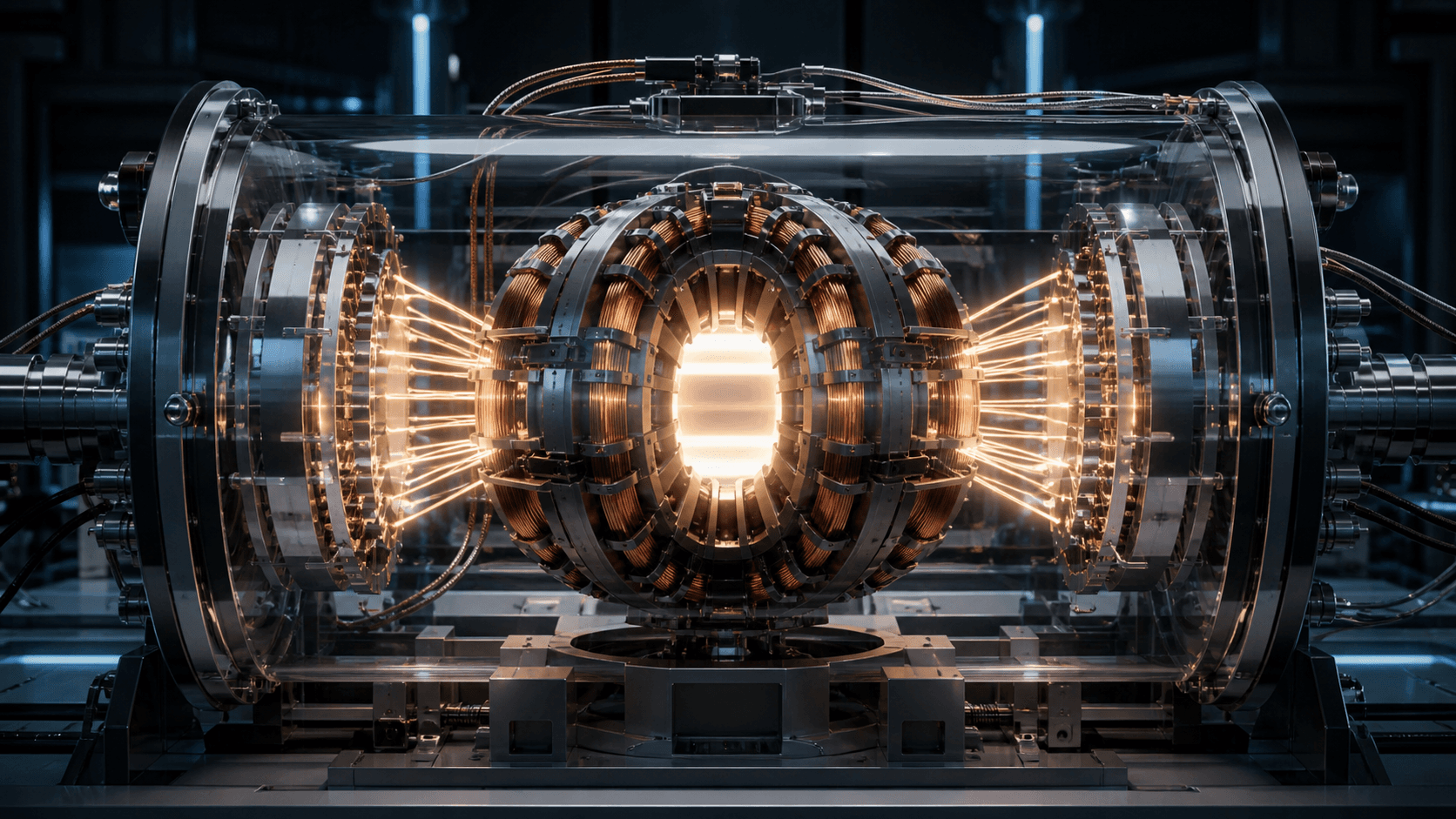
Aneutronic Fusion
Aneutronic fusion represents nuclear fusion reactions producing few or no neutrons, contrasting with conventional D-T fusion (80% energy as high-energy neutrons requiring massive shielding). Aneutronic reactions offer: minimal radiation shielding (reducing reactor mass); direct energy conversion via charged particle collection (70-90% efficiency bypassing thermal cycles); reduced radioactive waste; and compact reactor configurations for aerospace.
Primary Aneutronic Reactions
Proton-Boron-11 (p-B11, three alpha particles, no neutrons, requires ~5 billion Kelvin); Deuterium-Helium-3 (D-He3, produces proton and He-4, ~5% secondary neutrons, requires ~1 billion Kelvin); and He3-He3 (two protons and He-4, fully aneutronic but scarce fuel). All require far higher temperatures than D-T fusion (150 million Kelvin), presenting extreme confinement challenges.
Technical Approaches & Current Research
Multiple confinement strategies are being pursued for aneutronic fusion. Magnetic confinement variants include: advanced tokamak configurations (National Ignition Facility explored p-B11 in standard magnetic bottles, requiring extreme field strengths); field-reversed configuration (FRC) approaches (TAE Technologies' Norman device targeting D-He3 and p-B11, achieving 75 million Kelvin sustained plasmas with beam-driven stabilization); spheromak and levitated dipole concepts for improved confinement efficiency. Inertial confinement approaches include: laser-driven p-B11 (HB11 Energy in Australia using petawatt lasers achieving billion-to-one fusion yield improvements in 2020s); heavy ion beam fusion; and Z-pinch compression (Zap Energy exploring sheared-flow stabilization). Alternative approaches include: muon-catalyzed fusion (replacing electrons with muons reduces confinement scale, demonstrated but muon production costs exceed energy yield); magnetized target fusion (General Fusion compressing FRC plasmas with mechanical pistons); and electrostatic confinement (Polywell, focus fusion devices—compact but plagued by loss mechanisms).
Direct Energy Conversion
Aneutronic fusion's primary advantage stems from charged particle products enabling direct electricity generation. Unlike neutrons (which deposit energy as heat requiring steam turbines at ~40% efficiency), alpha particles and protons carry charge allowing: traveling wave direct converters (particles decelerated through electric potential gradients directly generating voltage); magnetic expansion energy recovery (charged particles adiabatically expanded, converting kinetic to electric potential); and inverse cyclotron conversion (particles spiraling in magnetic fields induce AC current in coils). Theoretical conversion efficiencies exceed 80-90%, versus 30-40% for conventional thermal cycles.
Aerospace & Propulsion Applications
Aneutronic fusion's low-neutron signature and compact potential make it ideal for spacecraft applications. Proposed systems include: D-He3 fusion rockets (exhaust velocities of 100-300 km/s, specific impulse 10,000-30,000 seconds, enabling fast Mars transits or outer solar system missions); direct fusion drive (Princeton Plasma Physics Laboratory and Princeton Satellite Systems developed concept using radio-frequency heating of FRC plasma, throttleable thrust, NASA NIAC studies); and p-B11 micro-reactors for satellite power (kilowatt to megawatt scales, decades-long operation without refueling or significant radiation hazards).
Challenges & Current Status
Aneutronic fusion faces severe physics and engineering barriers. Temperature requirements vastly exceed D-T fusion—p-B11 needs 5 billion Kelvin versus 150 million for D-T, requiring 30× higher ion energy and correspondingly more difficult confinement. Plasma losses scale adversely: bremsstrahlung radiation increases with temperature and atomic number, potentially exceeding fusion power at high temperatures; synchrotron radiation from magnetic confinement becomes severe at high energies; and fuel cross-sections for aneutronic fuels peak at higher energies than D-T, making ignition far more difficult. Current best results show: TAE Technologies achieving 75 million Kelvin for ~30 milliseconds (still 5-10× below p-B11 requirements); HB11's laser fusion achieving ~300 times more reactions than expected but still billions away from breakeven; and Helion Energy targeting D-He3 with pulsed compression FRC (claimed 100 million Kelvin achievements, pending independent verification). No facility has demonstrated sustained aneutronic fusion, let alone breakeven or net energy—decades away from practical reactors.
Fuel Availability
He3 scarcity presents additional challenge—virtually absent on Earth (~35 kg total planetary inventory), requiring lunar mining (He3 implanted in regolith by solar wind, ~1 ppm concentrations) or gas giant atmospheric extraction. This makes D-He3 and He3-He3 reactions dependent on off-world infrastructure, limiting near-term applications. P-B11 uses abundant boron and hydrogen, avoiding fuel supply concerns, but faces the most extreme ignition requirements.
Research this in Signals
Signals turns a topic into a sourced research record you can inspect and rerun. Your first scan is free, and this one starts with Aneutronic Fusion already loaded, so edit it or scan as is.