Public-Private Partnerships for Housing
Public-private partnerships for housing represent a strategic governance model designed to address a fundamental tension in contemporary housing markets: the need to deliver affordable, socially beneficial housing while leveraging private capital, expertise, and development capacity. The core challenge these partnerships aim to solve is the growing gap between public housing ambitions and constrained municipal budgets across the Benelux region. Traditional purely public housing development often struggles with funding limitations and slower delivery timelines, while purely market-driven development frequently fails to meet affordability targets or provide adequate public amenities. PPPs emerge as a hybrid approach that seeks to combine public sector objectives—such as affordability requirements, social mixing, sustainability standards, and community infrastructure—with private sector strengths in project financing, construction efficiency, and development innovation. This model has gained traction particularly in contexts where municipalities control land assets but lack capital for development, or where complex mixed-use projects require coordination across multiple stakeholders and funding streams.
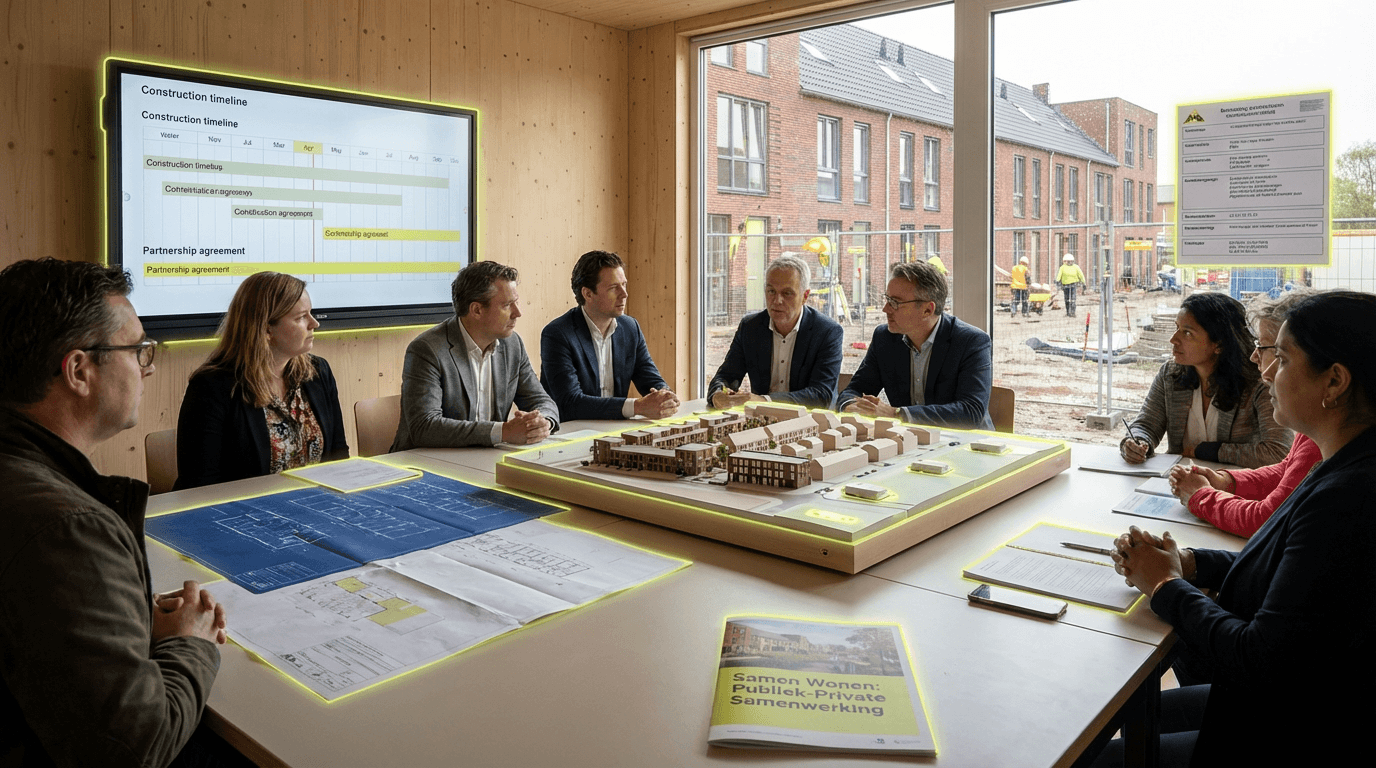
The operational mechanics of housing PPPs vary considerably, but typically involve contractual arrangements where public authorities contribute land, planning permissions, or subsidies while private developers provide capital, construction expertise, and ongoing management. In the Netherlands, municipalities increasingly enter into ground lease arrangements with developers, retaining land ownership while enabling private construction of mixed-income housing that includes social housing quotas alongside market-rate units. Belgian examples include collaborative frameworks where public housing corporations partner with private builders to regenerate urban districts, combining social housing with commercial development to cross-subsidise affordability. Luxembourg has experimented with models where the state provides guarantees or co-investment to de-risk projects that include significant affordable housing components. Early evidence suggests these partnerships can accelerate delivery timelines compared to purely public approaches, though outcomes depend heavily on contract design, risk allocation mechanisms, and the strength of public oversight. Research from Dutch housing policy institutes indicates that successful PPPs typically feature clear affordability commitments, transparent governance structures, and mechanisms to ensure public goals are not compromised when market conditions shift.
The implications of this signal extend beyond individual projects to broader questions about housing governance and the role of public authority in shaping urban development. As PPPs become more prevalent, monitoring should focus on whether these arrangements genuinely deliver on public objectives or gradually shift risk and control toward private partners. Key thresholds to watch include the proportion of affordable units actually delivered versus initial commitments, the long-term ownership and management structures that emerge, and whether partnerships create genuine innovation or simply privatise public assets. For municipalities, the challenge lies in building internal capacity to negotiate complex contracts and maintain oversight throughout project lifecycles. There is also the question of democratic accountability—ensuring that partnership decisions remain transparent and responsive to community needs rather than becoming opaque deals favouring developer interests. As housing pressures intensify across the Benelux region, the evolution of PPP models will likely influence whether collaborative governance can genuinely reconcile market dynamics with social housing goals, or whether it represents a transitional phase toward further marketisation of housing provision.