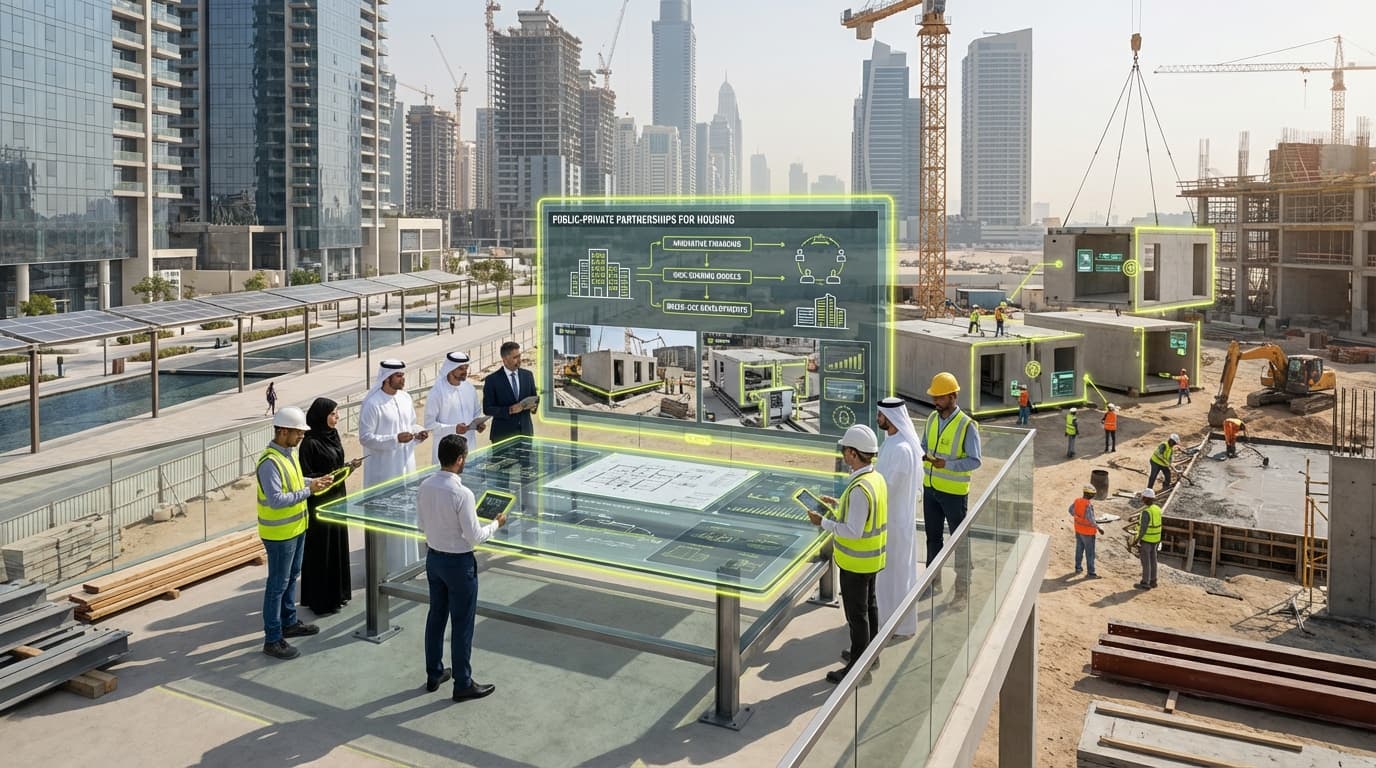
Public-Private Partnerships for Housing
Public-private partnerships for housing represent a strategic shift in how governments address housing shortages and affordability crises. Rather than relying solely on public budgets or leaving housing entirely to market forces, PPP models create structured collaborations where public entities provide land, regulatory support, or subsidies while private developers contribute capital, construction expertise, and operational efficiency. This signal matters because it points to a fundamental recalibration of housing provision in contexts where neither pure public housing nor unregulated markets have adequately met demand. In the Gulf, where rapid urbanization has created acute housing needs among citizen populations while governments seek to diversify economies and optimize public spending, PPPs offer a mechanism to scale housing delivery without overwhelming public budgets. The challenge these partnerships address is not merely financial—they also tackle capacity constraints, risk distribution, and the need to balance social objectives with commercial viability.
Early evidence of this model's traction appears in several GCC initiatives. Saudi Arabia's Sakani program, for instance, has explored partnership structures that leverage private sector efficiency while maintaining public oversight of affordability targets and citizen access. The UAE has similarly tested collaborative frameworks where government entities provide land or infrastructure while private developers handle construction and sometimes long-term management. These arrangements vary considerably in structure—some involve direct equity partnerships, others use land leases or revenue-sharing agreements, and still others rely on public guarantees to de-risk private investment. Industry observers note that successful PPPs typically require clear contractual frameworks that specify performance standards, affordability requirements, and exit mechanisms. The pattern suggests movement toward more sophisticated risk-sharing instruments rather than simple outsourcing, with governments retaining strategic control while accessing private capital and expertise. However, implementation remains uneven, with many pilots still testing optimal allocation of responsibilities and returns.
The implications extend beyond individual projects to broader housing system transformation. If PPP models prove scalable and financially sustainable, they could enable GCC nations to accelerate housing delivery without proportional increases in public expenditure—critical as these countries manage fiscal transitions. For private developers, structured partnerships with government backing may reduce market risk and provide more predictable revenue streams than purely speculative development. Yet significant uncertainties remain around long-term affordability preservation, especially if private partners prioritize returns over social objectives as projects mature. Monitoring should focus on actual delivery volumes compared to traditional public housing, sustained affordability over project lifecycles, and whether partnership structures genuinely transfer risk or simply create contingent public liabilities. The success threshold will likely be whether these models can consistently deliver housing at scale and target price points without requiring ongoing subsidies or bailouts—a test that will unfold over the next decade as early projects reach operational maturity.
Related Organizations
National Housing Company (NHC)
Saudi Arabia · Company
The investment arm of the Saudi Ministry of Housing, specifically created to enable private developers to build on government land through PPP models.

Abu Dhabi's leading developer, with a significant recurring income portfolio from investment properties (residential and commercial).

The leading provider of housing finance in Bahrain, actively engaging in PPPs (like the Danaat projects) to develop affordable housing.

A PIF subsidiary modeled after Fannie Mae, providing liquidity to the housing finance market to support private lending.

Mubadala Investment Company
United Arab Emirates · Government Agency
A sovereign investor managing a diverse portfolio of assets for the Government of Abu Dhabi, including Masdar and GlobalFoundries.

A UAE developer that has partnered with government entities to develop mixed-use and residential communities.