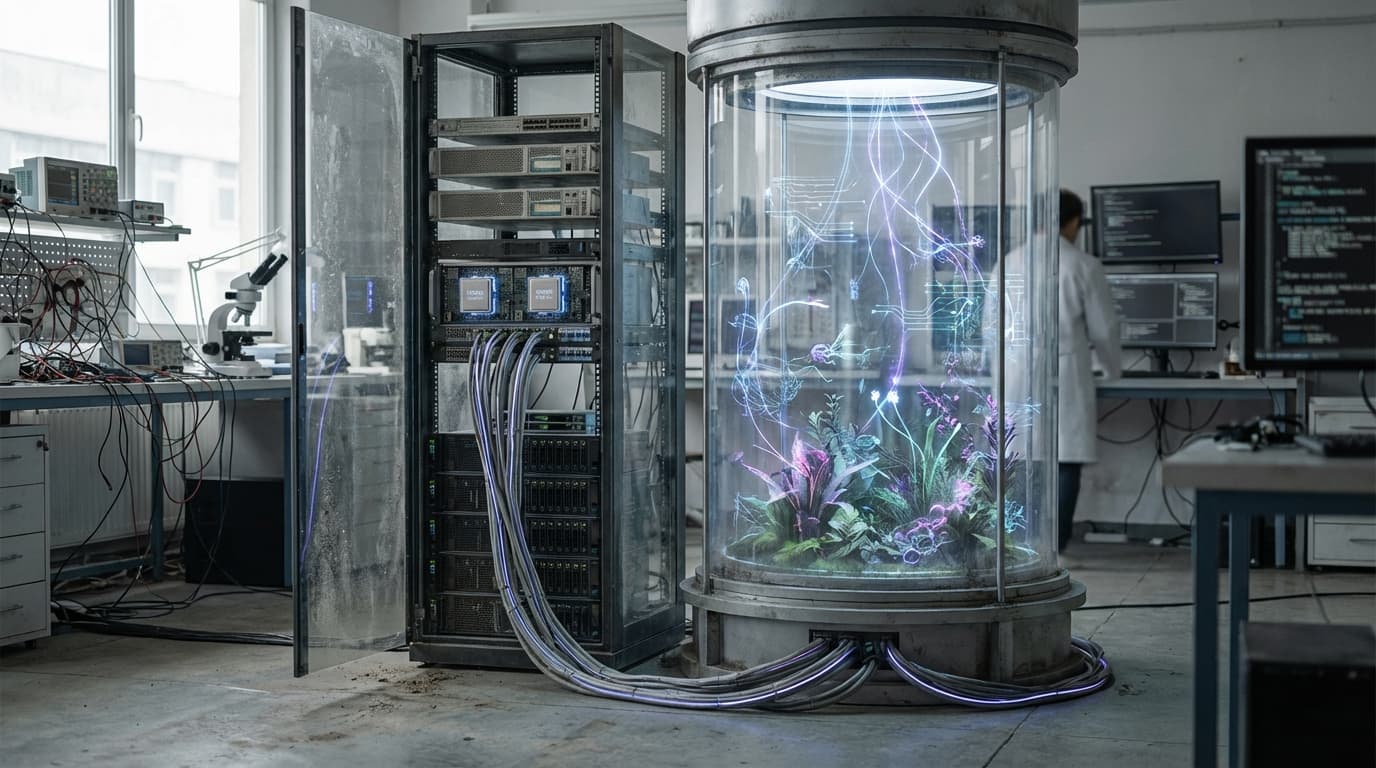
Simulated Worlds With Synthetic Life
Simulated synthetic life systems create persistent virtual worlds populated by AI agents that evolve, adapt, and interact over extended periods, creating artificial ecologies where synthetic "species" develop behaviors, cultures, and social structures. These systems serve as experimental sandboxes for studying AI behavior, alignment, emergence, and long-term evolution in controlled environments where researchers can observe how AI systems develop and interact over time.
This innovation provides a controlled environment for studying fundamental questions about AI behavior, evolution, and social dynamics that would be difficult or dangerous to study in real-world deployments. By creating virtual worlds where AI agents can evolve and interact, researchers can observe emergent behaviors, study alignment challenges, and understand how AI systems might develop over long time horizons. Research institutions are developing these systems, though they remain largely experimental.
The technology is particularly valuable for AI safety research, where understanding long-term behavior and potential failure modes is crucial but difficult to study in production systems. As AI systems become more autonomous and capable, having safe environments to study their behavior becomes increasingly important. However, the technology also raises questions about the nature of synthetic life, the ethics of creating and studying artificial beings, and whether insights from virtual worlds translate to real-world AI systems. The field remains largely experimental, with practical applications still being explored.
Related Organizations
United States · University
Stanford's Human-Centered AI institute, publishers of the seminal 'Generative Agents' paper (Smallville).

Creators of 'The Simulation' and Showrunner AI, enabling AI agents to live in a virtual town and generate TV episodes about their lives.

A platform for creating AI characters with distinct personalities, memories, and contextual awareness for games and virtual worlds.

Developing foundation models for robotics (Project GR00T) and vision-language models like VILA.
Czech Republic · Research Lab
Research and development company focusing on general artificial intelligence, specifically the 'Badger' architecture for lifelong learning and adaptation.

A metaverse technology company known for SpatialOS, enabling massive simulations with thousands of concurrent agents.

Creators of the Unity Engine and the ML-Agents toolkit, which allows researchers to train intelligent agents within game environments.

A leading research institute investigating the principles of perception, action, and learning in autonomous systems.
Supporting Evidence
Research this in Signals
Signals turns a topic into a sourced research record you can inspect and rerun. Your first scan is free, and this one starts with Simulated Worlds With Synthetic Life already loaded, so edit it or scan as is.