Biohybrid Constructs
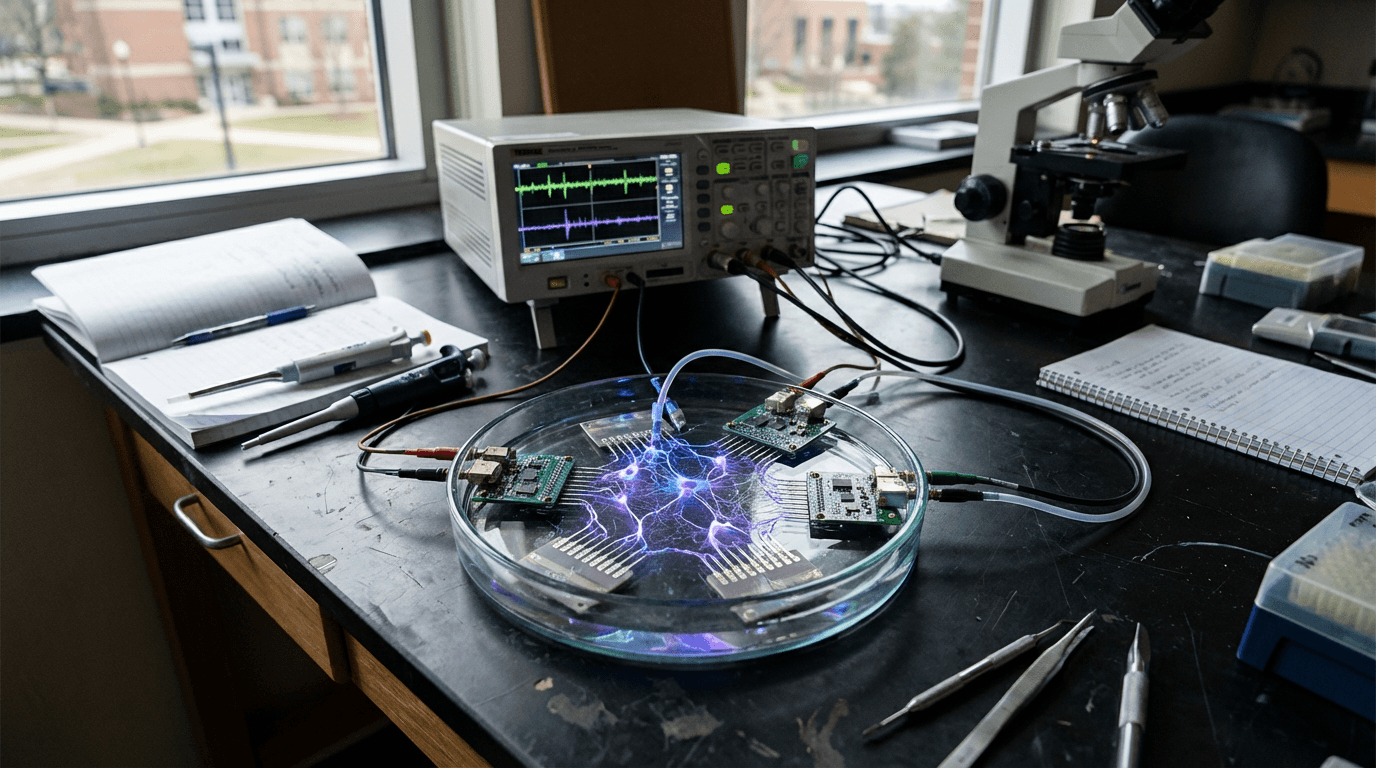
Biohybrid constructs integrate living biological neurons—cultured in vitro or derived from stem cells—with electronic interfaces and silicon controllers, creating computational systems that combine biological and artificial components. These systems use microelectrode arrays or other interfaces to read from and write to neuronal networks, leveraging the natural computational capabilities of biological neurons while providing electronic control and readout.
This innovation explores the boundary between biological and artificial intelligence, seeking to harness the remarkable efficiency, plasticity, and parallel processing capabilities of biological neurons for computational tasks. Biological neurons can perform complex pattern recognition and learning with far less energy than artificial systems, and their natural plasticity enables adaptation and learning. Research institutions are developing these systems, with some demonstrating basic computational capabilities like pattern recognition and simple control tasks.
The technology raises profound questions about the nature of intelligence, consciousness, and the relationship between biological and artificial systems. While still highly experimental, biohybrid constructs could potentially offer new approaches to AI that leverage biological computation. However, the technology faces significant challenges including maintaining living cells, interfacing biological and electronic systems, and ethical considerations around using biological tissue for computation. The field remains largely in research phase, with practical applications likely decades away if they materialize at all.
Related Organizations

Creators of 'DishBrain', a system that integrates living brain cells with silicon chips to play video games like Pong.

Offers the first online platform providing access to biological neural networks (organoids) for biocomputing research.

Integrates biological neurons with silicon to create 'smell cyborgs' capable of detecting explosives and diseases.

Conducts advanced research in bioelectronics and the interface between biological systems and electronic circuits.
Belgium · Research Lab
An academic research initiative by imec, KU Leuven, and VIB focusing on understanding brain circuits using neurotechnology.

Japan's largest comprehensive research institution, with significant work in brain science and bio-hybrid systems.
Germany · Research Lab
Conducts basic research into the development and function of the nervous system.

A graphene electronics company that acquired Cardea Bio, a leader in graphene-based biology-gated transistors.
Supporting Evidence
Research this in Signals
Signals turns a topic into a sourced research record you can inspect and rerun. Your first scan is free, and this one starts with Biohybrid Constructs already loaded, so edit it or scan as is.