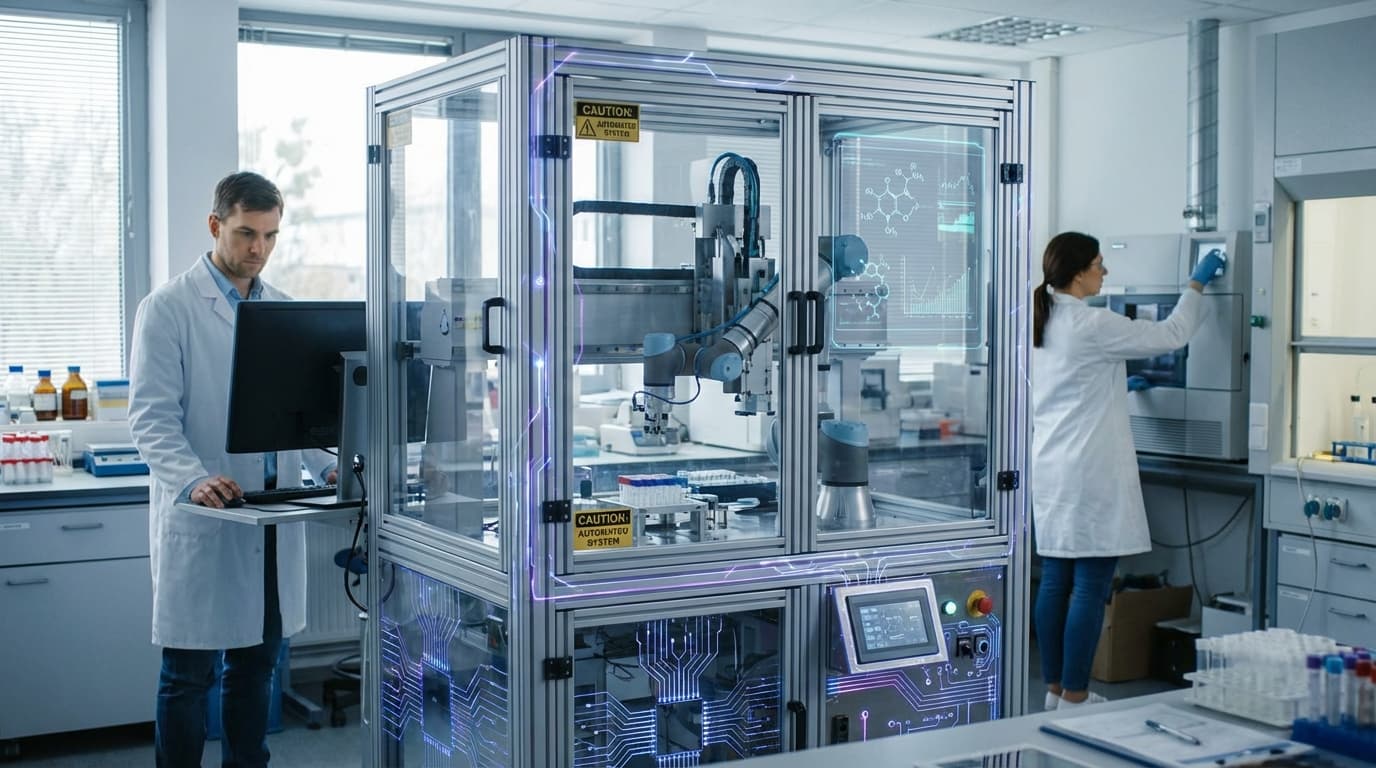
AI-Accelerated Science Platforms
AI-accelerated science platforms create closed-loop systems where AI agents can autonomously conduct the entire scientific process: proposing hypotheses based on existing knowledge, designing experiments to test those hypotheses, operating robotic laboratory equipment to run experiments, analyzing results, and updating their understanding to propose new experiments. These systems couple large language models with robotic automation and simulation capabilities, creating AI scientists that can work continuously without human intervention.
This innovation addresses the time-intensive nature of scientific research, where the cycle of hypothesis, experiment, and analysis can take months or years. By automating this cycle, AI-accelerated platforms can dramatically compress discovery timelines, potentially enabling scientific breakthroughs at unprecedented speed. The technology is particularly powerful in fields like materials science, drug discovery, and chemistry where experiments can be automated. Research institutions and companies are developing these systems, with some already demonstrating the ability to discover new materials or compounds autonomously.
The technology could fundamentally transform scientific discovery, enabling a new paradigm where AI systems can explore vast experimental spaces autonomously, potentially discovering solutions that humans might never consider. As the technology improves, it could accelerate progress across many scientific domains. However, ensuring that AI-generated hypotheses are meaningful, experiments are well-designed, and results are properly interpreted remains challenging. The technology also raises questions about the role of human scientists and how to ensure AI-driven science maintains rigor and produces reliable knowledge.
Related Organizations

Google's AI research lab, creators of AlphaFold (protein structure) and GNoME (materials discovery).

A subsidiary of Alphabet applying AI (specifically AlphaFold technology) to reimagine the drug discovery process.

A clinical-stage biotechnology company using generative AI for end-to-end drug discovery and research.

A clinical-stage techbio company decoding biology by integrating technological innovations across biology, chemistry, automation, and data science.
United Kingdom · Company
A pharmatech company using patient-first AI to discover better drugs, faster.
United States · Startup
A technology platform company for new materials discovery that combines robotics and artificial intelligence in a self-driving lab.

Argonne National Laboratory
United States · Research Lab
U.S. Department of Energy multidisciplinary science and engineering research center.
United States · Company
Provides a highly automated cloud laboratory where scientists can design and run experiments remotely via code.

Provides an AI platform for materials informatics, helping companies develop new materials and chemicals faster.
Canada · Startup
Uses AI to decode the world's biomedical data to help scientists design more successful experiments.
Supporting Evidence
Research this in Signals
Signals turns a topic into a sourced research record you can inspect and rerun. Your first scan is free, and this one starts with AI-Accelerated Science Platforms already loaded, so edit it or scan as is.