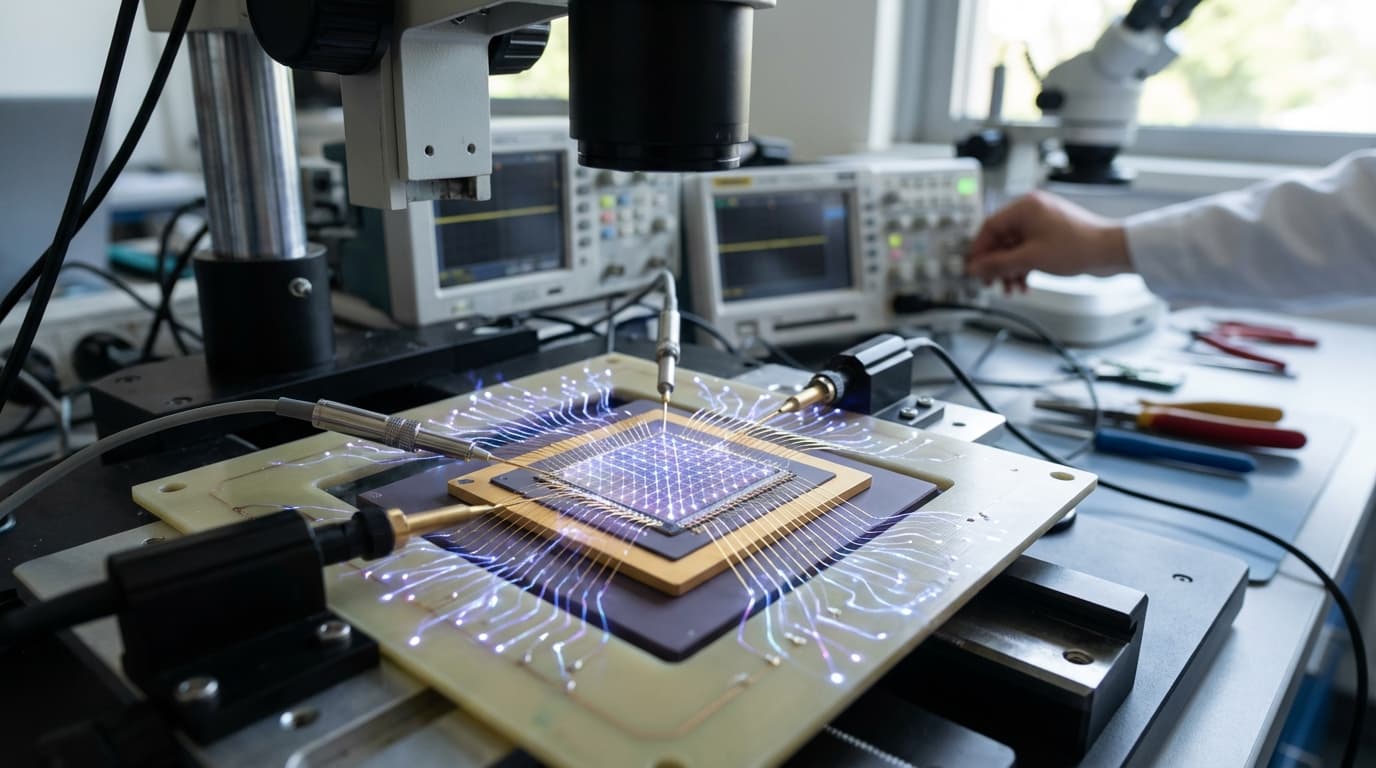
Memristor Crossbar Arrays
Memristor crossbar arrays use grids of memristive devices—circuit elements whose resistance can be programmed and remembers its state—to store neural network weights and perform multiply-accumulate (MAC) operations directly through Ohm's law. When input voltages are applied to rows and currents are read from columns, the array naturally computes matrix-vector multiplications, the core operation in neural networks, with exceptional energy efficiency.
This innovation addresses the energy and speed bottlenecks in AI inference by performing computation directly in memory where weights are stored, eliminating the need to repeatedly fetch weights from memory. Memristive crossbars can achieve orders-of-magnitude improvements in energy efficiency for inference tasks compared to traditional processors. Companies and research institutions are developing these technologies, with some systems demonstrating promising results for edge AI applications.
The technology is particularly valuable for edge devices where power efficiency is critical, such as smart assistants, IoT sensors, and mobile devices. As AI becomes more pervasive in edge applications, memristor crossbars offer a pathway to deploying sophisticated AI capabilities with minimal power consumption. However, the technology faces challenges including device variability, the need for calibration and compensation circuits, and manufacturing complexity, which must be addressed for commercial viability.
Related Organizations

The research arm of HPE, credited with the physical realization of the memristor and developing the Dot Product Engine.
United States · Startup
Develops analog in-memory computing accelerators using proprietary memristor crossbar technology for edge AI.
United States · Startup
Building analog neuromorphic hardware using memristive nanowire networks for training and inference.
United States · Company
Pioneers in Resistive RAM (ReRAM) technology, licensing IP for memory and neuromorphic applications.

Long-standing leader in neuro-symbolic AI, combining neural networks with logical reasoning for enterprise applications.
United States · Company
Provides discrete memristors and memristor-based learning modules for neuromorphic research.

A US Department of Energy lab actively researching adiabatic logic circuits and reversible computing to overcome thermodynamic limits in microelectronics.
Taiwan Semiconductor Manufacturing Company (TSMC)
Taiwan · Company
Global semiconductor foundry leader providing the advanced manufacturing and packaging processes required for wafer-scale integration.
Israel · Company
Developer of ReRAM technologies for embedded memory applications, partnering with foundries.
Italy · University
Leading European research institution in memristive devices and neuromorphic architectures.
Supporting Evidence
Research this in Signals
Signals turns a topic into a sourced research record you can inspect and rerun. Your first scan is free, and this one starts with Memristor Crossbar Arrays already loaded, so edit it or scan as is.