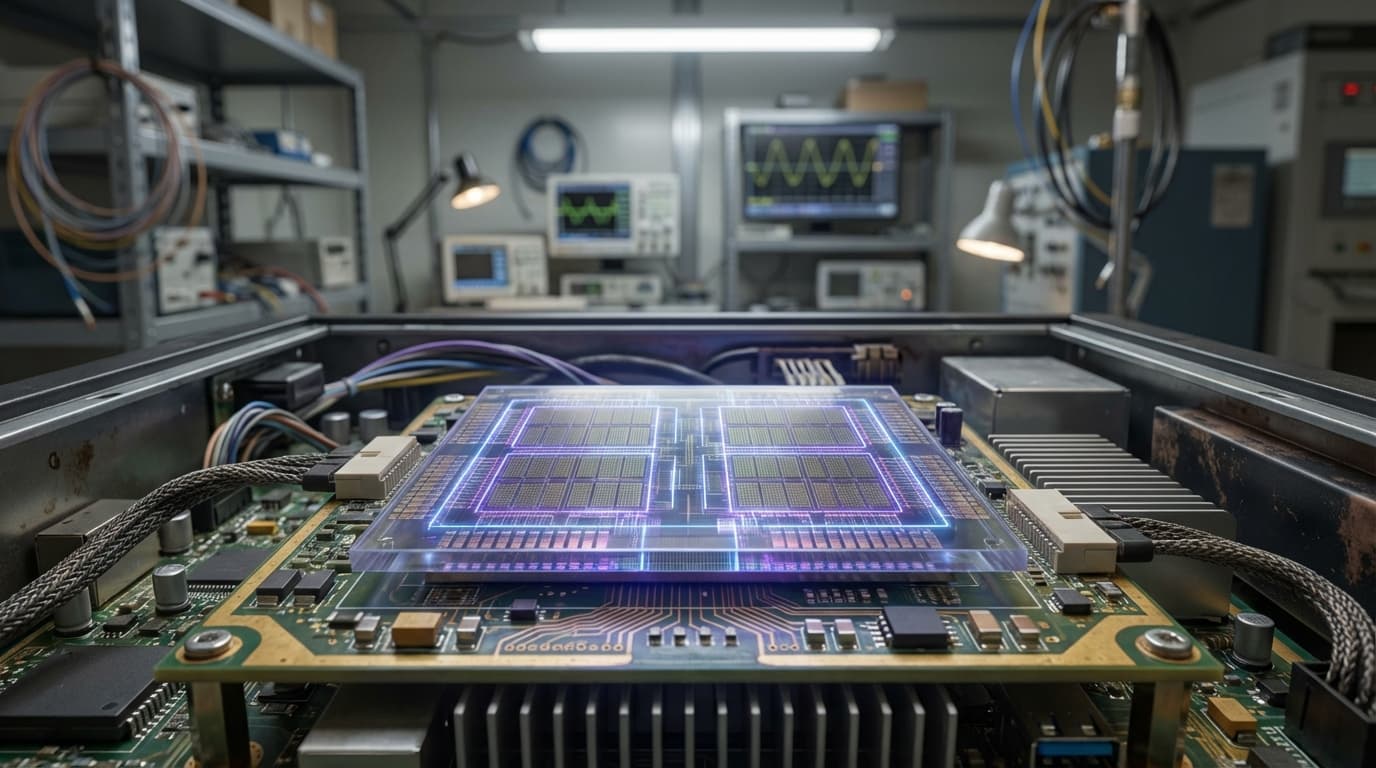
In-Memory Computing Chips
In-memory computing chips integrate processing logic directly within memory arrays, performing calculations where data is stored rather than moving data to separate processors. These systems use various memory technologies including SRAM, resistive RAM (ReRAM), or phase-change memory, combining memory cells with arithmetic units to execute operations in-place, dramatically reducing energy consumption and latency compared to traditional von Neumann architectures.
This innovation addresses the fundamental inefficiency of traditional computer architectures, where moving data between processors and memory consumes significant energy and time. By computing where data resides, in-memory chips can achieve orders-of-magnitude improvements in energy efficiency for AI workloads, particularly transformer models used in language processing and other applications. Companies like Mythic, Syntiant, and various research institutions are developing these technologies, with some chips already deployed in edge devices.
The technology is particularly valuable for edge AI applications where power efficiency is critical, such as autonomous vehicles, robots, and satellites that must operate on limited power budgets. As transformer models become the foundation of modern AI, in-memory computing offers a pathway to deploying these powerful models in resource-constrained environments. However, the technology faces challenges including precision limitations, manufacturing variability, and the need for algorithms optimized for in-memory computation.
Related Organizations
United States · Startup
Develops Analog Matrix Processors (AMP) that perform compute-in-memory using flash memory cells.
United States · Startup
Developing in-memory computing technology for AI based on charge-based analog computation.
Untether AI
Canada · Startup
Creates 'At-Memory' compute architectures that place processing elements directly adjacent to SRAM arrays.
Upmem
France · Startup
Develops Processing-in-Memory (PIM) solutions by integrating processors directly into DRAM chips.

Designs the Metis AI platform based on in-memory computing for computer vision at the edge.
United States · Company
Produces the Associative Processing Unit (APU), enabling compute-in-memory for search and AI.

SK Hynix
South Korea · Company
Developed GDDR6-AiM (Accelerator in Memory) technology for generative AI applications.
Israel · Startup
Building a SQL processing unit that computes directly inside memory to accelerate data analytics.

Develops Neural Decision Processors with near-memory compute architectures for ultra-low power edge AI.
Supporting Evidence
Research this in Signals
Signals turns a topic into a sourced research record you can inspect and rerun. Your first scan is free, and this one starts with In-Memory Computing Chips already loaded, so edit it or scan as is.