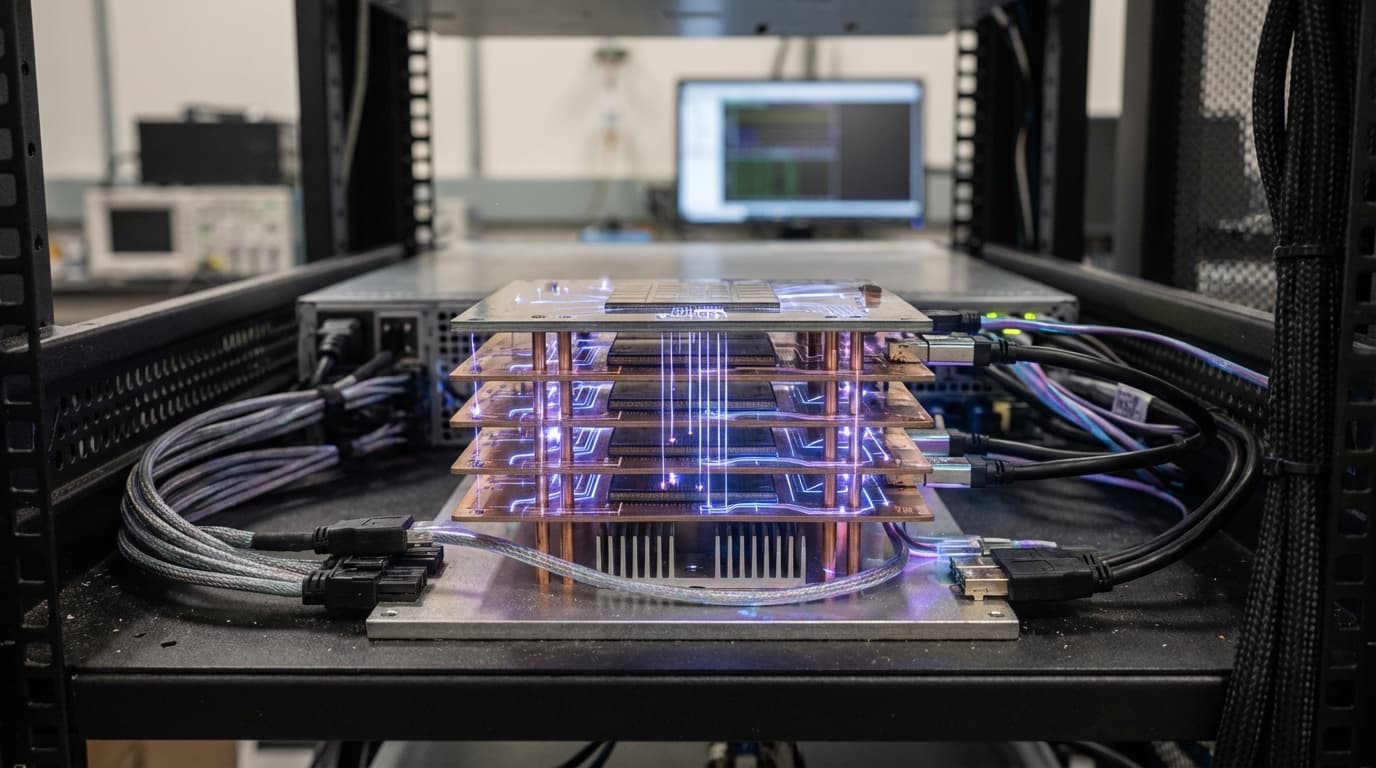
3D-Stacked Neuromorphic Architectures
3D-stacked neuromorphic architectures use vertical integration of multiple processing layers to create dense, brain-like connectivity patterns that support spiking neural networks, sparse activation, and recurrent processing natively. Unlike traditional 2D processors that struggle to efficiently emulate brain-like computation, these 3D architectures provide the physical connectivity and event-driven processing capabilities needed for neuromorphic computing.
This innovation addresses the fundamental mismatch between how brains compute and how traditional processors work. Brains use sparse, event-driven, massively parallel computation with dense local connectivity, while GPUs excel at dense, synchronous, matrix operations. Neuromorphic architectures bridge this gap by providing hardware that naturally supports brain-inspired algorithms. Research institutions and companies like Intel (Loihi), IBM (TrueNorth), and various startups are developing these systems.
The technology is particularly significant for applications requiring efficient, low-power processing of sparse, event-driven data, such as sensor networks, edge AI, and real-time pattern recognition. As we seek to create more efficient and brain-like AI systems, neuromorphic architectures offer a pathway to achieving biological levels of efficiency. However, the technology is still early-stage, and significant research is needed to develop algorithms and applications that fully leverage neuromorphic capabilities.
Related Organizations

Conducts advanced research into cryogenic CMOS and quantum computing interconnects.

Developer of the Loihi neuromorphic research chip and Foveros 3D packaging technology.
United Kingdom · University
A massive parallel computing platform based on spiking neural networks, designed to simulate the human brain.

A French technology research institute focusing on micro- and nanotechnologies.

Pioneer in event-based vision sensors and associated neuromorphic processing algorithms.
Develops ultra-low-power mixed-signal neuromorphic processors and sensors for edge AI applications.

Developer of the Akida neuromorphic processor IP and chips.
United States · Startup
Building analog neuromorphic hardware using memristive nanowire networks for training and inference.

Creates ultra-low power intelligence for sensors using spiking neural processor architecture.

Creators of the Intelligence Processing Unit (IPU), designed specifically for AI workloads.
Supporting Evidence
Research this in Signals
Signals turns a topic into a sourced research record you can inspect and rerun. Your first scan is free, and this one starts with 3D-Stacked Neuromorphic Architectures already loaded, so edit it or scan as is.