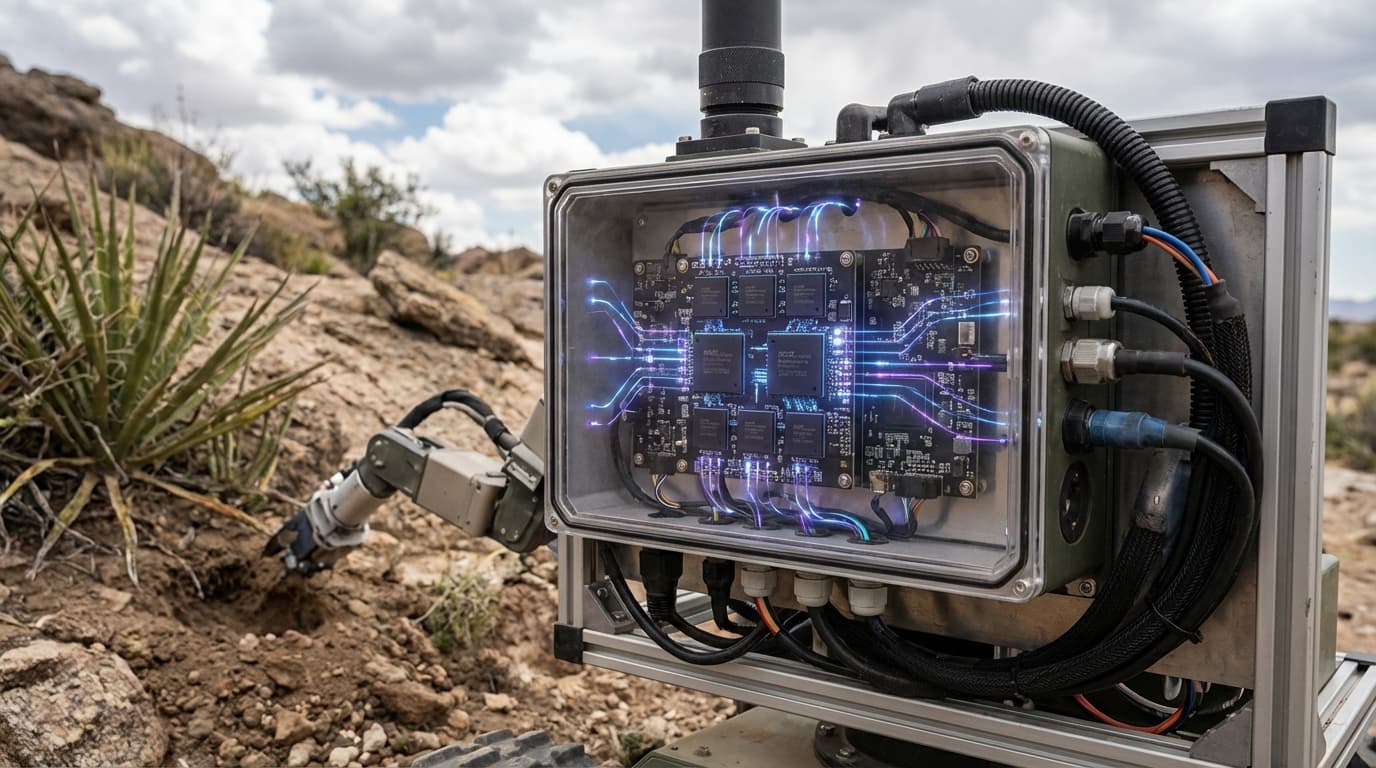
Analog In-Memory Compute Chips
Analog in-memory compute chips perform calculations directly within memory arrays where data is stored, eliminating the von Neumann bottleneck where processors must constantly fetch data from separate memory. These chips use analog circuits to perform matrix operations in-place, using the physical properties of memory cells (like resistance or capacitance) to compute results, dramatically reducing energy consumption and latency compared to traditional digital processors.
This innovation addresses the massive energy consumption of AI systems, where data movement between processors and memory accounts for a significant portion of power usage. By computing where data resides, analog in-memory chips can achieve orders-of-magnitude improvements in energy efficiency for AI workloads, particularly transformer models and continual learning tasks. Companies like Mythic, Syntiant, and various research institutions are developing these technologies, with some chips already deployed in edge devices.
The technology is particularly valuable for edge AI applications where power constraints are critical, such as mobile devices, IoT sensors, and autonomous systems. As AI becomes more pervasive and energy efficiency becomes a competitive advantage, analog in-memory computing offers a pathway to deploying sophisticated AI capabilities in power-constrained environments. However, the technology faces challenges including precision limitations, manufacturing variability, and the need for specialized design tools and algorithms optimized for analog computation.
Related Organizations

Long-standing leader in neuro-symbolic AI, combining neural networks with logical reasoning for enterprise applications.
United States · Startup
Develops Analog Matrix Processors (AMP) that perform compute-in-memory using flash memory cells.

Designs the Metis AI platform based on in-memory computing for computer vision at the edge.
United States · Startup
Developing in-memory computing technology for AI based on charge-based analog computation.
United States · Startup
Building analog neuromorphic hardware using memristive nanowire networks for training and inference.
United States · Startup
Develops analog in-memory computing accelerators using proprietary memristor crossbar technology for edge AI.

Develops analog machine learning chips for always-on sensing applications.
Canada · Startup
Designing analog semiconductor architecture for edge AI, utilizing standard CMOS manufacturing.

Taiwan Semiconductor Manufacturing Company (TSMC)
Taiwan · Company
Global semiconductor foundry leader providing the advanced manufacturing and packaging processes required for wafer-scale integration.
Supporting Evidence
Research this in Signals
Signals turns a topic into a sourced research record you can inspect and rerun. Your first scan is free, and this one starts with Analog In-Memory Compute Chips already loaded, so edit it or scan as is.