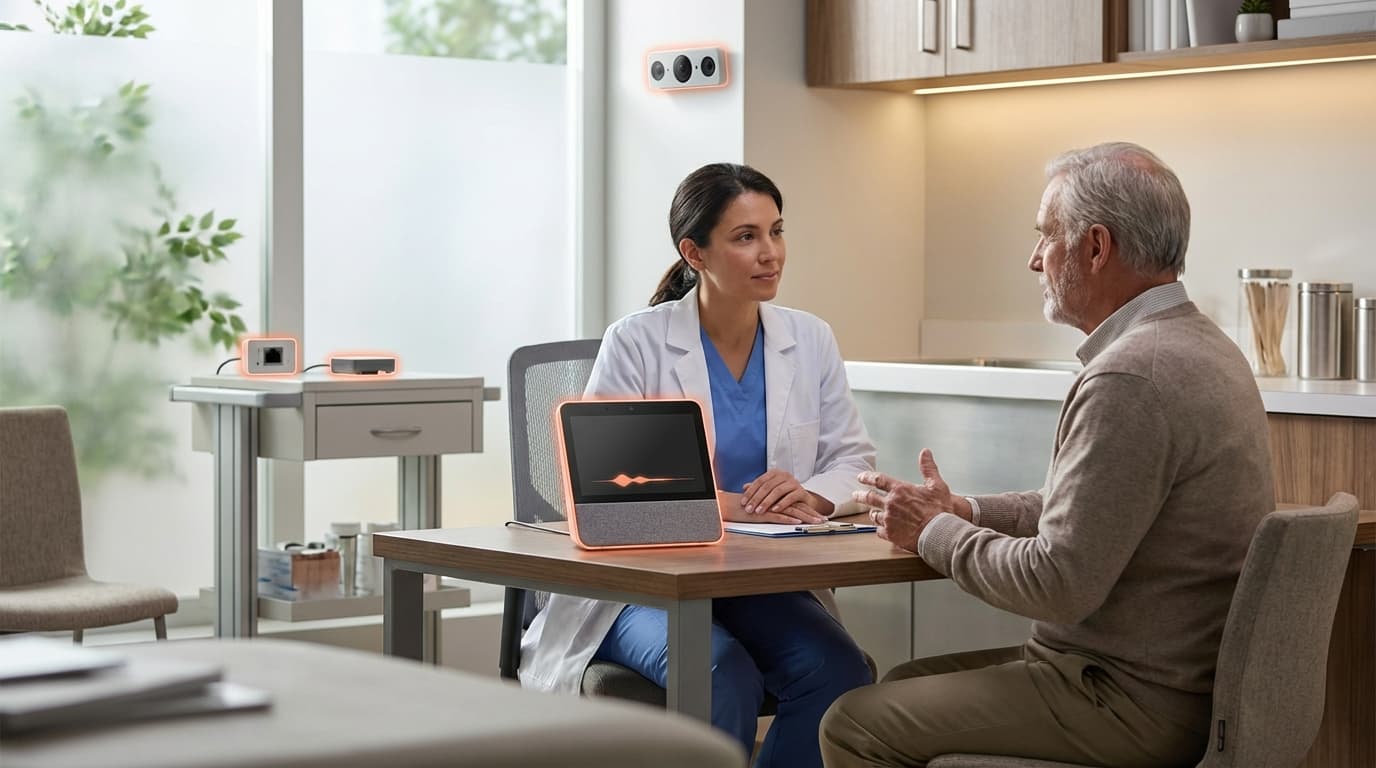
Ambient Clinical Intelligence
Ambient Clinical Intelligence represents a significant advancement in healthcare technology, leveraging sophisticated natural language processing and generative AI to transform how clinical documentation is created and managed. The system operates by continuously listening to conversations between healthcare providers and patients during consultations, using advanced speech recognition algorithms to capture dialogue in real-time. Through deep learning models trained on vast medical datasets, the technology can distinguish between casual conversation and clinically relevant information, identifying symptoms, diagnoses, treatment plans, and other critical medical details. The AI then processes this information through medical ontologies and clinical frameworks to generate structured documentation that aligns with Electronic Health Record (EHR) requirements and medical coding standards. Unlike traditional voice-to-text dictation systems that require physicians to speak directly to the software, ambient intelligence works passively in the background, capturing natural conversations without interrupting the flow of the patient encounter.
The healthcare industry has long grappled with the burden of clinical documentation, which consumes an estimated two hours of administrative work for every hour of direct patient care. This documentation overload has become a primary driver of physician burnout, contributing to reduced job satisfaction and even early retirement among healthcare professionals. Ambient Clinical Intelligence addresses this challenge by automating the most time-consuming aspects of medical record-keeping, allowing physicians to maintain eye contact and engage more meaningfully with patients rather than typing notes into a computer. The technology also helps ensure more comprehensive and accurate documentation, as it captures details that might otherwise be forgotten or omitted when physicians rush through charting at the end of a busy day. By reducing the cognitive load associated with remembering and transcribing every relevant detail, these systems enable clinicians to be more present during consultations while simultaneously improving the quality and completeness of medical records.
Several major healthcare systems and medical practices have begun deploying ambient clinical intelligence solutions, with early adopters reporting significant improvements in physician satisfaction and productivity. Research suggests that these systems can reduce documentation time by up to seventy percent, giving physicians back hours each day that can be redirected toward patient care or personal well-being. The technology is being implemented across various specialties, from primary care and cardiology to orthopedics and mental health, demonstrating its versatility in capturing different types of clinical encounters. As the systems continue to learn and improve through machine learning, they are becoming increasingly adept at handling complex medical terminology, understanding context, and adapting to individual physician preferences and documentation styles. The trajectory of this technology aligns with broader healthcare trends toward reducing administrative burden, improving clinician well-being, and enhancing the patient experience through more attentive, human-centered care delivery.
Related Organizations


Microsoft subsidiary specializing in conversational AI.

Provides an operating system for healthcare that includes 'AutoScribe', an ambient AI for generating notes in real-time.

Offers ambient medical documentation services, originally via Google Glass, now transitioning to fully automated AI solutions.

Provides a voice-based AI assistant for healthcare, allowing doctors to dictate notes and retrieve patient data.

Provides the M*Modal Fluency Direct platform, which includes ambient clinical intelligence capabilities for documentation.

An AI 'co-pilot' for healthcare consultations that listens in to provide documentation and decision support.

Provides ambient AI scribing technology that claims high accuracy by learning from user edits.


Offers the Real-Time Health System and Command Center dashboarding to visualize and predict operational bottlenecks.
Supporting Evidence
Research this in Signals
Signals turns a topic into a sourced research record you can inspect and rerun. Your first scan is free, and this one starts with Ambient Clinical Intelligence already loaded, so edit it or scan as is.