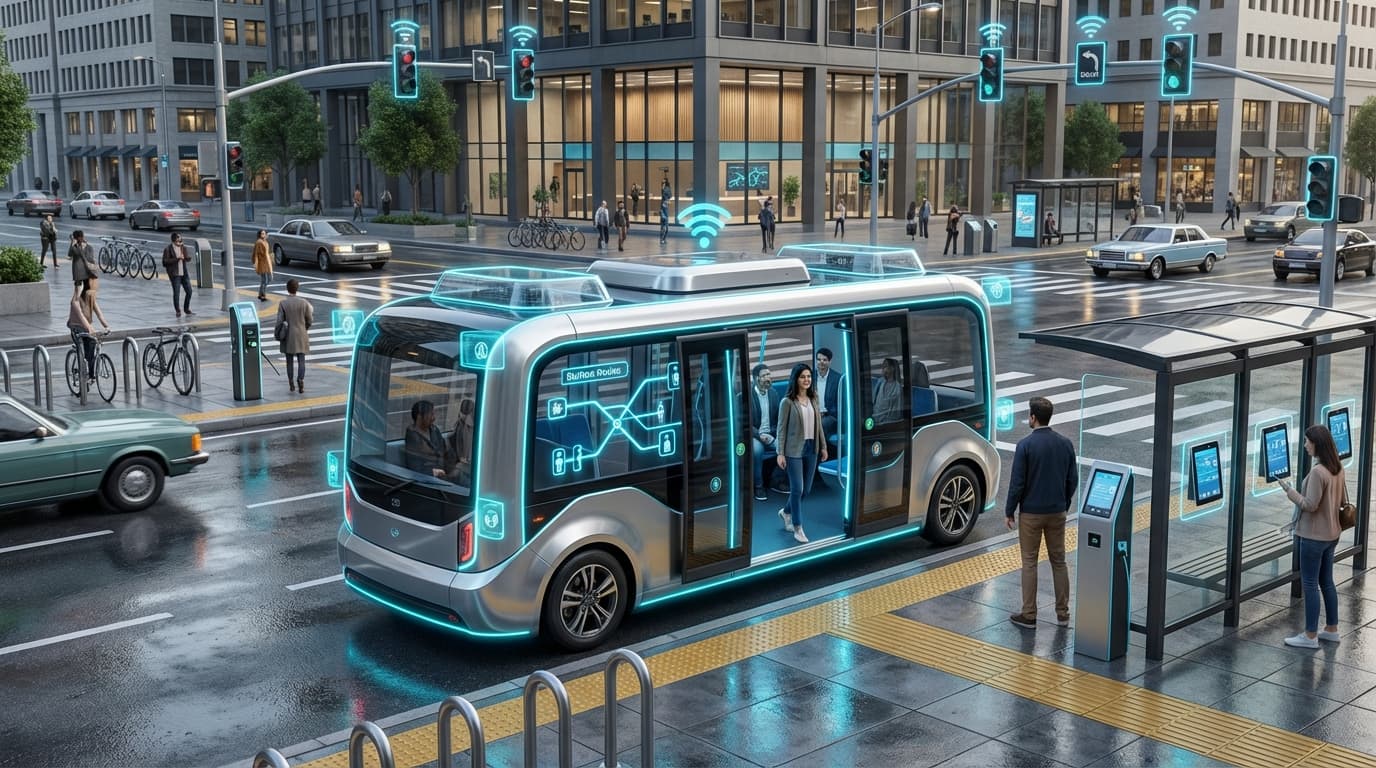
Demand-Responsive Transit (DRT)
Traditional public transportation systems face a persistent challenge: balancing service coverage with operational efficiency. Fixed-route buses often run half-empty during off-peak hours or in lower-density areas, while taxis and ride-hailing services remain too expensive for daily commuting. This creates transportation deserts where residents lack reliable, affordable mobility options. Demand-Responsive Transit (DRT) emerges as a solution that bridges this gap by combining the affordability of public transport with the flexibility of on-demand services. At its technical core, DRT systems employ sophisticated algorithms that continuously process passenger requests, vehicle locations, and traffic conditions to dynamically route shared vehicles. Unlike traditional bus services with predetermined schedules, DRT vehicles adjust their paths in real-time based on actual demand, picking up multiple passengers traveling in similar directions. The system typically operates through mobile applications where users request rides, receiving estimated pickup times and virtual bus stop locations that may shift slightly to optimize routing efficiency. Advanced matching algorithms consider factors such as passenger proximity, destination clustering, maximum detour times, and vehicle capacity to create efficient routes that minimize both individual wait times and overall system costs.
The implications for urban and suburban mobility are substantial, particularly in addressing the first-mile and last-mile connectivity problems that plague conventional transit systems. Research suggests that DRT can reduce operational costs by 30-50% compared to running fixed routes in low-demand areas, while simultaneously improving service frequency and coverage. This makes viable the provision of public transportation in suburban neighborhoods, rural communities, and during off-peak hours when traditional bus services become economically unsustainable. For municipalities, DRT offers a pathway to extend transit equity without proportionally expanding budgets, ensuring that elderly residents, people with disabilities, and those without private vehicles maintain access to essential services, employment, and social opportunities. The technology also enables transit agencies to gather granular data on actual travel patterns, informing future infrastructure investments and service adjustments based on demonstrated need rather than assumptions.
Several cities have moved beyond pilot programs to operational DRT services, with deployments ranging from suburban feeder systems connecting to major transit hubs to comprehensive networks serving entire communities. Early implementations indicate that DRT can achieve occupancy rates of 2-4 passengers per vehicle trip, significantly higher than single-occupancy ride-hailing while maintaining convenience levels that attract users away from private cars. The technology proves particularly effective in areas with dispersed origins and destinations where fixed routes would require excessive transfers or circuitous travel. As autonomous vehicle technology matures, industry analysts note that DRT systems are well-positioned to integrate self-driving vehicles, potentially reducing operational costs further while maintaining the intelligent routing that makes the service viable. The convergence of DRT with broader mobility-as-a-service platforms suggests a future where public transportation becomes increasingly personalized and responsive, adapting to community needs in real-time while maintaining the efficiency and accessibility that define public transit's social mission.
Related Organizations

Provides TransitTech software to cities and agencies, powering on-demand microtransit services globally.

Provides on-demand transit software that allows agencies to set complex fare rules, including subsidized or dynamic pricing for specific user groups.

A subsidiary of Deutsche Bahn providing software for on-demand transport and mobility analytics to integrate DRT into public transport networks.

Major public transport operator that designs and operates on-demand transport networks globally on behalf of transit authorities.

Provides AI-driven DRT solutions for peri-urban and rural areas, acquired by Siemens Mobility.

Microtransit software provider enabling agencies to offer dynamic on-demand transit with flexible fare structures.

Develops the 'Pingo' platform, using MIT-born algorithms to optimize on-demand vehicle routing for public transit.

Develops shared mobility platforms for corporate carpooling and community transport (DRT) to reduce single-occupancy vehicles.

Develops 'Macrotransit' software that dynamically routes large buses in real-time based on demand rather than fixed schedules.

Supporting Evidence
Research this in Signals
Signals turns a topic into a sourced research record you can inspect and rerun. Your first scan is free, and this one starts with Demand-Responsive Transit (DRT) already loaded, so edit it or scan as is.