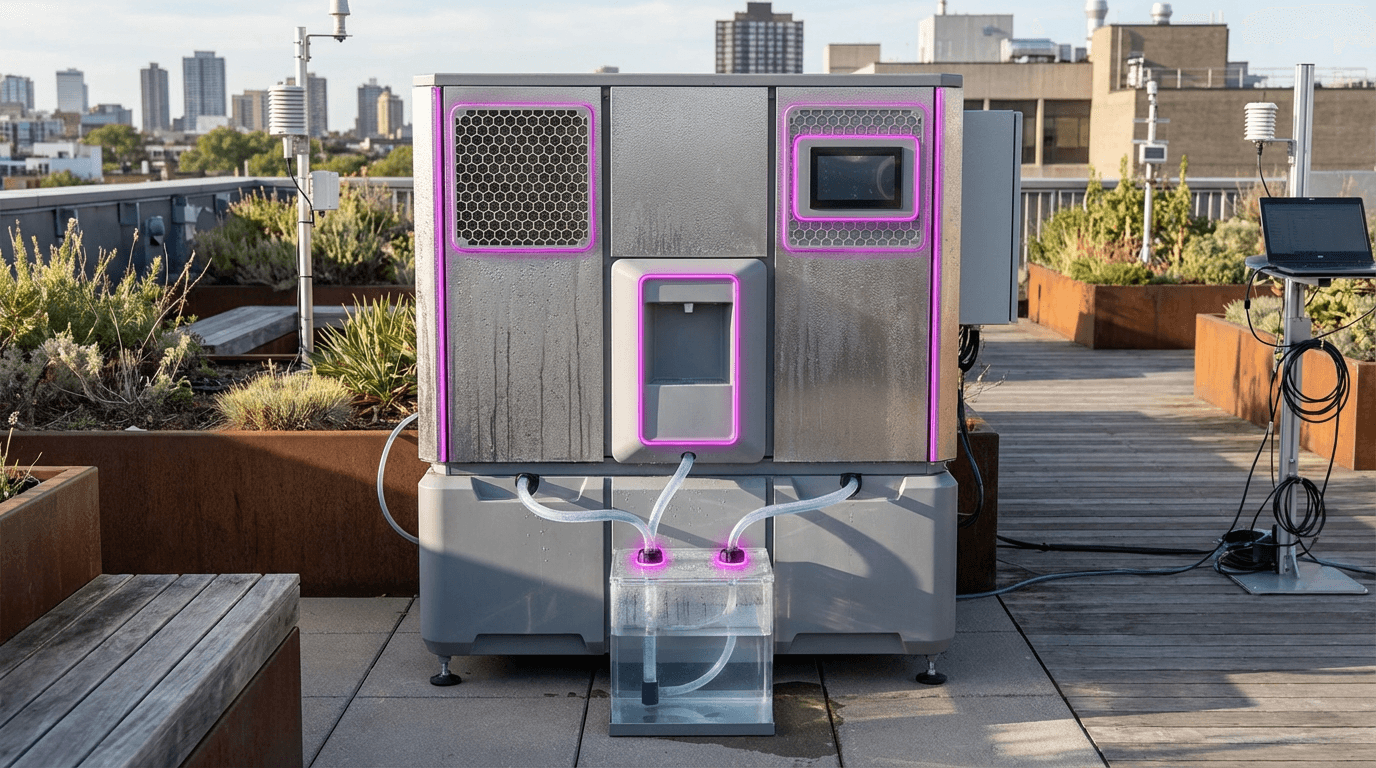
Atmospheric Water Harvesting
Water scarcity affects billions of people worldwide, with traditional freshwater sources increasingly strained by climate change, population growth, and over-extraction. Atmospheric water harvesting addresses this challenge by extracting moisture directly from the air, transforming an abundant but underutilised resource into potable water. The technology relies on advanced sorbent materials—such as metal-organic frameworks (MOFs), hygroscopic salts, and specialised polymers—that can capture water vapour even in environments with relative humidity as low as 20 percent. These materials work through adsorption, where water molecules bind to the surface of the sorbent, and are then released through temperature changes or pressure differentials. Some systems incorporate passive radiative cooling, using specially designed surfaces that emit heat into space, creating temperature differentials that trigger condensation without requiring external energy input. This combination of novel materials science and thermodynamic principles enables water extraction in regions previously considered too dry for such approaches.
For infrastructure systems, atmospheric water harvesting offers a paradigm shift from centralised water distribution networks to decentralised, point-of-use generation. This is particularly valuable in remote locations, disaster-affected areas, or regions where traditional water infrastructure is prohibitively expensive or vulnerable to disruption. The technology addresses critical challenges in water security by reducing dependence on aquifers, rivers, and desalination plants, while also eliminating the need for extensive pipeline networks that are costly to maintain and susceptible to contamination or sabotage. Early deployments indicate that atmospheric water generators can be integrated into building management systems, providing supplementary water for non-potable uses or emergency reserves. The modular nature of these systems also enables scalability, from small household units producing a few litres per day to larger installations capable of supporting entire communities or industrial facilities.
Current implementations range from pilot programs in arid regions to commercial products for residential and institutional use. Research suggests that as material efficiency improves and manufacturing costs decrease, atmospheric water harvesting could become a viable component of resilient water infrastructure, particularly in water-stressed regions experiencing rapid urbanisation. The technology aligns with broader trends toward distributed infrastructure systems that reduce vulnerability to single points of failure and adapt to local environmental conditions. Future developments may see these systems integrated with renewable energy sources and smart building technologies, creating autonomous water-energy nexuses that enhance sustainability and self-sufficiency. As climate patterns shift and traditional water sources become less reliable, atmospheric water harvesting represents a forward-thinking approach to ensuring water security, offering communities a renewable, locally-sourced alternative that operates independently of conventional water grids.
Related Organizations

Manufactures Hydropanels that use solar energy to extract drinking water from the air, even in arid conditions.

Home to the BAIR lab and researchers like Angjoo Kanazawa who pioneered NeRF technologies.
Watergen
Israel · Company
Develops atmospheric water generation technology that captures humidity from the air to create fresh drinking water.

Swedish water innovation company developing scalable atmospheric water generation systems for industrial use.

Social enterprise in Kenya using desiccant-based atmospheric water generators to provide water in arid regions.

An Indian deep-tech startup building 100% renewable water infrastructure using liquid desiccants.

The central technology development arm of General Electric.

Develops the WaterCube, an industrial-scale atmospheric water generator designed to solve global water scarcity.

A Tunisian startup designing machines that replicate the dew phenomenon to produce drinking water.

An Indian company manufacturing 'Meghdoot' atmospheric water generators.
Supporting Evidence
Research this in Signals
Signals turns a topic into a sourced research record you can inspect and rerun. Your first scan is free, and this one starts with Atmospheric Water Harvesting already loaded, so edit it or scan as is.