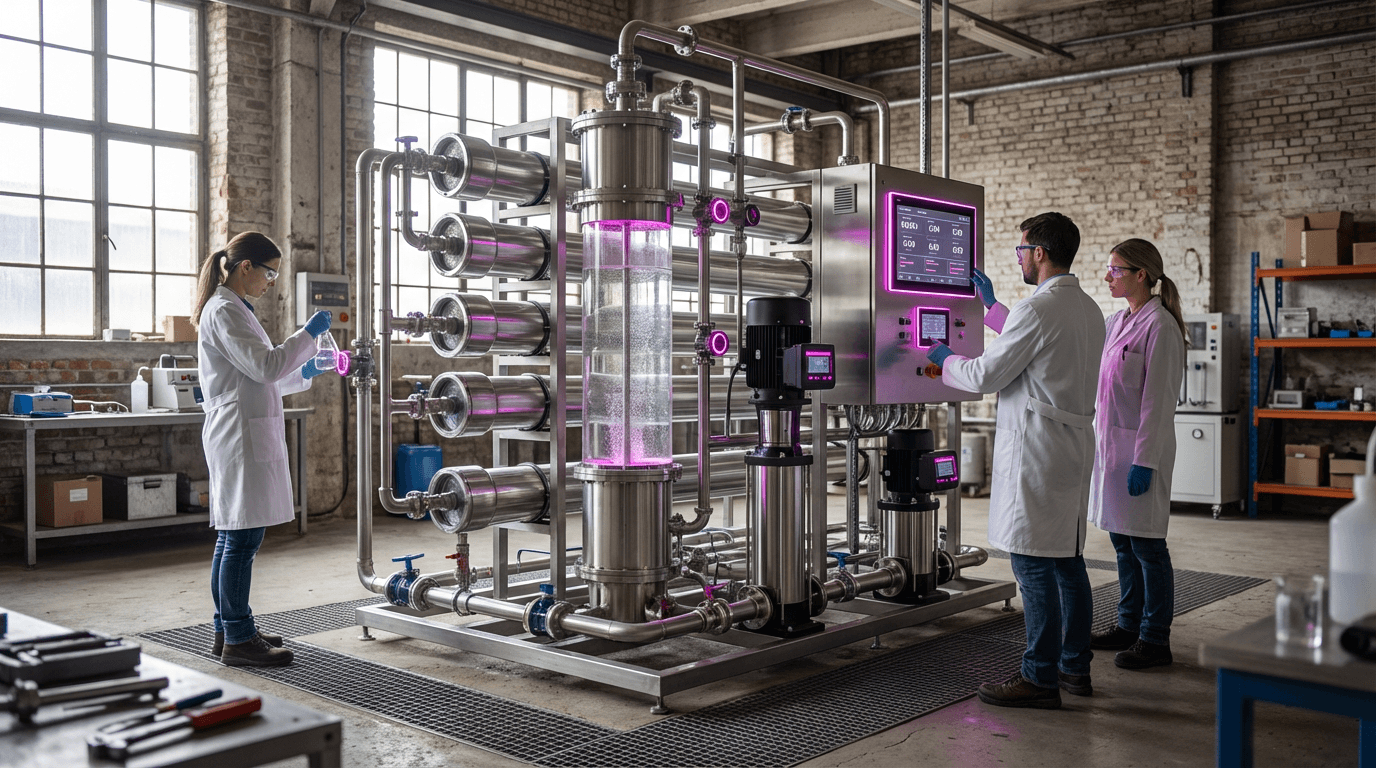
Forward Osmosis Systems
Forward osmosis represents a paradigm shift in membrane-based water treatment, leveraging natural osmotic pressure gradients rather than energy-intensive hydraulic pumps. Unlike conventional reverse osmosis systems that force water through membranes using high pressure—typically requiring 200-1000 psi and substantial electrical input—forward osmosis relies on the fundamental principle of osmosis itself. A highly concentrated draw solution on one side of a semi-permeable membrane creates a natural chemical potential difference that pulls water molecules across from a less concentrated feed solution. The membrane selectively allows water to pass while rejecting dissolved solids, contaminants, and other unwanted constituents. The draw solution is then separated from the extracted water through a secondary process, which can range from simple thermal separation to membrane distillation, depending on the draw solute chemistry selected. This approach fundamentally decouples the energy requirements of water extraction from the pressurisation demands that dominate conventional treatment systems.
The technology addresses critical limitations in water treatment infrastructure, particularly in contexts where energy availability constrains deployment options or where feed water characteristics make conventional approaches economically prohibitive. Industrial facilities generating hypersaline brines, mining operations in remote locations, and agricultural operations with limited grid connectivity face significant challenges in managing water resources using traditional treatment methods. Forward osmosis systems can operate effectively with these challenging feed streams while consuming a fraction of the electrical energy required by pressure-driven alternatives. Research suggests that FO systems can reduce energy consumption by 50-80% compared to reverse osmosis in certain applications, though the total energy footprint depends heavily on the draw solution recovery method employed. The technology also demonstrates remarkable fouling resistance, as the absence of hydraulic pressure reduces the compaction of foulant layers on membrane surfaces, potentially extending operational lifespans and reducing chemical cleaning requirements. This resilience makes FO particularly valuable for treating wastewater streams with high organic loads or suspended solids that would rapidly compromise conventional membrane systems.
Current deployments span diverse applications, from pilot-scale industrial wastewater concentration facilities to emergency water treatment units designed for disaster response scenarios. The technology has found early commercial traction in food and beverage processing, where concentrating liquid products without heat damage offers distinct advantages, and in landfill leachate treatment, where conventional methods struggle with extreme contaminant loads. Several municipal utilities have explored FO for indirect potable reuse applications, where its gentle treatment characteristics and low fouling propensity complement multi-barrier treatment trains. The offshore oil and gas industry has investigated FO systems for produced water management in locations where power generation capacity limits treatment options. As membrane materials continue to improve and draw solution chemistries become more sophisticated, forward osmosis is positioned to play an increasingly important role in decentralised water infrastructure, particularly in contexts where renewable energy integration, minimal maintenance requirements, and resilience to variable feed water quality align with broader sustainability objectives in water resource management.
Related Organizations

Biotech company using aquaporin proteins to create biomimetic membranes for forward and reverse osmosis.

Develops proprietary forward osmosis membranes and systems for food processing and water reuse.

Develops FO desalination systems using a proprietary thermolytic draw solution.

Commercializes forward osmosis technology for industrial wastewater treatment and lithium extraction.

A research university actively developing novel cooling materials, including passive radiative cooling films and energy-efficient building envelopes.

Research institution known for developing stretchable piezoelectric fabrics and energy-harvesting materials.

German research institute developing forward osmosis processes for wastewater treatment and nutrient recovery.

Pioneered the 'All-Membrane Brine Concentration' (AMBC) process utilizing forward osmosis.

Major chemical company manufacturing hollow fiber membranes used in forward osmosis applications.

Japanese chemical giant producing advanced textiles, including nanofiber-based nonwovens for medical and industrial use.
Supporting Evidence
Research this in Signals
Signals turns a topic into a sourced research record you can inspect and rerun. Your first scan is free, and this one starts with Forward Osmosis Systems already loaded, so edit it or scan as is.