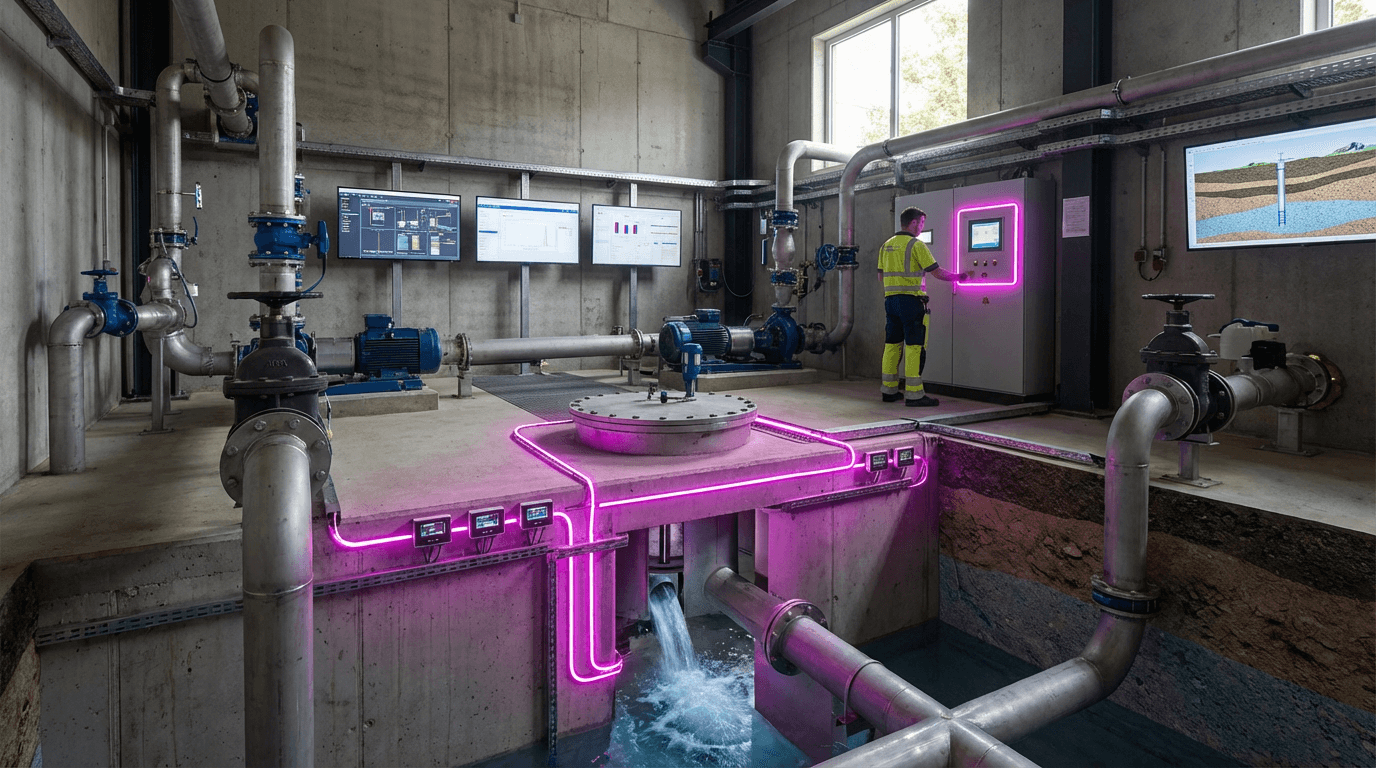
Aquifer Storage & Recovery (ASR)
Aquifer Storage and Recovery (ASR) represents a sophisticated approach to water management that leverages natural underground geological formations as storage vessels for treated water. The technology operates on a straightforward yet powerful principle: during periods when water supply exceeds demand—such as wet seasons, periods of low consumption, or when treatment facilities have excess capacity—treated surface water or reclaimed wastewater is injected into permeable aquifer layers through specially designed wells. These underground formations, typically consisting of porous rock or sand layers bounded by less permeable geological strata, act as natural containers that can hold substantial volumes of water. When demand increases during droughts, seasonal peaks, or emergency situations, the stored water is extracted through the same or nearby wells. The aquifer itself serves multiple functions: it provides storage capacity without the surface footprint of traditional reservoirs, naturally filters and maintains water quality through interaction with geological materials, and protects stored water from evaporation and contamination that plague surface storage systems.
The water infrastructure challenges facing modern cities and agricultural regions are intensifying as climate patterns become less predictable and populations continue to grow in water-stressed areas. Traditional surface reservoirs face significant limitations: they consume valuable land, lose substantial volumes to evaporation (particularly in arid climates), require expensive dam construction and maintenance, and can face environmental opposition due to ecosystem disruption. ASR systems address these constraints by utilizing existing underground space, effectively creating invisible water banks beneath cities and farmlands. This approach proves particularly valuable in regions experiencing pronounced wet and dry seasons, where the timing mismatch between water availability and demand creates persistent management challenges. By enabling water utilities to capture and store surplus water that might otherwise flow unused to the ocean or evaporate from surface storage, ASR systems enhance overall water security and system resilience. The technology also supports the integration of alternative water sources, including treated wastewater and stormwater, by providing a buffer that allows these variable supplies to be captured when available and deployed when needed.
ASR technology has progressed from experimental pilots to operational systems serving major metropolitan areas, particularly in water-scarce regions of Australia, the southwestern United States, and parts of the Middle East. Water utilities in Florida have operated ASR systems for decades, storing billions of gallons of treated water in limestone aquifers to meet seasonal demand fluctuations and provide emergency reserves during hurricane disruptions. In California's Central Valley, agricultural operations increasingly employ ASR to capture winter rainfall and irrigation runoff for use during the dry growing season, helping to address chronic groundwater overdraft. The technology's appeal continues to grow as climate change intensifies hydrological variability and traditional water sources become less reliable. Recent advances focus on improving water quality monitoring during storage cycles, developing better predictive models for aquifer behavior, and optimizing well design to maximize storage efficiency while preventing unwanted mixing with native groundwater. As urban areas seek to build climate resilience and achieve water independence, ASR systems are becoming integral components of diversified water portfolios, working alongside desalination, water recycling, and conservation programs to ensure reliable supplies for growing populations in an uncertain climatic future.
Related Organizations

A public utility owned by the City of San Antonio, Texas.

A regional governmental agency that oversees the water resources in the southern half of Florida.


A not-for-profit water supply agency.

A leading provider of consulting and engineering services, focusing on water, environment, and sustainable infrastructure.

A scientific agency of the United States government.

An employee-owned engineering, procurement, consulting and construction company.

PUB, Singapore's National Water Agency
Singapore · Government Agency
Manages Singapore's water supply and drainage, implementing the 'Active, Beautiful, Clean Waters' (ABC Waters) programme.

Stantec
Canada · Company
An international professional services company in the design and consulting industry.
Supporting Evidence
Research this in Signals
Signals turns a topic into a sourced research record you can inspect and rerun. Your first scan is free, and this one starts with Aquifer Storage & Recovery (ASR) already loaded, so edit it or scan as is.