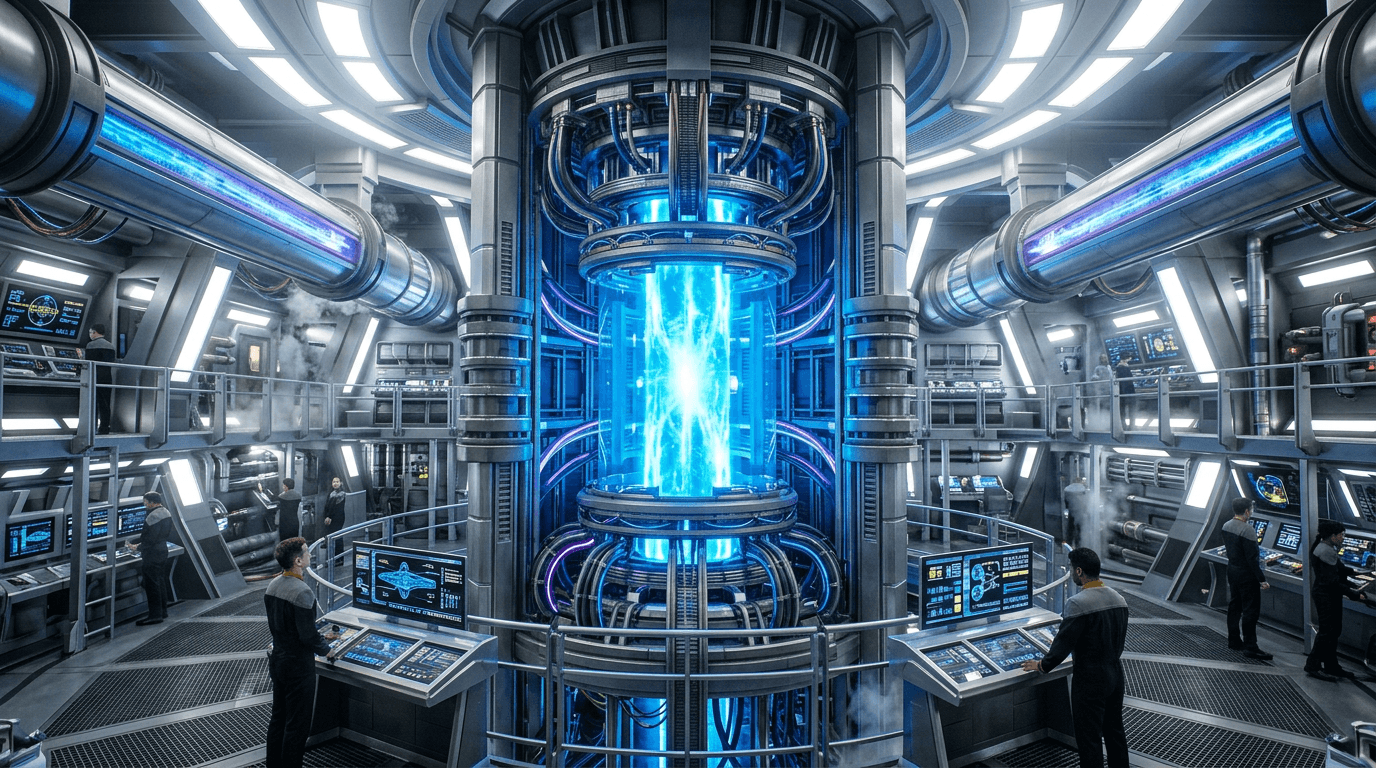
Warp Drive
The warp drive represents one of the most compelling concepts in speculative propulsion physics, proposing a method to circumvent the light-speed barrier not by accelerating through space, but by manipulating the geometry of spacetime itself. The theoretical framework draws from solutions to Einstein's field equations in general relativity, most notably the Alcubierre metric proposed in 1994, which mathematically describes how spacetime could be contracted ahead of a vessel while simultaneously expanding behind it. This creates a "warp bubble" within which the spacecraft remains in flat, stationary spacetime while the bubble itself moves through the surrounding cosmos at superluminal velocities. The ship would effectively surf on a wave of distorted spacetime, never locally exceeding light speed and thus avoiding relativistic time dilation effects that would otherwise make interstellar journeys impractical for human crews. The concept has captured imaginations precisely because it appears to exploit a loophole in physics rather than violate fundamental laws outright.
Within science fiction narratives and strategic foresight exercises exploring humanity's cosmic future, the warp drive serves as an enabling technology that makes galactic civilizations, interstellar commerce, and rapid response to distant threats narratively feasible. It appears prominently in cultural touchstones that have shaped public expectations about space exploration, functioning as a plot device that compresses the vast timescales of conventional space travel into human-comprehensible journeys. Beyond entertainment, the concept has found its way into serious aerospace discourse as a thought experiment for examining the boundaries of known physics. Research institutions have occasionally explored whether any physical mechanism could approximate warp-like effects, examining exotic matter requirements, quantum field theory implications, and potential connections to emerging areas like metamaterial physics. The warp drive thus occupies a unique position as both a narrative necessity for certain types of future scenarios and a legitimate, if highly speculative, subject of theoretical investigation that probes the limits of general relativity.
The primary obstacle to any real-world warp drive remains the requirement for exotic matter with negative energy density—a substance that has never been observed and may be prohibited by quantum field theory. The Alcubierre metric, while mathematically consistent, demands energy levels that some estimates place at multiple times the mass-energy of the observable universe, though subsequent refinements have reduced these requirements to merely stellar-scale masses. Proposals involving Casimir effect manipulation or other quantum phenomena have yet to demonstrate scalability beyond microscopic laboratory conditions. Even if the energy problem were somehow solved, concerns about causality violations, particle accumulation at the warp bubble boundary, and the inability to control the bubble from within present additional theoretical challenges. For warp drive technology to transition from mathematical curiosity to plausible engineering project would require revolutionary discoveries in our understanding of quantum gravity, the nature of vacuum energy, and perhaps entirely new physics beyond the Standard Model. Until such breakthroughs emerge, the warp drive remains a powerful tool for exploring the conceptual boundaries of physics and imagining futures where the stars are within humanity's reach, rather than a technology approaching practical development.
Research this in Signals
Signals turns a topic into a sourced research record you can inspect and rerun. Your first scan is free, and this one starts with Warp Drive already loaded, so edit it or scan as is.