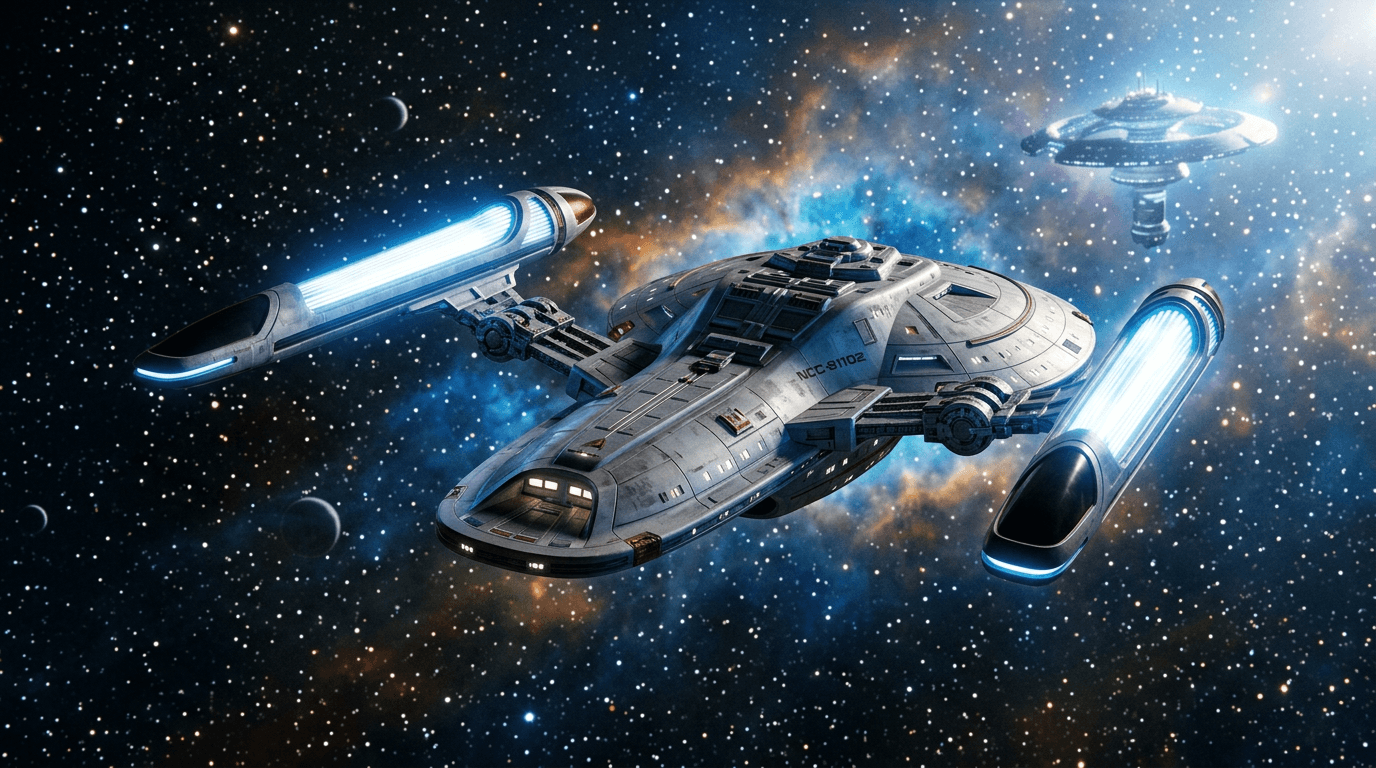
Variable Geometry Warp Nacelles
Variable geometry warp nacelles represent a fictional propulsion concept from the Star Trek universe, specifically designed to address an in-universe environmental concern: subspace damage caused by conventional warp drive operation. The concept emerged in Star Trek: Voyager's Intrepid-class starship design, where nacelles mounted on articulated pylons could rotate between different positions depending on operational requirements. In the narrative framework, this mechanical reconfiguration was imagined to optimize the geometry of the warp field bubble—the region of distorted spacetime that theoretically enables faster-than-light travel—across different velocity regimes. By adjusting nacelle position, the system purportedly reduced harmful stress on the fabric of subspace itself, a fictional substrate underlying normal space in the Star Trek cosmology. The mechanism reflects a broader science fiction tradition of treating space as a fragile medium that advanced propulsion systems might damage through repeated use.
Within Star Trek's narrative logic, variable geometry nacelles served both a technological and thematic purpose. They demonstrated the franchise's occasional engagement with environmental consequences of advanced technology, paralleling real-world concerns about pollution and resource depletion. The adjustable configuration also provided visual distinctiveness to the Intrepid-class design while suggesting engineering sophistication—a ship that could adapt its propulsion geometry implied finer control over exotic physics than static designs. This connects to genuine aerospace engineering principles where variable geometry (as seen in swing-wing aircraft like the F-14 Tomcat) optimizes performance across different flight regimes, though the analogy breaks down when applied to speculative faster-than-light propulsion with no current scientific foundation.
From a plausibility standpoint, variable geometry warp nacelles exist entirely within fictional physics. Real-world science offers no evidence for subspace as a physical phenomenon, and faster-than-light travel remains theoretically problematic under general relativity, with proposed concepts like Alcubierre drives requiring exotic matter with negative energy density that may not exist. The mechanical articulation itself is straightforward engineering, but without a functional warp drive to optimize, the concept remains purely speculative. For such technology to gain scientific credibility, multiple foundational breakthroughs would be required: confirmation of additional spatial dimensions or substrates, discovery of mechanisms to manipulate spacetime geometry with reasonable energy requirements, and evidence that propulsion systems could meaningfully damage spatial structure. The concept's value lies not in technical feasibility but in its role as a narrative device exploring how fictional civilizations might balance technological capability with environmental stewardship.
Research this in Signals
Signals turns a topic into a sourced research record you can inspect and rerun. Your first scan is free, and this one starts with Variable Geometry Warp Nacelles already loaded, so edit it or scan as is.