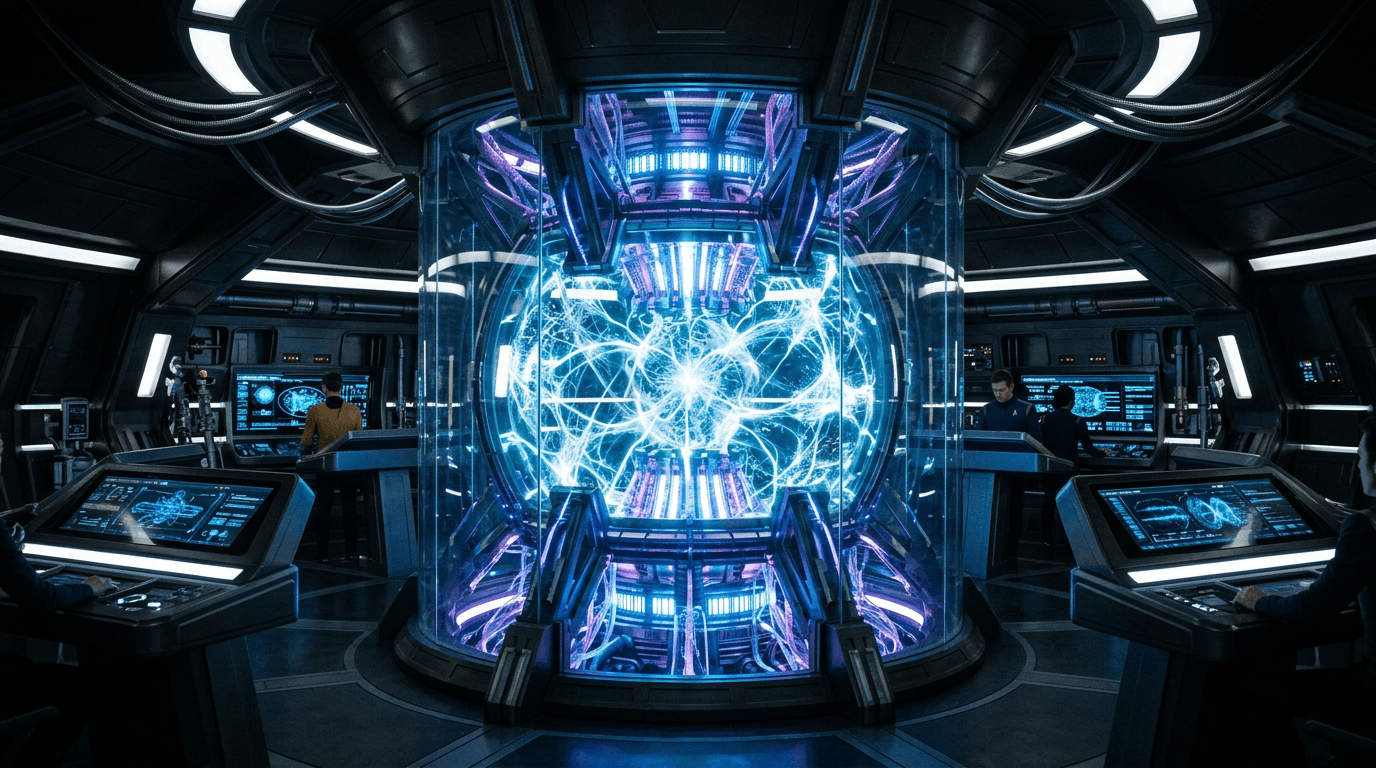
Displacement-Activated Spore Hub Drive
The Displacement-Activated Spore Hub Drive, commonly known as the spore drive, represents one of science fiction's most imaginative departures from conventional propulsion concepts. Rather than accelerating through normal space or creating localized distortions in spacetime, this fictional technology proposes accessing an entirely separate domain—a mycelial network of fungal origin that theoretically spans multiple universes. The conceptual mechanism involves cultivating a specialized organism, often depicted as a tardigrade-derived fungus, which serves as a biological interface to this subspace realm. When activated, the drive doesn't move the vessel in any traditional sense; instead, it exploits quantum superposition principles to allow the ship to exist simultaneously across all points within the mycelial network before collapsing the probability wave into a single desired location. This requires either a biological navigator with unique cognitive abilities or an extraordinarily sophisticated computer system capable of processing the multidimensional navigation calculations necessary to traverse what amounts to a living, constantly shifting substrate underlying conventional reality.
Within narrative frameworks, the spore drive serves multiple strategic purposes beyond simple faster-than-light travel. It represents a fundamentally different relationship between biology and technology, suggesting that organic systems might possess capabilities that purely mechanical approaches cannot replicate. The concept appears in discussions about alternative propulsion paradigms precisely because it challenges assumptions about the separation between living and non-living systems in advanced technology. In real-world scientific discourse, researchers have explored how mycelial networks demonstrate remarkable information-processing capabilities and how quantum biological effects might operate in certain organisms, though these phenomena operate at vastly different scales and contexts than interstellar propulsion would require. The narrative appeal lies in its implication that consciousness, biology, and fundamental physics might be more deeply interconnected than conventional models suggest, making it a useful thought experiment for exploring post-mechanical technological philosophies.
From a plausibility standpoint, the spore drive concept requires several extraordinary assumptions that currently lack scientific foundation. No evidence suggests the existence of a universal mycelial substrate in subspace, nor do we have theoretical frameworks that would predict such a structure. While quantum entanglement does allow for correlations across distance, it cannot transmit information or matter instantaneously in ways that would enable propulsion. The biological interface component assumes capabilities—such as conscious navigation through higher-dimensional spaces—that exceed anything demonstrated in terrestrial organisms by many orders of magnitude. For this concept to approach feasibility, we would need revolutionary discoveries in quantum biology, confirmation of additional spatial dimensions accessible through biological processes, and entirely new physics governing the relationship between consciousness and spacetime geometry. The technology remains firmly in the realm of narrative speculation, valuable primarily for exploring philosophical questions about the nature of space, biology, and the limits of technological development rather than as a near-term research direction.
Research this in Signals
Signals turns a topic into a sourced research record you can inspect and rerun. Your first scan is free, and this one starts with Displacement-Activated Spore Hub Drive already loaded, so edit it or scan as is.